Ekiplerinizin gerçekten kullandığı arketipler.
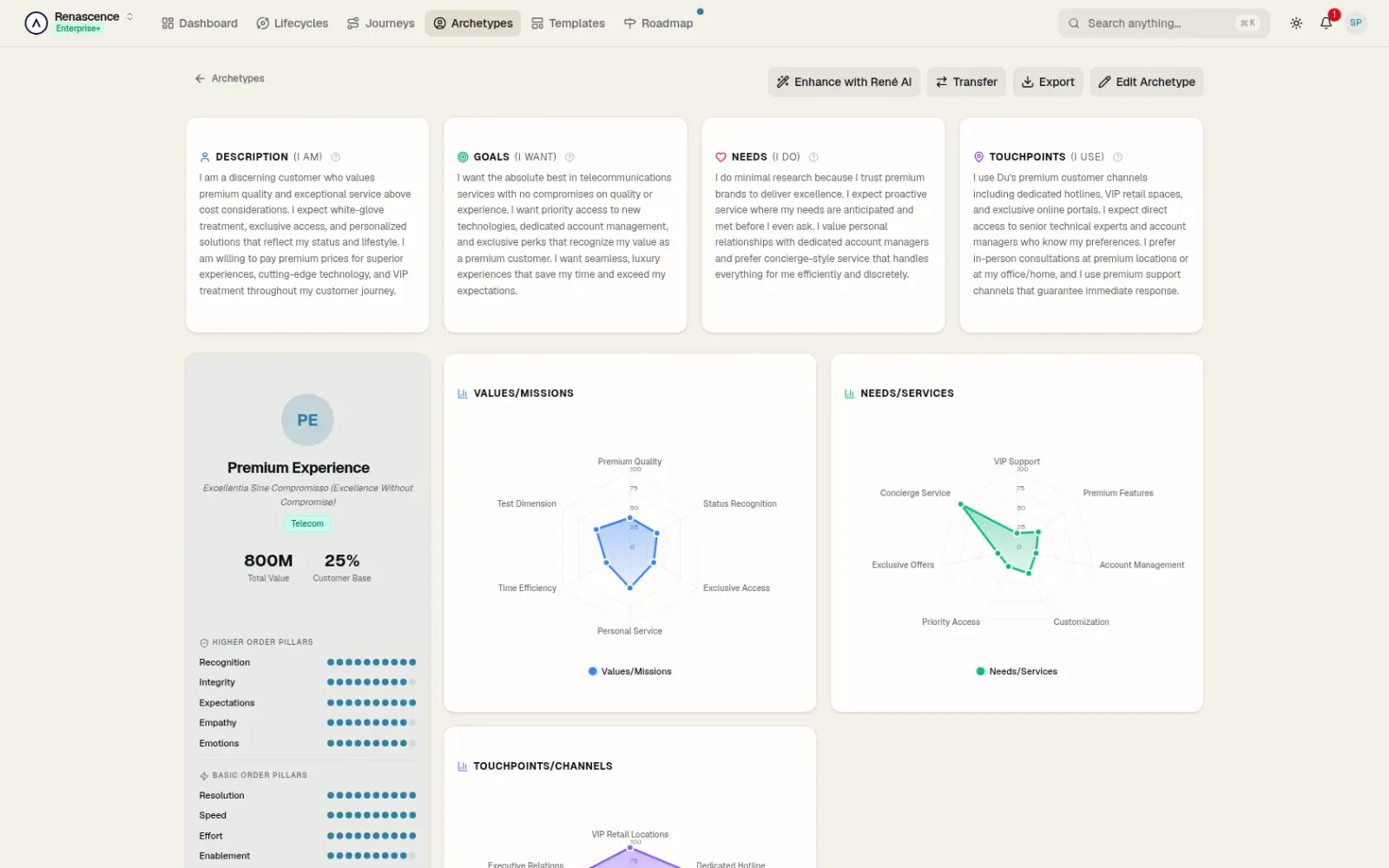
Arketip'lerimiz, yolculukların yanında René Studio'da yer alır, böylece her tasarım kararı, kimin için olduğuyla karşılaştırılabilir.
- Arketipler
- İhtiyaçlar ve motivasyonlar
- Yolculuklara bağlı

Hakkında
Davranışsal ekonomi ve insan deneyiminin kesişim noktasında doğan danışmanlık.
ŞİRKET
BİZİMLE BÜYÜYÜN
Hizmetler
Kurumsal markalar için kapsamlı müşteri deneyimi ve yönetim danışmanlığı.
TEMEL
Çözümler
Müşteri deneyimi hedeflerini ölçülebilir sonuçlara dönüştüren yapılandırılmış çözümler.
STRATEJİ VE YÖNETİM
TASARIM VE UYGULAMA
Sektörler
Bölgenin belirleyici sektörlerinde on yıllık CX dönüşümü.
YAPILI ÇEVRE
FİNANS VE TEKNOLOJİ
Ürünler
Müşteri deneyimi dönüşümünü güçlendiren tescilli araçlar, platformlar ve yapay zeka.
PLATFORMS
Yapay Zeka ve Teknoloji
ÖĞRENME VE ÇERÇEVELER
MÜŞTERİ DENEYİMİ ARAÇ KİTAPLIĞI
Görüş
Müşteri deneyiminin ön saflarında içgörüler, araştırmalar ve sohbetler.
Merkez
Müşteri deneyimi (CX) uygulamalarınızı geliştirecek ücretsiz araçlar, şablonlar ve kaynaklar.
Yapay Zeka Araçları
ÜCRETSİZ ARAÇLAR
ÖĞRENİM
Solution · Müşteri Deneyimi Arketipleri
Most CX failures trace back to one root cause: designing for an average customer who doesn't exist. CX Archetypes give your teams a shared, research-grounded picture of who actually walks through your door.
Bu çalışmanın arkasındaki platform
Arketip'lerimiz, yolculukların yanında René Studio'da yer alır, böylece her tasarım kararı, kimin için olduğuyla karşılaştırılabilir.

01 — Genel Bakış
CX Archetypes are research-based models of your distinct customer types, defined by their goals, motivations, behaviors, and decision-making patterns — not demographics alone. Where a persona tells you a customer is a 35-year-old professional, an archetype tells you she's a Control-Seeker who needs to feel informed at every step or she walks.
Most organisations already have personas. What they lack is behavioral depth: the underlying drivers that explain why a customer hesitates, complains, churns, or advocates. Archetypes answer that question. They draw on behavioral economics — specifically the distinction between System 1 and System 2 thinking — to map not just what customers do, but the cognitive shortcuts and emotional triggers that shape every choice they make.
The practical result is a shared language across your business. When your product team, your contact centre, and your branch network all understand that Archetype 3 is a Reassurance-Seeker who needs social proof before committing, every design decision gets faster, sharper, and more consistent. That alignment is where the commercial return lives.
The business case for archetype-driven design is grounded in what happens when teams stop guessing who they're serving.
02 —Neler Dahil?
Each engagement produces a set of validated, activation-ready archetype models — not slide decks that gather dust, but working tools your teams use in design sprints, service blueprints, and campaign briefs.
03 —Yaklaşımımız
We assess your maturity, research the people involved and pinpoint the highest-impact opportunities.
We craft the strategy and interventions, grounded in evidence and validated with real users.
We implement alongside your teams, with quick wins and knowledge transfer along the way.
We embed governance, measurement and tools so the gains compound over time.
04 —Sonuçlar
05 —Kanıtla
06 —Günlükten
Danışmanlarımızdan daha derinlemesine analizler.
07 — Neden Önemli?
The dominant failure mode in CX is designing for a statistical average. Demographic segments tell you who is in the room; archetypes tell you what they need from you and what will make them leave. Daniel Kahneman's work on dual-process cognition established that most customer decisions are driven by fast, emotional, heuristic thinking — not the rational deliberation that most service designs assume. An archetype built on behavioral research reflects that reality. One built on survey demographics does not.
There is a compounding organisational benefit that is easy to underestimate. When a bank's digital team, its branch network, and its complaints function all operate from different mental models of the customer, every handoff creates friction. Archetypes dissolve that. They become the common reference point that makes cross-functional design conversations shorter, sharper, and less political. We have consistently found that teams with a shared archetype model move from insight to design decision in a fraction of the time.
In MENA markets specifically, the behavioral diversity within a single customer base is striking. A retail bank in the Gulf may serve a risk-averse national customer, a transaction-focused expatriate professional, and a digitally-native younger segment — each with fundamentally different trust signals, communication preferences, and service expectations. A single persona flattens that. A well-constructed set of archetypes preserves it, and gives your teams the precision to serve each type well without building three separate service models.
Listen: The Naked Customer podcastConversations on CX, loyalty & behavior08 —FAQ
Sohbeti başlatın
Kıdemli bir danışmanla bir keşif görüşmesi ayarlayın ve nelerin mümkün olduğunu görün.