
Service Design · August 12, 2026
SIPOC for CX: The Process Discovery Tool Journey Maps Miss
Journey maps show where customers feel friction. SIPOC and other process discovery tools show why — by exposing the operational chain behind every touchpoint.

The journey map says the refund takes forty-eight hours. The process behind it takes eleven days, four departments, and a legacy system that nobody in the room can quite explain how to bypass. This is the gap that kills more CX programmes than bad design ever does: a beautifully drawn customer journey sitting on top of an operational process nobody has actually mapped.
SIPOC — Suppliers, Inputs, Process, Outputs, Customers — is a process discovery tool that forces a team to see the entire chain that produces a customer moment, not just the moment itself. It matters to CX because most experience failures aren't design failures; they're process failures that surface at the front line. A journey map shows you where the customer feels friction. SIPOC, alongside tools like swimlane diagrams, value stream mapping, and service blueprinting, shows you why the friction exists in the operating model underneath.
My argument in this piece is simple and, I think, underappreciated in CX circles: journey mapping without process discovery is diagnosis without an autopsy. You know something hurts. You don't know which organ failed.
What is process discovery, and why does CX need it?
Process discovery is the disciplined act of finding out what actually happens inside a business process — as opposed to what the org chart, the policy manual, or the confident VP in the steering committee says happens. It is distinct from process design, which comes after: you cannot redesign a process you haven't first discovered honestly.
CX teams tend to skip this step. They run voice of customer programmes, build journey maps, score touchpoints, and recommend fixes — all without ever pulling back the curtain on the workflow that produced the pain point. The result is a familiar pattern: the recommendation is "reduce time-to-resolution," but nobody on the CX team can say which of the fourteen handoffs inside the resolution process is actually the bottleneck. Process discovery answers that question. It is the missing link between an emotional insight ("customers feel ignored during onboarding") and an operational fix ("onboarding passes through three systems that don't talk to each other, and the third handoff sits in a queue for 36 hours").
This is also where CX and operations stop being separate conversations. A service blueprint or a SIPOC diagram is the shared artefact that lets a Head of CX and a Head of Operations argue about the same reality instead of two different ones.
What is SIPOC, and how do you build one?
SIPOC is a high-level process mapping tool, developed within the Six Sigma tradition, that captures a process in five columns: Suppliers (who provides inputs), Inputs (what they provide), Process (the major steps, usually five to seven), Outputs (what the process produces), and Customers (who receives it). The American Society for Quality documents SIPOC as a standard tool for scoping a process before deeper analysis — deliberately shallow, deliberately fast, built to establish boundaries rather than granular detail.
Its discipline is what makes it useful for CX work. Most process conversations drown in detail on day one — someone wants to talk about the exception case, the legacy workaround, the one client who broke the system in 2019. SIPOC refuses that. It insists on altitude first.
A practical build order looks like this:
- Name the process, not the department. "Handling a warranty claim" is a process. "The claims team" is a department. Naming the process forces cross-functional thinking from the first minute.
- Map the Process column first, at five to seven steps. Counter-intuitively, start in the middle. Fixing the process steps early anchors everything else and stops the exercise sprawling.
- Work backward to Inputs and Suppliers. For each step, ask what had to arrive before it could start, and who provided it — a system, a document, another team, the customer.
- Work forward to Outputs and Customers. Ask what each step produces and who receives it — noting that the "customer" of an internal step is often another employee, not the end customer.
- Validate with the people who actually do the work. A SIPOC built by managers in a conference room is fiction. A SIPOC built with the frontline agent who processes the claim is discovery.
Done properly, the exercise takes sixty to ninety minutes and produces something a Six Sigma black belt, a service designer, and a customer experience lead can all read the same way. That shared legibility is the entire point.
Why do CX teams underuse SIPOC?
Because it looks too simple to matter, and because it was born in manufacturing quality circles, not customer experience ones. CX practitioners are trained to reach for journey maps and personas; SIPOC feels like someone else's tool, borrowed from a discipline about defect rates and control charts.
That instinct is a mistake, and it is the original observation this piece wants to leave you with: SIPOC's low resolution is exactly what makes it the right first tool in CX process discovery, not a lesser one. A service blueprint is high-resolution and expensive to build correctly — it demands you already know roughly where the process boundaries sit. SIPOC is how you find those boundaries in the first place. Skip it, and teams routinely blueprint the wrong scope: too narrow to catch the real handoff failure, or so broad the exercise collapses under its own detail. SIPOC is the scoping conversation that should happen before the expensive mapping session, not instead of it.
What other process discovery tools should a CX team know?
SIPOC is a starting point, not the whole toolkit. Depending on what you're trying to surface, four other tools do different jobs:
- Swimlane (cross-functional) diagrams. Popularised in Geary Rummler and Alan Brache's work on organisational performance, swimlane diagrams plot process steps against the department or role responsible for each one. They are the fastest way to expose handoffs — the moment a task crosses from one lane to another is almost always where delay, ambiguity, or dropped ownership lives.
- Value stream mapping. Drawn from the Toyota Production System and the broader Lean methodology, value stream mapping tracks both the flow of work and the flow of time, distinguishing value-adding steps from waste. It's the right tool when the business question is "where is time actually going," not just "what are the steps."
- Service blueprinting. Introduced by Lynn Shostack in her 1984 Harvard Business Review article "Designing Services That Deliver", the service blueprint sits the customer's visible journey on top of the invisible backstage process, systems, and support that produce it. It is the tool that finally reunites the CX view and the operations view on one page — provided the backstage layer is built from genuine process discovery rather than assumption.
- Process mining. Where the first three tools are drawn by hand from interviews and workshops, process mining reconstructs the actual process from system log data — the digital footprints left in CRM, ticketing, or ERP platforms. It tells you what genuinely happened, including every deviation and workaround, rather than what people believe happened.
The sequencing matters more than the individual tools. SIPOC scopes the process. A swimlane or value stream map exposes where the process bleeds time or ownership. A service blueprint connects that operational reality to the customer's felt experience. Process mining, where the data exists, keeps everyone honest about what "the process" actually is today rather than what the last workshop assumed it to be.
How does process discovery connect to what the customer actually feels?
Every process step has a psychological signature, whether anyone designed it that way or not. This is where operational design and behavioural economics meet, and it's the connection CX teams most often miss when they treat process mapping as a back-office exercise.
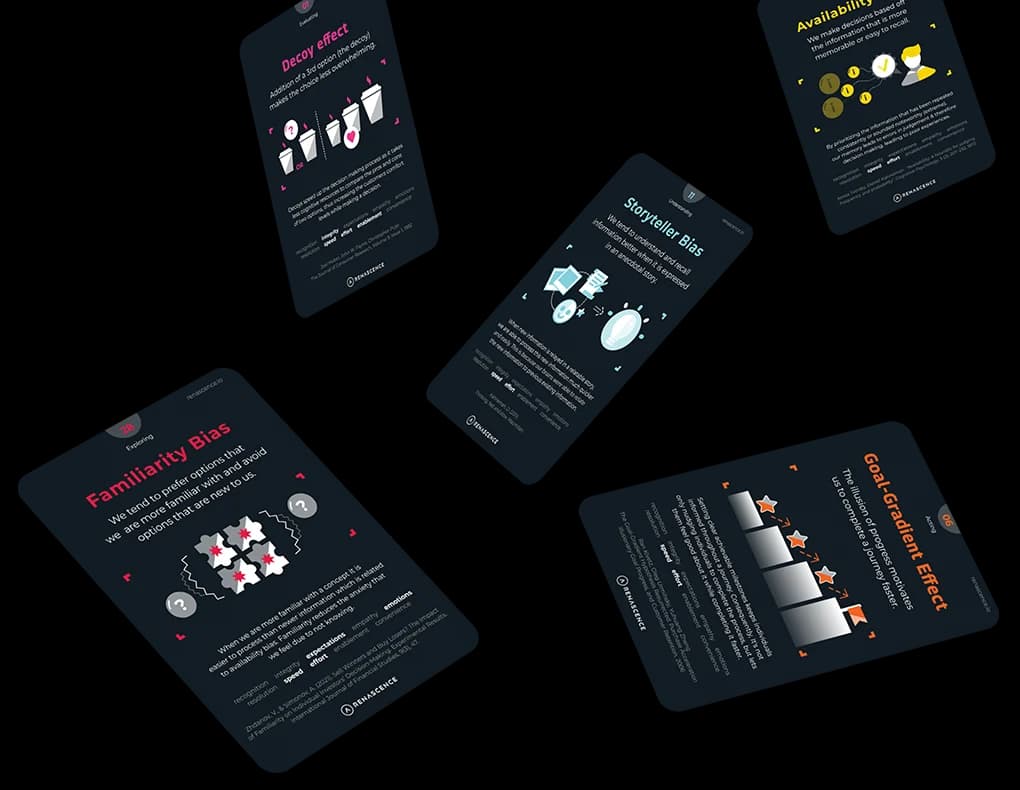
Take the goal-gradient effect — the finding, first observed in Clark Hull's animal-learning experiments and later confirmed in consumer contexts by Ran Kivetz, Oleg Urminsky, and Yuhuang Zheng in their 2006 study "The Goal-Gradient Hypothesis Resurrected," published in the Journal of Marketing Research, that effort and motivation intensify as people perceive themselves nearing a goal. A poorly discovered process routinely violates this without anyone noticing: a mortgage application that shows "80% complete" and then silently reopens two earlier steps for a compliance re-check. The customer isn't just delayed — they experience a psychological reversal, the sensation of sliding backward from the finish line. No journey map catches that; only a SIPOC or swimlane diagram that exposes the rework loop does.
The same discovery work exposes sludge — a term associated with Richard Thaler's writing on behavioural design, describing friction that a process imposes for no legitimate reason, as distinct from friction that exists to protect the customer or the business. A verification step that exists because a 2015 fraud incident scared a compliance team is sludge if the risk it defends against has since been solved another way. You don't find sludge by asking customers how they feel. You find it by tracing Inputs and Suppliers in a SIPOC and asking, of every single step, "what would break if we removed this?" If the honest answer is "nothing," you've found sludge masquerading as due diligence.
This is also why process discovery deserves its own place next to journey mapping in a CX team's toolkit, rather than living permanently inside operations or Six Sigma teams. The people who understand the emotional stakes of a delay are best placed to judge which friction is protective and which is simply inherited.
How do you run a process discovery workshop that doesn't turn into a documentation exercise?
The failure mode is predictable: a well-intentioned team spends a day mapping the "as-is" state, produces a beautiful diagram, files it, and nothing changes. Discovery has to be built to produce decisions, not artefacts. A workable sequence:
- Scope with SIPOC first, in under ninety minutes. Agree the process boundary and the five to seven major steps before anyone reaches for sticky notes and a wall.
- Pull the real data before the workshop, not during it. Volumes, cycle times, handoff counts, exception rates — whatever exists in ticketing or CRM logs. Workshops run on opinion when they should run on evidence.
- Bring the frontline, not just the process owners. The person who handles the exception every Friday afternoon knows more about the real process than the director who last touched it two reorganisations ago.
- Layer a swimlane diagram over the SIPOC's Process column. This is where handoffs, not tasks, become visible — and handoffs are where most delay and most blame-shifting actually live.
- Name every step's psychological cost, not just its time cost. Ask, for each step: does this feel like progress to the customer, or does it feel like a setback? A ten-minute wait framed as "your specialist is being assigned" lands differently from the same ten minutes with no explanation at all.
- Convert findings into owned actions with deadlines, not a report. A discovery exercise that ends in a slide deck rather than a named owner and a date has produced documentation, not change.
Teams that skip straight to step four — usually because someone is impatient to "just map the journey" — routinely rediscover, three months later, that the real bottleneck was never in the customer-facing steps at all. It was in a supplier handoff nobody bothered to scope.
What actually breaks when teams skip process discovery?
Three failure patterns show up again and again in organisations that jump straight to journey mapping or redesign without discovery:
- The wrong villain gets blamed. A slow contact centre response is frequently a symptom of a broken handoff two departments upstream — a fact no amount of frontline coaching will fix, and no amount of CSAT analysis will reveal, because the customer only ever sees the last, visible delay.
- Redesign solves a symptom and reproduces the disease. A new digital front-end gets built on top of an undiscovered legacy process, and the friction simply relocates — now the customer waits inside a slicker interface instead of a clunky one.
- Governance has no shared language. Without a common map, CX, operations, and IT each defend their own version of "the process," and every improvement initiative stalls in the argument about whose version is true. This is a governance failure as much as a mapping one — see how CX governance structures assign decision rights precisely to avoid this.
There's a staffing dimension too, one operations leaders feel before anyone names it. A process discovered honestly usually reveals that a bottleneck isn't a training gap or a motivation problem — it's a capacity problem, too much work routed through too few hands at one specific step. That's a sizing question, and it's worth running the numbers rather than guessing, which is exactly the kind of gap an FTE Calculator is built to expose once the bottleneck step is known.
Where process discovery fits in a broader CX operating model
Process discovery is not a one-off exercise you run before a redesign project and then forget. Processes drift — new systems get bolted on, new compliance steps get added, new exceptions become permanent workarounds — and a SIPOC or blueprint that was accurate eighteen months ago quietly stops being true. Organisations with real CX maturity treat discovery as a recurring discipline, not a project phase, revisiting core processes on a cadence rather than only when something has already broken publicly.
This is also where process design and service design should be read as sequential disciplines rather than interchangeable terms. Discovery tells you what exists. Design tells you what should replace it. Conflating the two is how organisations end up redesigning a process they never actually understood — confident, well-intentioned, and wrong in ways nobody notices until the next customer complaint traces back to the same undiscovered handoff.
The organisations that get this right treat the SIPOC diagram the way a good operator treats a floor plan: unglamorous, occasionally tedious to build, and the only thing standing between a renovation that works and one that just moves the mess to a different room.
FAQ
Questions we get on this topic
Related reading



Writing on how human behavior shapes the experiences brands deliver — at the intersection of behavioral economics and customer experience.
Stay ahead of CX
Get the Journal in your inbox.
Insights, frameworks and event round-ups from the Renascence team. No spam, ever.