Service Design: Build Services That Work as Well as They Feel
Renascence designs the end-to-end architecture of your service — aligning people, processes, and touchpoints so every customer interaction delivers what you promised.
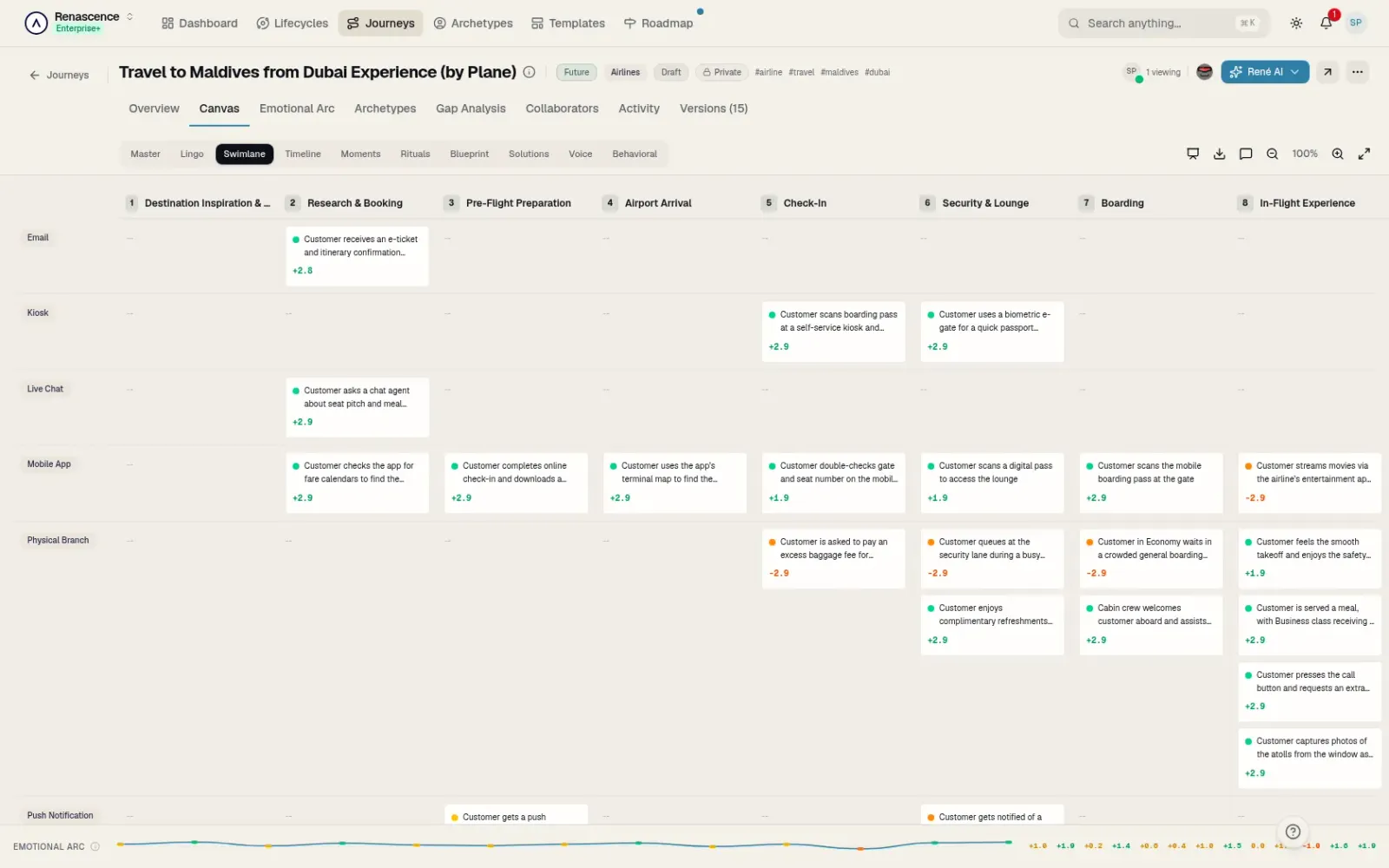
We build the service blueprint in René Studio: every stage, step and touchpoint with its front-stage and back-stage owners, the emotional arc and the fixes, on one living canvas.
What is service design and why does it matter for customer experience?
Service design is the discipline of planning and organising a service — its touchpoints, people, processes, and infrastructure — so that every interaction a customer has is coherent, intentional, and worth repeating. It is the difference between a service that was assembled and one that was built.
Most service failures are not front-end problems. They are back-end ones: a process that breaks under load, a handoff nobody owns, a policy that made sense in a meeting but creates friction the moment a real customer encounters it. Service design surfaces those structural faults before they become complaints, churn, or headlines.
Renascence applies service design as a precision instrument, not a workshop exercise. We map what is actually happening — not what the org chart says should happen — then redesign the architecture so the experience customers receive matches the one you intended to deliver. The behavioral economics concept of the Peak-End Rule (Kahneman) shapes how we sequence that redesign: we identify the emotional peaks and the final moments of your service, and we engineer those first.
Service design delivers measurable operational and experience outcomes — here is what structured redesign typically moves.
Efficiency gainOperational impact
~30%
Reduction in service resolution time after end-to-end process redesign
Systemic vs. surfaceCX outcome
2×
Higher customer effort score improvement vs. touchpoint fixes alone
Structural, not staffingRoot-cause insight
40%
Of service failures trace to a single broken internal handoff
02 —What's included
What a Renascence Service Design Engagement Includes
Each engagement is scoped to your service reality — but these are the core building blocks we consistently deploy to move from diagnosis to a service that performs.
A living, cross-functional map of your service that exposes every backstage process, system dependency, and ownership gap behind each customer-facing moment.
A facilitated session that brings your CX, operations, and product teams to a single, shared picture of the customer journey — resolving the competing versions that quietly undermine execution.
Structured redesign of the processes that directly drive customer experience, eliminating redundant steps, clarifying ownership, and building in recovery protocols for when things go wrong.
Rapid, low-cost testing of redesigned service concepts with real users before you commit to full implementation — reducing the risk of building the wrong thing at scale.
A deliberate mapping and sequencing of every channel and interaction point, ensuring consistency of tone, information, and effort across digital, physical, and human touchpoints.
A prioritised, phased plan that translates service design decisions into operational actions — with clear owners, sequencing logic, and success metrics your team can track.
03 —Our Approach
How Renascence Approaches Service Design
1
Discover
We assess your maturity, research the people involved and pinpoint the highest-impact opportunities.
2
Design
We craft the strategy and interventions, grounded in evidence and validated with real users.
3
Deliver
We implement alongside your teams, with quick wins and knowledge transfer along the way.
4
Sustain
We embed governance, measurement and tools so the gains compound over time.
04 —Outcomes
What you can expect.
1
Measurable impact
Every engagement ties to business metrics — not vanity scores.
2
Capability you keep
We transfer the skills, tools and frameworks so your team owns it.
3
Aligned organization
Shared standards and governance get every team rowing together.
Why Service Design Is the Structural Fix CX Programmes Often Miss
Most organisations invest in customer experience at the surface — better scripts, redesigned apps, refreshed brand language. Those investments are not wasted, but they are insufficient. When the underlying service architecture is misaligned, every surface improvement fights against the current. Customers feel the contradiction: a beautiful interface that leads to a broken process, a warm frontline agent who cannot resolve the issue because the system will not allow it. The experience promise and the service reality diverge, and trust erodes precisely at the moments that matter most.
Service design closes that gap. It treats the organisation as the product — examining not just what customers see, but the people, policies, and processes that produce what customers see. Research by the Design Management Institute found that design-led companies outperformed the S&P 500 by 228% over a ten-year period, a figure that reflects the compounding advantage of building services that are structurally coherent rather than cosmetically improved. When Thaler and Sunstein's work on choice architecture is applied at the process level, even small changes to defaults and sequencing can reduce customer effort dramatically without additional headcount or technology spend.
For organisations in the MENA region, the stakes are particularly high. Rapidly scaling service sectors — banking, healthcare, government, hospitality, retail — are simultaneously managing legacy infrastructure and rising customer expectations shaped by global digital benchmarks. Service design gives those organisations a method for managing that tension: building experiences that are operationally sustainable, culturally resonant, and commercially defensible. The goal is not a perfect blueprint. It is a service that works, consistently, for the people it was built to serve.
Service design is the practice of planning and organising all the components of a service — people, processes, technology, and physical or digital touchpoints — so they work together to deliver a consistent, high-quality experience. It looks at both what customers experience and the backstage operations that produce that experience.
Service design is relevant for any organisation that delivers a service to customers and has experienced gaps between what it intends to deliver and what customers actually receive. It is particularly valuable for heads of CX, operations directors, and transformation leads in sectors such as banking, government services, healthcare, hospitality, and telecoms.
UX focuses on the design of digital interfaces; journey mapping documents the customer's path. Service design encompasses both — and goes further by redesigning the backstage processes, systems, and organisational structures that determine whether the journey actually works. It is the architectural layer beneath the experience layer.
We begin with a current-state diagnostic — interviewing customers and staff, auditing existing processes, and building an accurate service blueprint. We then identify structural failure points, co-design solutions with your teams, prototype and test changes, and deliver a prioritised implementation roadmap. The process is iterative, not linear.
A focused engagement — covering one service or one critical journey — typically runs eight to sixteen weeks. More complex, multi-channel or multi-market redesigns may extend to six months. We scope each engagement based on the number of touchpoints, the complexity of backstage operations, and your organisation's readiness to implement.
Core deliverables include a validated service blueprint, a redesigned process map with ownership assignments, a touchpoint architecture document, prototyping outputs, and a phased implementation roadmap with success metrics. All deliverables are built to be usable by your internal teams, not archived in a consultant's deck.
We establish baseline metrics at the start of each engagement — typically NPS, Customer Effort Score, resolution time, and cost-to-serve. Post-implementation, we track movement against those baselines. Service design ROI is most clearly visible in reduced complaint volumes, lower operational cost, faster resolution, and improved retention rates.
We work alongside your teams throughout. Service design is most effective when it builds internal capability, not dependency. Our workshops are structured so that your CX, operations, and product leads leave with the tools and frameworks to continue the work — not just a report to implement.
Our core toolkit includes service blueprinting, customer journey mapping, ethnographic research, stakeholder interviews, process flow analysis, rapid prototyping, and facilitated co-design workshops. We select and adapt tools based on the specific service context rather than applying a fixed methodology regardless of fit.
Yes — and increasingly so. Government entities across the UAE, Saudi Arabia, and the wider GCC are under explicit mandates to improve citizen experience as part of national transformation programmes. Service design provides the structured method for meeting those mandates operationally, not just aspirationally. We have direct experience working within the regulatory and cultural context of the region.
Cultural context shapes how customers interpret effort, trust, and resolution. In MENA markets, the role of human interaction, language, and relationship in a service experience carries more weight than many Western service models assume. Our research phase explicitly captures these expectations, and our redesigns reflect them — rather than importing a service model that works elsewhere but lands poorly here.
The most useful first step is a scoping conversation — typically 30 to 45 minutes — where we identify the service or journey causing the most friction, align on what a successful outcome looks like, and determine the right engagement model. From there we can propose a scoped brief within one week. There is no obligation and no generic proposal: every brief is written to your specific situation.