







About

The consultancy born at the intersection of behavioral economics and human experience.

René Studio
AI EXPERIENCE STUDIO

The CX design platform we built from a decade of client work.

Explore René Studio
Mysterya
MYSTERY AUDITS, LIVE

Mystery audits we run, scored live for every location.

Explore Mysterya
NOW HIRING

Join a team reshaping how the world experiences brands.

View open roles →

COMPANY

GROW WITH US

CONNECT

Services

Comprehensive CX and management consulting for enterprise brands.

René Studio
AI EXPERIENCE STUDIO

Every engagement, mapped and scored in one AI workspace.

Explore René Studio
Mysterya
MYSTERY AUDITS, LIVE

Mystery shopping, scored and evidenced in real time.

Explore Mysterya
ALL SERVICES

Explore the full range of CX & management consulting services.

Browse all services →

CORE

SPECIALIST

Solutions

Structured solutions that turn CX ambition into measurable outcomes.

René Studio
AI EXPERIENCE STUDIO

Map, score and fix the journeys we redesign, with AI.

Explore René Studio
Mysterya
MYSTERY AUDITS, LIVE

Check the experience you designed is delivered.

Explore Mysterya
ALL SOLUTIONS

Explore every CX solution we offer.

Browse solutions →

STRATEGY & GOVERNANCE

DESIGN & DELIVERY

CULTURE & EXPERIENCE

Industries

A decade of CX transformation across the region's defining sectors.

René Studio
AI EXPERIENCE STUDIO

Sector-ready journeys, scored by AI in minutes.

Explore René Studio
Mysterya
MYSTERY AUDITS, LIVE

Mystery audits tuned to your sector, scored live.

Explore Mysterya
ALL INDUSTRIES

See how we work across every sector.

Browse industries →

BUILT ENVIRONMENT

FINANCE & TECH

PEOPLE & MOBILITY

Products

Proprietary tools, platforms, and AI that power CX transformation.

René Studio
AI EXPERIENCE STUDIO

Design, score and fix customer journeys with AI.

Explore René Studio
Mysterya
MYSTERY AUDITS, LIVE

Audit every location and act on what you find.

Explore Mysterya
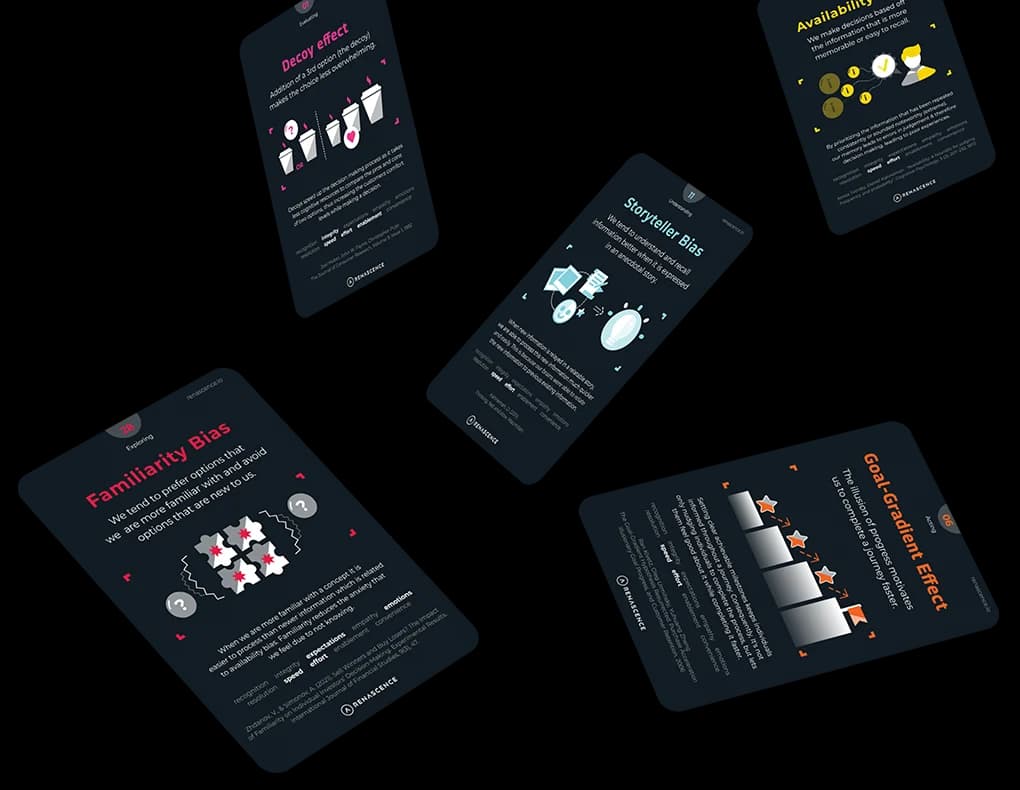
REBELDECK A · 36 FORCES

The forces that shape how humans experience the world.

Explore REBEL Reveal →
ALL PRODUCTS

Explore the full Renascence product ecosystem.

Browse products →

PLATFORMS

AI & TECHNOLOGY

LEARNING & FRAMEWORKS

CX TOOLKIT

Opinion

Insights, research, and conversations at the frontier of CX.

René Studio
AI EXPERIENCE STUDIO

Turn what you read into a journey you can score.

Explore René Studio
Mysterya
MYSTERY AUDITS, LIVE

See what customers really experience, visit by visit.

Explore Mysterya
ReadExperience JournalArticles & research on CX, behavior, and transformation.Watch & listenExperience LoomOur video podcast on CX & behavior.CuratedCX NewsIndustry news that matters in CX, minus the noise.

Latest articles

Latest episodes

Latest news

Hub

Free tools, templates, and resources to advance your CX practice.

René Studio
AI EXPERIENCE STUDIO

Design, score and fix customer journeys with AI.

Explore René Studio
Mysterya
MYSTERY AUDITS, LIVE

Every visit, every location, every score. Live.

Explore Mysterya
THE MANIFESTOBurn the Deck.
Ten Virtues. Zero Excuses.Start reading →
THE HUB

Every free tool, template and resource in one place.

Visit the Hub →

AI TOOLS

FREE TOOLS

LEARNING

CULTURE

Digital Transformation · 19 October 2026

AWS open-sources Strands agent harness, claiming lower token use

Amazon Web Services has released Strands, an open-source agent harness it says uses fewer tokens than rival tools while approaching Claude Code and Codex benchmark results. The efficiency claims are self-reported and cover coding agents only.

Newsdesk
Curated briefing · 2 min read

What happened

Amazon Web Services has released Strands, an open-source agent harness that it says consumes fewer tokens than competing agent tools while delivering close to the same benchmark results as Claude Code and Codex.

The Register reports that the headline claims come from benchmarks covering only coding agents, and that AWS ran the comparison itself. The efficiency and parity figures are therefore self-reported and have not been independently verified in the coverage.

The release is positioned as a bundling of existing components into a single open-source framework, rather than a new foundation model. The emphasis is on how the system is assembled and how economically it runs.

Why it matters

An agent harness is the orchestration layer that sits around a language model. It manages planning, tool calls, memory and the loop of attempts that lets an AI agent complete multi-step work. As agents move from demonstrations into production, the harness increasingly determines cost, speed and reliability, not just the underlying model. A claim about token efficiency is therefore a claim about unit economics: fewer tokens per task means lower running costs and faster responses for every workflow built on top.

For organisations, an open-source harness also changes the buy-or-build question. Teams can inspect how the agent loop works, adapt it to their own systems and avoid tying every workflow to a single vendor's tooling. For leaders in digital transformation, that makes the harness a design decision with consequences for governance, auditability and operating cost, not only a developer preference.

The Renascence take

The efficiency headline is the easy part to repeat. The harder question is what it means for the customer and employee experience once agents handle real service work, where tasks are messier than coding benchmarks.

Most readers will focus on the token count and miss that the benchmark was limited to coding agents and designed by the vendor. Customer service journeys involve ambiguous requests, policy exceptions and emotional stakes, and none of that is measured here. The behavioural principle at play is that cheaper interactions tempt organisations to automate more, quickly, before they have defined what a good outcome looks like. Customer-obsessed operators should pilot any harness on their own failure cases, measure resolution quality and customer effort alongside cost, and only then decide how much autonomy an agent earns.

Sources

This briefing was written by our Newsdesk, synthesising reporting from the outlets below. Follow the links for the original coverage.

FAQ

Questions we get on this topic

Strands is an open-source agent harness released by Amazon Web Services. It bundles existing components into one framework that manages planning, tool calls, memory and the attempt loop around a language model, rather than introducing a new foundation model.

Not in the reporting covered. The Register notes that the efficiency and benchmark parity figures come from benchmarks AWS ran itself, which cover only coding agents, and have not been independently verified.

An agent harness is the orchestration layer that sits around a language model. It handles planning, tool calls, memory and the repeated attempts that let an AI agent complete multi-step work.

Fewer tokens per task lowers running costs and can speed up responses across every workflow built on the harness. Whether those gains hold for messy customer service tasks has not been measured in the benchmarks reported.

Stay ahead of CX

Get the signal, not the noise.

The stories shaping customer experience — plus the Journal and Experience Loom — in your inbox.