About

The consultancy born at the intersection of behavioral economics and human experience.

René Studio
AI EXPERIENCE STUDIO

The CX design platform we built from a decade of client work.

Open rene.cx
Mysterya
MYSTERY AUDITS, LIVE

Mystery audits we run, scored live for every location.

Open mysterya.cx
NOW HIRING

Join a team reshaping how the world experiences brands.

View open roles →

COMPANY

GROW WITH US

CONNECT

Services

Comprehensive CX and management consulting for enterprise brands.

René Studio
AI EXPERIENCE STUDIO

Every engagement, mapped and scored in one AI workspace.

Open rene.cx
Mysterya
MYSTERY AUDITS, LIVE

Mystery shopping, scored and evidenced in real time.

Open mysterya.cx
ALL SERVICES

Explore the full range of CX & management consulting services.

Browse all services →

CORE

SPECIALIST

Solutions

Structured solutions that turn CX ambition into measurable outcomes.

René Studio
AI EXPERIENCE STUDIO

Map, score and fix the journeys we redesign, with AI.

Open rene.cx
Mysterya
MYSTERY AUDITS, LIVE

Check the experience you designed is delivered.

Open mysterya.cx
ALL SOLUTIONS

Explore every CX solution we offer.

Browse solutions →

STRATEGY & GOVERNANCE

DESIGN & DELIVERY

CULTURE & EXPERIENCE

Industries

A decade of CX transformation across the region's defining sectors.

René Studio
AI EXPERIENCE STUDIO

Sector-ready journeys, scored by AI in minutes.

Open rene.cx
Mysterya
MYSTERY AUDITS, LIVE

Mystery audits tuned to your sector, scored live.

Open mysterya.cx
ALL INDUSTRIES

See how we work across every sector.

Browse industries →

BUILT ENVIRONMENT

FINANCE & TECH

PEOPLE & MOBILITY

Products

Proprietary tools, platforms, and AI that power CX transformation.

René Studio
AI EXPERIENCE STUDIO

Design, score and fix customer journeys with AI.

Open rene.cx
Mysterya
MYSTERY AUDITS, LIVE

Audit every location and act on what you find.

Open mysterya.cx
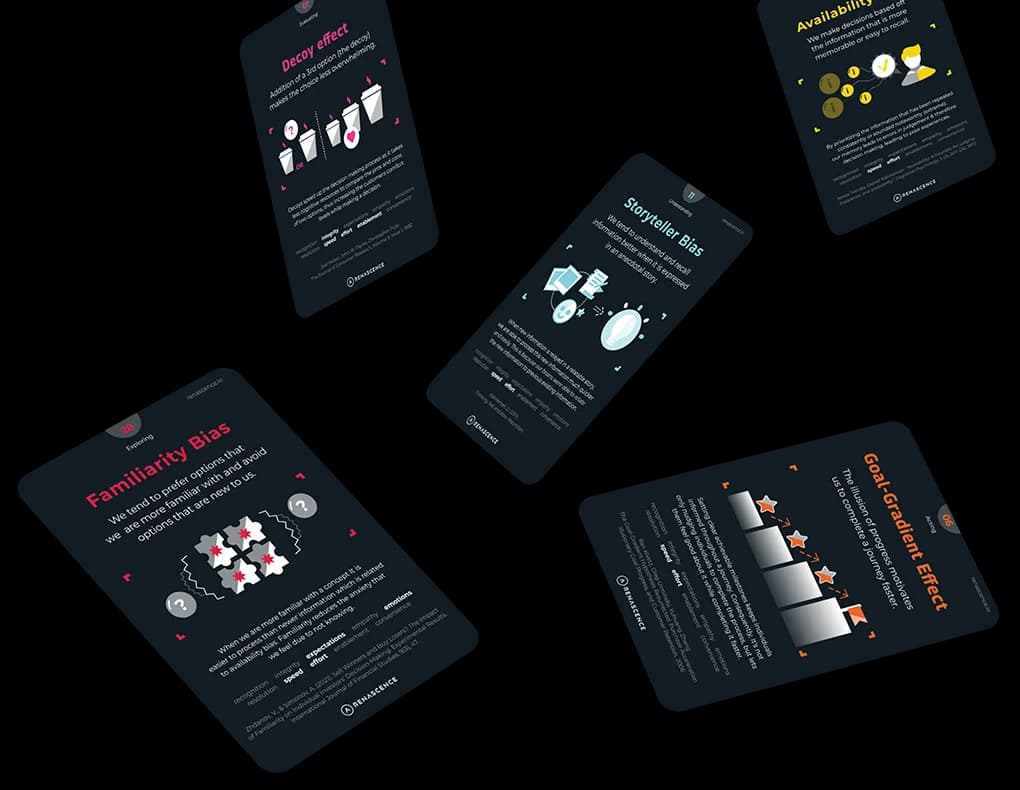
REBELDECK A · 36 FORCES

The forces that shape how humans experience the world.

Explore REBEL Reveal →
ALL PRODUCTS

Explore the full Renascence product ecosystem.

Browse products →

AI & TECHNOLOGY

LEARNING & GAMES

PLATFORMS & TOOLS

CX TOOLKIT

Opinion

Insights, research, and conversations at the frontier of CX.

René Studio
AI EXPERIENCE STUDIO

Turn what you read into a journey you can score.

Open rene.cx
Mysterya
MYSTERY AUDITS, LIVE

See what customers really experience, visit by visit.

Open mysterya.cx
ReadExperience JournalArticles & research on CX, behavior, and transformation.Watch & listenExperience LoomOur video podcast on CX & behavior.CuratedCX NewsIndustry news that matters in CX, minus the noise.

Latest articles

Latest episodes

Latest news

Hub

Free tools, templates, and resources to advance your CX practice.

René Studio
AI EXPERIENCE STUDIO

Design, score and fix customer journeys with AI.

Open rene.cx
Mysterya
MYSTERY AUDITS, LIVE

Every visit, every location, every score. Live.

Open mysterya.cx
THE MANIFESTOBurn the Deck.
Ten Virtues. Zero Excuses.Start reading →
THE HUB

Every free tool, template and resource in one place.

Visit the Hub →

AI TOOLS

FREE TOOLS

LEARNING

CULTURE

AI · 16 October 2026

Gemini 4 Argon: Google's Single AI Model for Robotics Control

Google has introduced Gemini 4 Argon, positioned as one AI model for robot control, simulation and training-video evaluation. It scores 87 percent on ERQA, a benchmark Google created itself.

Newsdesk
Curated briefing · 2 min read

What happened

Google has introduced Gemini 4 Argon, an AI model it is positioning as a single system for robotics. According to reporting by The Decoder, the model can control robots, generate simulations from photos or sketches, and evaluate training videos.

On ERQA, a benchmark that Google created itself, Gemini 4 Argon scores 87 percent. The published example prompts, however, suggest that the demonstrations still depend heavily on human guidance.

Why it matters

If one model can handle control, simulation and evaluation, robotics teams could in principle consolidate a stack of specialised tools into one platform. That would change how organisations build, test and refine physical AI systems, shortening the loop between a concept sketch and a trained behaviour. It would also shift where effort goes, from assembling tooling towards supervising and validating what the model produces.

The gap between the benchmark result and the example prompts is the detail to watch. A strong score on a vendor-designed test does not show how much human direction a system needs in day-to-day operation, and the operational cost of that direction is what determines whether a model reduces work or simply moves it.

The Renascence take

Most of the coverage will focus on the single-model ambition. The more useful question for service and operations leaders is how much human judgement still sits between the model's output and a reliable outcome.

The headline promise is one model that does everything robots need, but the published prompts point to a system that still leans on people to frame, check and correct its work. Behavioural science suggests that when a tool looks autonomous, teams tend to under-invest in oversight, which is exactly where errors reach customers. A customer-obsessed operator should treat any robotics or AI rollout as a supervised workflow, define where human review is required, and measure failure rates in the field rather than on benchmarks.

Sources

This briefing was written by our Newsdesk, synthesising reporting from the outlets below. Follow the links for the original coverage.

FAQ

Questions we get on this topic

Google has introduced Gemini 4 Argon, an AI model it positions as a single system for robotics. According to reporting by The Decoder, it can control robots, generate simulations from photos or sketches, and evaluate training videos.

Gemini 4 Argon scores 87 percent on ERQA, a benchmark that Google created itself. The source reporting notes that this is a vendor-designed test.

The published example prompts suggest the demonstrations still depend heavily on human guidance. A strong benchmark score does not by itself show how much human direction a system needs in day-to-day operation.

Behavioural science suggests teams may under-invest in oversight when a tool appears autonomous, and errors can then reach customers. Treating rollouts as supervised workflows and measuring field failure rates is a practical safeguard.

Stay ahead of CX

Get the signal, not the noise.

The stories shaping customer experience — plus the Journal and Experience Loom — in your inbox.