








Customer Experience · November 21, 2026
Square Customer Experience Strategy Explained
Square built its customer experience strategy by treating friction removal as the product itself, not a feature — instant approval, flat pricing, and no contracts for small merchants.

Jim McKelvey once lost a $2,000 sale because he couldn't take a credit card. He made handblown glass fixtures in St. Louis, and a buyer walked away from a glass faucet simply because Mr McKelvey had no way to process American Express. That single missed sale, repeated across millions of small vendors who were too small, too new, or too risky for a traditional merchant account, became the founding insight behind Square. Jack Dorsey and McKelvey built the company in 2009 on a narrow but furious problem: the payment system was designed to exclude people like him.
Most accounts of Square's growth focus on the hardware — the small white card reader that plugged into a headphone jack and turned any phone into a point of sale. That is the artefact, not the strategy. Square's actual customer experience strategy is structural: it treats the removal of friction as the product itself, not a feature wrapped around one. Every seller-facing decision, from pricing to onboarding to lending, is built to erase the gatekeeping moments that used to stand between a small business and getting paid.
Square's customer experience strategy is built on removing the structural friction — approval delays, hidden fees, contracts, and paperwork — that historically excluded small and informal merchants from accepting card payments, making instant inclusion itself the core product rather than a support layer around it. That single design choice explains almost everything else the company has built since, from its pricing model to its lending arm to its 2021 transformation into Block, Inc.
What problem was Square's customer experience actually built to solve?
Before Square existed, accepting a card required a merchant account, a credit check, monthly minimums, and a multi-week approval process run by banks that had little appetite for food trucks, market stalls, or freelance plumbers. The system wasn't broken for large retailers. It was working exactly as designed for them — and failing everyone below a certain revenue threshold. McKelvey's lost faucet sale was not an edge case; it was the median experience for millions of small operators.
Square's founding move was to stop treating "can this merchant be trusted with a card terminal" as a question to be answered upfront, in advance, by a human underwriter. Instead, it pushed the question downstream — approve almost everyone instantly, and manage risk continuously through transaction monitoring rather than a gate at the door. That is a classic case of redesigning choice architecture: rather than asking the customer to clear a hurdle before they can act, the system lets them act first and manages the consequences in the background. For a sector built on small-business customers who had been turned away so often they expected rejection, instant approval wasn't a convenience. It was the entire pitch.
How does Square turn friction removal into the product itself?
The behavioural economist Richard Thaler, in a short 2018 paper titled "Nudge, Not Sludge" published in the journal Science, described sludge as friction that works against a person's interest — the extra forms, the hold music, the fine print designed to make an action harder than it needs to be. Legacy merchant banking was sludge by design: contracts with early-termination penalties, monthly minimums regardless of sales volume, and statements written to obscure the effective rate. Square's pricing model did the opposite on every axis — a single, flat, transparent rate per transaction, no monthly fee, no long-term contract, and a sign-up flow that a non-technical shopkeeper could complete without assistance.
That is not a marketing decision. It is a behavioural one. Removing sludge reduces the cognitive load a prospective customer carries before they even transact — a principle the Nielsen Norman Group has long argued is central to usable design, since every unnecessary decision a person must make is a point where they can abandon the process entirely. Square's onboarding compresses what used to be a multi-week bank decision into a sequence a seller can finish between customers:
- Sign up online with basic business details — no credit check gate, no minimum revenue threshold.
- Receive or order hardware that is pre-configured, so there is no technical installation step between purchase and first sale.
- Take the first payment within the same session the account was created, often within minutes rather than weeks.
- See the money and the data instantly in a dashboard that replaces the paper ledger most micro-merchants had relied on.
Each step removes a decision point where a smaller competitor would have made the seller wait, call, or fill in another form. That sequencing matters more than any single feature: a merchant who has been rejected by banks before is primed to expect friction, and every step that doesn't demand it chips away at that expectation. This is the seller-side mirror of what consumer fintechs like Wise have done with cross-border transfers — stripping out the steps that exist to protect the institution rather than the customer, a pattern explored in Renascence's look at Wise's customer journey.
Why did Square expand into lending, software, and an entire ecosystem?
A payment reader is a commodity; once a merchant trusts the brand enough to run daily revenue through it, Square holds something far more valuable than hardware margin — a live feed of that business's cash flow. That data asset is what turned a card-reader company into a financial-services platform, through products such as Square Capital, which extends cash advances to sellers and collects repayment as a fixed percentage of each day's card sales rather than a fixed monthly instalment.
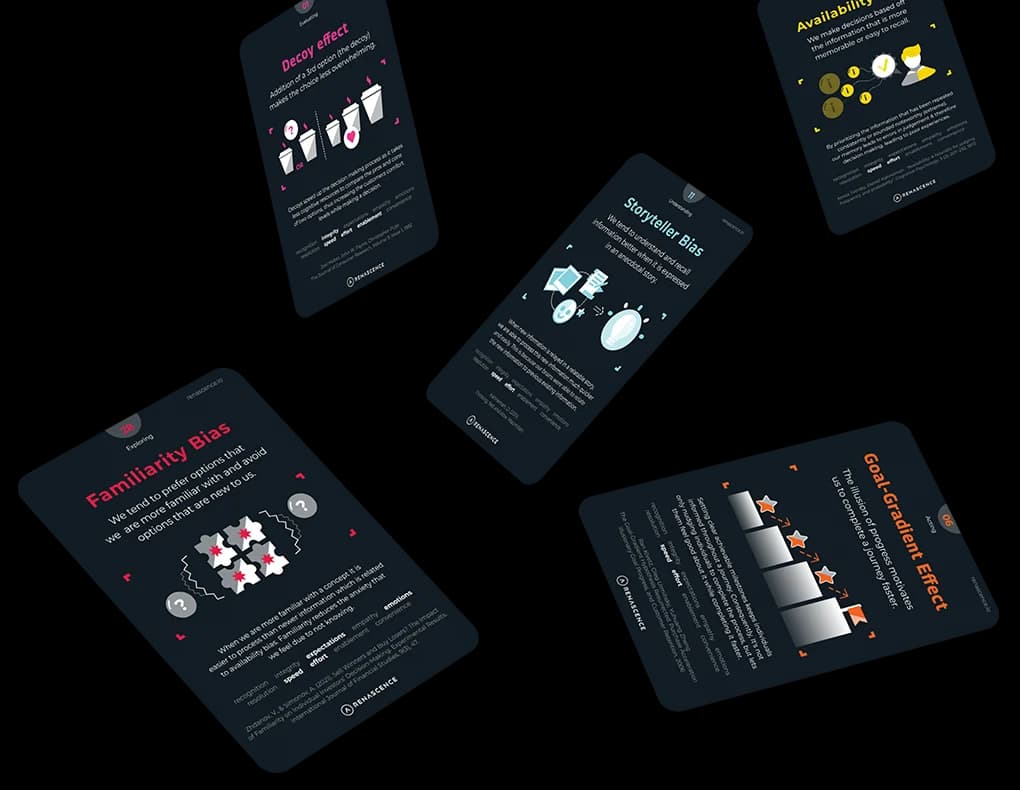
That repayment structure is a textbook application of the goal-gradient effect — the behavioural finding that effort and motivation intensify as a person perceives themselves closing in on a goal, and that progress which scales naturally with activity feels lighter than progress demanded on a rigid clock. A merchant having a slow week is not chased for a fixed sum they don't have; a merchant having a strong week pays down the advance faster without the loan ever feeling like a separate bill to dread. The repayment is invisible inside the transaction they were going to process anyway. Contrast that with a traditional small-business loan, where a fixed monthly debit lands regardless of how the month actually went — a design that manufactures exactly the kind of dread and default risk Square's model was built to avoid.
The seller dashboard plays a related but distinct role. Once a shopkeeper has a year of sales history, inventory trends, and customer repeat-rate data sitting inside one login, switching providers means losing visibility into their own business, not just changing a card reader. That is a mild but real form of the endowment effect — people place disproportionate value on what they already possess, and a merchant's accumulated data inside Square's dashboard becomes something they feel ownership over, even though it was Square's software that generated it. Renascence's own work in behavioral economics consistently finds this pattern in subscription and platform businesses: retention built on accumulated value is sturdier than retention built on price alone.
What does the move to Block reveal about Square's wider CX philosophy?
In 2021, Square's parent company renamed itself Block, Inc., the same year it announced the acquisition of buy-now-pay-later firm Afterpay. Read narrowly, that's corporate housekeeping. Read as a customer experience signal, it marks an explicit shift from serving one side of a transaction to designing the whole exchange — seller tools under the Square brand, consumer-facing payments and peer-to-peer transfer through Cash App, and instalment credit through Afterpay, all under one roof.
Two-sided markets are notoriously hard to design for because the seller's friction and the buyer's friction pull in different directions — a seller wants funds fast and risk managed tightly; a buyer wants to pay later and face as few checks as possible. Block's bet is that owning both experiences lets it tune the two against each other rather than optimising one side at the other's expense. It is the same logic Klarna applies on the buy-now-pay-later side of consumer fintech, where the checkout experience is engineered to feel frictionless for the shopper while the underwriting happens invisibly behind it — a tension Renascence has examined in Klarna's customer service model. Square's version of that same trade-off plays out between its merchants and their customers, with Block as the party holding both ends of the rope.
Where does Square's friction-first model show strain?
The same automation that approves a new seller in minutes and lets them take a tap-to-pay purchase that afternoon is, by necessity, a risk engine running quietly in the background. When that engine flags unusual activity — a sudden spike in transaction size, an unfamiliar category of goods, a pattern that resembles fraud — it can freeze funds or hold a payout without the kind of human explanation a merchant would get from a bank relationship manager. This tension between speed on the way in and opacity on the way out has been a long-running theme in small-business forums and trade press coverage of Square and its payments-industry peers, and it is the natural shadow side of a model built on instant approval rather than upfront vetting.
This is not a flaw unique to Square; it is the structural cost of replacing human judgement with automated risk scoring at scale. But it is worth naming plainly, because it shows the limit of friction removal as a strategy on its own. Removing friction at the front door is only sustainable if the organisation also designs a fair, legible process for the moments when the system says no. A business that makes entry effortless but exit or escalation opaque has simply moved the sludge from onboarding to resolution — which is exactly the kind of blind spot a structured escalation strategy is built to close.
What can other brands actually copy from Square's approach?
The transferable lesson isn't "remove friction everywhere." It's more disciplined than that: identify the single moment where your category has historically excluded or punished the customer, and rebuild the business model around removing exactly that moment, rather than layering service gestures on top of an unchanged core process. A few principles generalise well beyond payments:
- Find the exclusion point, not the irritation point. Square didn't fix slow checkout lines; it fixed the fact that whole categories of seller couldn't get a terminal at all. Look for where your industry says "no" by default, not just where it's merely slow.
- Match the back-end mechanism to the front-end promise. Flat, transparent pricing only works as a trust signal if the actual billing matches it exactly — any mismatch between the promise and the invoice destroys the trust faster than the friction it replaced.
- Design repayment and renewal around the customer's natural rhythm, not the calendar. A revenue-linked repayment structure, scaled to the customer's own activity, exploits the goal-gradient effect in the customer's favour instead of against it.
- Treat accumulated customer data as a retention asset, not just a reporting feature. A dashboard that shows a merchant their own growth over time builds endowment-driven loyalty that a lower price elsewhere can't easily beat.
- Design the exit and the escalation with the same rigour as the entry. Instant "yes" without a legible, fair "no" simply relocates the friction to the moment customers trust you least to handle it well.
None of these require payments-industry scale to apply. A bank onboarding a new SME client, a telecom activating a new SIM, a hospitality brand processing a group booking — each has its own version of the faucet McKelvey couldn't sell. The question worth asking of any customer experience strategy is not how polished the surface feels, but which structural "no" it has actually removed.
The lesson Square's story keeps proving
Square didn't win small-business trust with a loyalty programme, a slick app rating, or a clever script for its support team. It won it by rebuilding the plumbing so that an entire category of customer stopped hearing the word no. That is a harder, slower, and far more structural form of customer experience work than most organisations attempt — and it is precisely why it has been so difficult for competitors to copy with surface-level service improvements alone. The next brand to win a market the way Square won small retail won't be the one with the warmest call centre. It will be the one that finds its own version of the glass faucet nobody else would sell.
Renascence works with organisations across banking, retail, and technology to find that structural point of exclusion before a competitor does — mapping where a customer experience strategy needs to change the mechanism, not just the manner, of how customers are served.
FAQ
Questions we get on this topic
Related reading



Writing on how human behavior shapes the experiences brands deliver — at the intersection of behavioral economics and customer experience.
Stay ahead of CX
Get the Journal in your inbox.
Insights, frameworks and event round-ups from the Renascence team. No spam, ever.