



Customer Experience · October 14, 2026
Inside Apple Store CX: The A-P-P-L-E Script Decoded
Apple Stores aren't staffed by naturally nice people — they run on a scripted five-step framework built on the peak-end rule. Here's how it works.
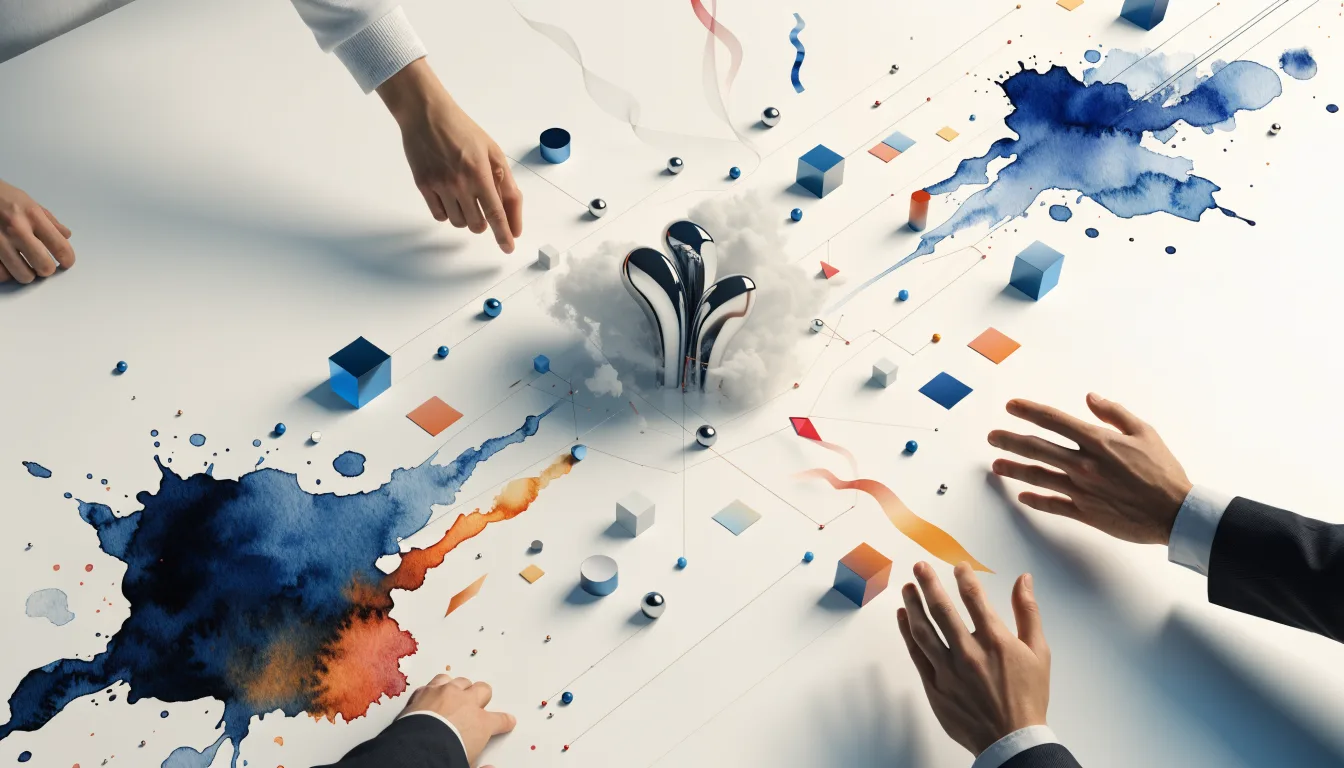
Walk into an Apple Store and the first thing an employee does is not sell you anything. It is shake your hand, ask your name, and remember it. That is not warmth left to chance — it is Step One of a five-step script every Apple retail employee is trained to follow, reverse-engineered from decades of behavioral research on how people actually judge a service encounter.
The script is called A-P-P-L-E, and it is the clearest evidence yet that Apple's retail experience is not a culture of nice people — it is a designed system of psychological cues, deployed with the same rigor Apple applies to industrial design. The thesis of this piece is simple: Apple Stores succeed commercially because they are built around how memory and emotion actually work, not around product knowledge or sales targets. Strip away the architecture and the products, and what remains is a behavioral-economics playbook any service brand can study — and most have never bothered to read closely.
What is the A-P-P-L-E framework Apple uses to script its stores?
A-P-P-L-E is the acronym Apple reportedly trains retail staff to follow during every customer interaction, details of which surfaced when portions of Apple's internal retail training materials were reported on by business press in 2012. The steps are:
- Approach customers with a personalised, warm welcome.
- Probe politely to understand the customer's needs — asking open questions rather than pitching.
- Present a solution for the customer to take home today.
- Listen for and resolve any issues or concerns, including ones the customer hasn't voiced yet.
- End with a fond farewell and an invitation to return.
Read it again and the structure becomes obvious: it is a customer journey compressed into five beats, with the emotional peaks deliberately engineered at the start and the finish. That is not an accident. Daniel Kahneman's peak-end rule holds that people judge an experience almost entirely by its most intense moment and its final moment, not by the average of every minute inside it. Apple's script puts a manufactured high at the open (the personal welcome) and another at the close (the farewell and invitation back), regardless of what happens — a queue, a stock-out, a technical glitch — in between. The middle can wobble. The bookends cannot.
This is the single most liftable insight in Apple's retail model: most brands pour their training budget into the middle of the interaction — product knowledge, upselling technique — and leave the opening and closing to instinct. Apple inverted that, because the behavioral science says the opening and closing are what gets remembered and repeated.
Why doesn't Apple pay its retail staff on commission?
Because commission changes what an employee optimises for, and Apple needed its staff optimising for something commission actively undermines: trust. Apple's retail employees have long been reported to be salaried rather than commission-based, which removes the single biggest source of adversarial friction in retail — the sense that the person across the counter wants your money more than your satisfaction.
This is choice architecture applied to the employee experience, not just the customer's. Remove the commission incentive and an employee is free to say "you don't need the more expensive model" — a sentence that, paradoxically, builds more revenue-driving trust than any upsell could. It is the retail equivalent of a doctor who doesn't profit from the test they recommend: the absence of self-interest becomes the credibility signal. Reichheld's Net Promoter research at Bain & Company has long argued that loyalty is driven less by any single transaction and more by whether a customer believes the company is acting in their interest — a principle Renascence has written about at length in its own breakdown of Bain's Net Promoter System. Apple's commission-free floor staff are a structural answer to that exact question.
Why did Apple get rid of the cash register?
Because every metre a customer walks between "I've decided to buy this" and "I have paid for this" is friction, and friction is where decisions get second-guessed. Apple replaced the fixed checkout counter with mobile point-of-sale devices carried by staff throughout the store, letting a transaction complete wherever the decision was made.
Richard Thaler's distinction between friction and "sludge" — his term for the unnecessary resistance institutions build into processes that should be effortless — is the right lens here. A queue at a till is sludge: it adds time, doubt, and a final checkpoint where a customer can talk themselves out of a purchase they'd already emotionally committed to. By collapsing the gap between decision and payment to zero, Apple protects the momentum of the "yes" rather than giving it room to cool. It is the retail equivalent of a one-click checkout, executed in physical space.
There is a second, quieter mechanism at work on the shop floor itself: the endowment effect. Every product in an Apple Store is unboxed, powered on, and free to touch, scroll, and hold for as long as a customer likes. Behavioral research on ownership — notably the work of Kahneman, Knetsch and Thaler on the endowment effect in the late 1980s — shows that physical possession, even briefly, inflates how much people value an object relative to simply viewing it. A customer who has held the device for ten minutes doesn't feel like they're deciding whether to buy it. They feel like they're deciding whether to give it back.
What problem is the Genius Bar actually designed to solve?
Not technical faults. The Genius Bar exists to solve a trust problem: customers arrive anxious, often already embarrassed about what they broke or don't understand, and the format has to defuse that anxiety before it can fix anything. The physical layout — a single bar, staff standing rather than seated behind a desk, no visible hierarchy between "support" and "sales" — was explicitly modelled on hospitality service, not on a traditional electronics repair counter.
That design choice maps directly onto the affect heuristic: people make judgments based on how a situation makes them feel, often before they've processed any actual information. A customer who feels condescended to at a repair desk will rate the outcome poorly even if the fix is perfect. A customer greeted at eye level, asked to sit alongside (not across from) the person helping them, rates the same fix far more positively. The service blueprint behind the Genius Bar is worth studying in detail — the way it stages empathy before diagnosis is a model any brand running a crisis or complaint-handling moment could learn from, and it echoes the structured approach to mapping every backstage and frontstage step that the Nielsen Norman Group has documented as core to good service design.
It is also a lesson in sequencing choice architecture: by making the first available option "book a slot and come back," rather than "wait in an unstructured queue," Apple converts an open-ended wait (highly aversive) into a scheduled appointment (far less aversive), even when the total elapsed time is identical. The goal-gradient effect — people's motivation to reach a goal increases the closer they perceive themselves to be to it — does the rest: once a customer has a time slot, the wait feels like progress rather than limbo.
Why does Apple call its stores "town squares"?
Because the company stopped describing its stores as retail outlets and started describing them as civic spaces — a reframing led by Angela Ahrendts, who joined Apple as senior vice president of retail in 2014 and oversaw the redesign of flagship locations under that language before departing in 2019. Stores built in that era, such as the Chicago flagship on the Chicago River, were explicitly designed with open plazas, trees, and seating meant to function whether or not anyone bought anything that day.
This matters because it changes what the store is for. A retail outlet's only legitimate visit has a transaction at the end of it. A town square's visits are legitimate on their own terms — meeting a friend, attending a free session, charging a phone, sitting down. Social proof does heavy lifting here: a space full of people who aren't buying anything signals, to everyone walking past the window, that this is a place worth being in, not merely a place to extract money. That reframing is also what made "Today at Apple," the company's programme of free in-store sessions on photography, coding, and creative skills launched during the Ahrendts era, make commercial sense: a free class has no immediate transaction attached to it, yet it is one of the most effective loyalty mechanics in the entire model, because reciprocity — give something of value first, ask for nothing in return — is one of the oldest, best-evidenced persuasion principles in behavioral science.
Apple doesn't train its staff to sell. It trains them to end every interaction on a high note, because it understood — ahead of most of retail — that customers don't remember transactions. They remember how the last sixty seconds felt.
What should other brands steal from Apple's retail model?
None of this requires Apple's margins or Apple's real estate. It requires discipline about where the emotional investment goes. A brand looking to apply the same logic should work through it in this order:
- Script the opening and the closing, not the middle. Identify the first ten seconds and the last ten seconds of your highest-volume customer interaction and design them deliberately — the peak-end rule rewards the bookends far more than the bulk of the encounter.
- Separate incentive structure from advice-giving. Wherever staff are paid to push a specific outcome, customers eventually sense it. Consider whether a flatter, trust-preserving incentive model would raise lifetime value even if it lowers the per-transaction upsell.
- Audit every point of friction between "yes" and "done." Count the steps, forms, and handoffs between a customer's decision and its completion. Each one is a chance for doubt to creep back in.
- Let people hold the product before they buy it. Wherever physically possible, give customers possession — a trial, a sample, a test drive — before the purchase decision, not after.
- Build something worth visiting for free. A session, a clinic, a piece of content with no sales pitch attached builds the reciprocity that pays off on the next visit, not this one.
- Map the whole interaction as a blueprint, not a vibe. Apple's staff aren't improvising warmth; they're executing a documented sequence. Translate your own best service moments into a repeatable service design blueprint rather than leaving them to individual personality.
What ties all six together is a refusal to treat "customer experience" as a soft, unmeasurable mood. Apple's version of it is closer to choreography: specific steps, specific sequencing, specific psychological targets at each beat. That is the part most competitors miss when they try to copy the stores — they copy the wood tables and the lighting, and skip the behavioral architecture underneath.
The real product on sale
Apple Stores don't primarily sell hardware anymore; the hardware is available cheaper and faster online. What they sell is the fifteen minutes of feeling competent, welcomed, and unhurried — a feeling engineered through a five-letter acronym, a salary structure, a missing cash register, and a bar shaped like a place you'd want to be seen. Any brand chasing the same loyalty Apple commands should stop asking what Apple sells and start asking what Apple scripts. The answer is never "a product." It is always the last sixty seconds.
Renascence works with retail, banking, and hospitality leaders across the region to turn exactly this kind of behavioral insight into a working customer experience strategy — mapped, scripted, and measured rather than left to individual goodwill. If you want to see where your own frontline moments stand against this kind of discipline, the CX Maturity Assessment is a useful place to start.
Further reading
FAQ
Questions we get on this topic
Related reading
Writing on how human behavior shapes the experiences brands deliver — at the intersection of behavioral economics and customer experience.
Stay ahead of CX
Get the Journal in your inbox.
Insights, frameworks and event round-ups from the Renascence team. No spam, ever.