
Feedback Management · August 13, 2026
From Listening to Action: Fixing the VoC Execution Gap
Most VoC programmes collect feedback nobody acts on. Here's why the gap between insight and execution persists — and the two-loop framework that closes it.

Ask any Head of CX how many surveys their organisation sent last year and they will have a number ready in seconds. Ask them how many of those responses changed anything, and the room goes quiet. That silence is the entire problem with Voice of Customer programmes today: they have become listening exercises rather than decision engines.
The central failure in most VoC programmes is not a data problem — it is an action problem. Companies collect more feedback than ever, yet the mechanism that turns a comment into a fix, a fix into a routine, and a routine into a measurable shift in loyalty is either missing or too slow to matter. Fixing that mechanism, not adding another survey channel, is what separates a VoC function that shapes the business from one that decorates a dashboard.
Why do most VoC programmes collect feedback but never act on it?
Most VoC programmes stall at the reporting stage because no one owns the gap between insight and execution. Survey data lands with the research or CX team, gets summarised into a monthly deck, and is presented to leadership as information rather than routed to the specific process owner as a mandate. Without an owner, a deadline and a visible consequence for inaction, feedback simply decays into a historical record of dissatisfaction rather than a driver of change.
This is a well-documented gap, not a new observation. In its 2005 study Closing the Delivery Gap, Bain & Company found that 80% of companies believed they delivered a superior customer experience, while only 8% of their customers agreed. Two decades of survey tooling later, the gap between what companies believe about their listening and what customers experience as a result has not closed — it has simply been repackaged with better dashboards.
What does "closing the loop" actually mean?
Closing the loop means every piece of customer feedback triggers a visible, tracked response — either a direct follow-up with the customer who gave it, or a structural fix to the process that caused it. There are two loops, and most organisations only close one of them.
- The individual loop: a customer flags a problem, and someone contacts them to acknowledge it, resolve it, and confirm the resolution. This is service recovery, and it protects the single relationship.
- The systemic loop: the underlying cause of that complaint — a broken policy, a confusing form, a slow handoff between departments — gets logged, prioritised, and fixed so the next hundred customers never hit the same friction.
Closing only the individual loop is common and comfortable — a service recovery call feels like action. But it treats every complaint as a one-off rather than a data point, which means the same root cause keeps generating the same unhappy customers indefinitely. A mature Voice of Customer strategy has to close both loops, and it needs a different owner and cadence for each.
Why does feedback die in the inbox instead of becoming action?
The honest answer is behavioural, not procedural. Acting on a piece of feedback requires someone to absorb a small, certain cost today — reworking a script, escalating to IT, rewriting a policy clause — in exchange for an uncertain, diffuse benefit later: slightly higher retention, slightly fewer complaints, spread across a customer base they will never meet individually. Loss aversion, the well-established finding from Daniel Kahneman and Amos Tversky's prospect theory that losses are felt roughly twice as intensely as equivalent gains, means the immediate cost of changing a process looms larger in a manager's mind than the deferred, probabilistic gain of a happier customer. Left to instinct, most people will defer. This is compounded by what Richard Thaler calls sludge — friction deliberately or accidentally built into a process that should be easy. If closing a feedback ticket requires five approvals and a change-request form, most employees will quietly let it slide rather than fight the workflow. The fix for both is the same: shrink the number of steps between "customer said X" and "someone with authority did Y," and make the deadline visible to more than one person.
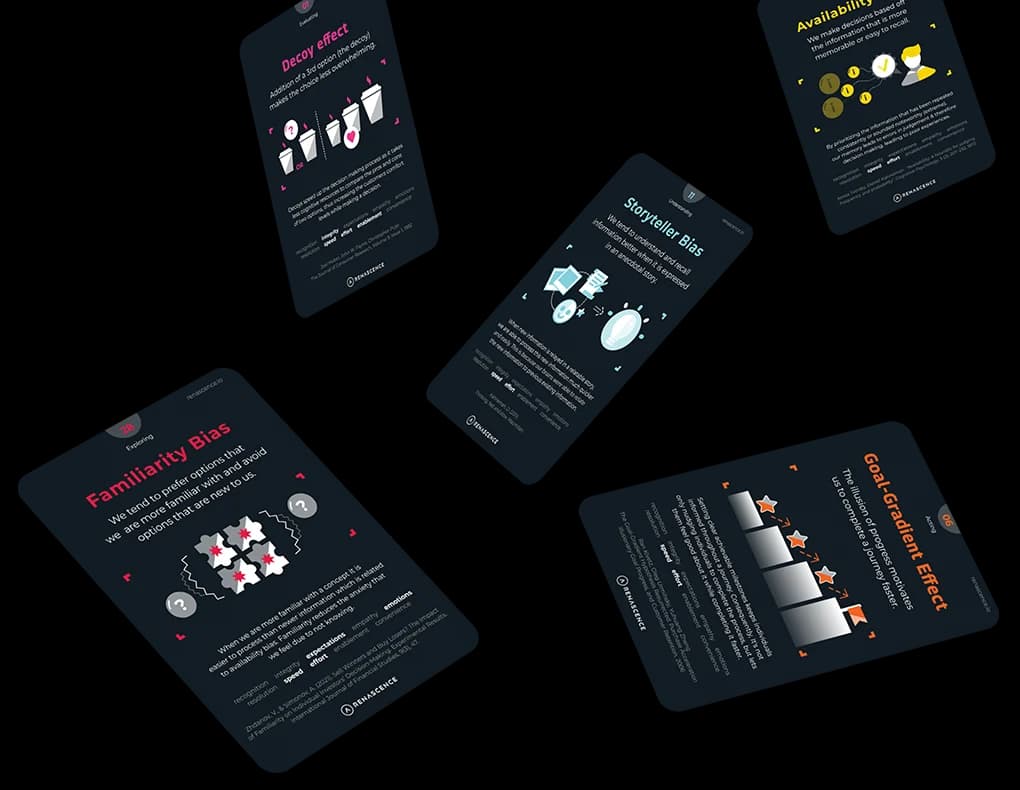
There is a second, more useful behavioural lever hiding inside a well-run action tracker: the goal-gradient effect, documented by Ran Kivetz, Oleg Urminsky and Yuhuang Zheng in their study of retail loyalty programmes, which found that people accelerate their effort as they perceive themselves getting closer to a finishing line. A visible progress bar on open VoC actions — "6 of 9 root causes resolved this quarter" — exploits the same instinct that makes a loyalty stamp card work. Teams push harder on the last few items precisely because the end is in sight. Most VoC dashboards show volume and sentiment. Few show progress toward closure, which is the one number that actually motivates the people who have to do the fixing.
How do you turn VoC data into action? A five-step framework
Turning feedback into decisions is a workflow problem before it is an analytics problem. The following sequence works because each step removes a specific excuse for inaction — ambiguity, ownership, urgency, and proof.
- Triage by impact, not by volume. A complaint mentioned by 200 customers about a minor cosmetic issue is less urgent than one mentioned by 20 customers about a payment failure. Score each theme on frequency and business impact (revenue at risk, churn signal, safety or compliance exposure) before it goes anywhere near a priority list.
- Assign a single named owner, not a department. "Operations will look into it" is where accountability goes to die. Every action needs one person's name attached, with the authority to actually implement the fix or escalate it.
- Set a visible deadline and a review cadence. Open items with no date attached rarely close. A simple rule — every action gets a due date and appears on a recurring leadership review — creates the mild social pressure that gets things moved.
- Close the loop with the customer who raised it. Even a short message — "you told us X, here is what we changed" — matters disproportionately. It converts a complainant into someone who feels heard, which is one of the strongest predictors of forgiveness after a service failure.
- Log the systemic fix on a shared roadmap and track its downstream effect. Route the structural change into a CX implementation roadmap with a clear owner, and revisit the original metric 60–90 days later to confirm the fix actually moved the number, not just the ticket status.
Skip any one of these five steps and the loop reopens. Skip step four in particular, and you lose the compounding trust benefit of listening at all — customers who are asked for feedback and never told what happened to it become measurably more cynical about the next survey, which quietly erodes response rates and data quality over time.
Which metric actually predicts whether a company will act — NPS, CSAT or CES?
None of the three metrics in the standard VoC toolkit predicts action on its own — they measure different things and are frequently misapplied as if they were interchangeable. NPS gauges overall relationship loyalty and willingness to advocate; CSAT measures satisfaction with a specific interaction; Customer Effort Score (CES) measures how hard the customer had to work to get something resolved. Matthew Dixon, Karen Freeman and Nicholas Toman introduced CES in their 2010 Harvard Business Review article "Stop Trying to Delight Your Customers", arguing that reducing customer effort is a stronger driver of loyalty than attempting to delight, because most customers simply want their problem solved with minimal friction — they are not looking to be impressed.
The metric that actually predicts whether feedback gets acted on is none of these three — it is the verbatim comment, the open-text answer most companies treat as an afterthought. A score tells you something changed; the comment tells you what to do about it. An organisation that routes every low-score verbatim through a text-analytics or human-tagging process before it reaches an owner will act faster and more precisely than one that stares at a trend line and guesses. The score triggers the alarm. The words tell you which fire to put out.
This is also where the choice-architecture problem in most surveys does real damage. A ten-question NPS survey with an optional comment box, sent quarterly, generates a lagging, low-resolution signal. A one-question effort-score prompt triggered immediately after a specific interaction, with a mandatory "what could we have done better" field, generates a live signal tied to a specific, fixable moment. If your survey design does not make the comment box the default rather than the afterthought, you are optimising for a clean chart instead of a useful one.
What does a working closed-loop system actually look like day to day?
In practice, a functioning closed-loop system looks less like a dashboard and more like an escalation desk. Low scores or negative sentiment trigger an automatic case in a workflow tool, assigned by rule (not by whoever happens to be free) based on issue type and severity. High-severity cases — payment failures, safety complaints, anything with legal exposure — follow a defined escalation strategy with a response-time SLA measured in hours, not weeks. Lower-severity themes get bundled weekly into a triage session where the CX or VoC team decides what becomes a fix this sprint versus a longer-term roadmap item.
The organisational detail that makes or breaks this is where the VoC function sits. If it reports only into marketing, action tends to stop at messaging and service-recovery gestures. If it reports into an operations or transformation function with the mandate to change process, the systemic loop actually closes. This is why serious customer feedback management programmes are structured as cross-functional governance, not a research subscription — the team running VoC needs enough organisational weight to make operations, product and frontline teams answer for open actions, not just read about them.
A survey that never changes a process is not customer feedback. It is customer venting, recorded at company expense.
There is a related structural failure worth naming directly: employee experience. Frontline staff are usually the first to know why a complaint keeps recurring, yet most VoC programmes never ask them. A parallel employee experience feedback loop — where staff can flag the process friction they see daily — often surfaces the root cause faster than the customer survey does, because the employee has seen the pattern a hundred times before the tenth customer complaint lands. Renascence has written previously about how frontline attrition is itself a CX problem — unresolved friction does not just frustrate customers, it burns out the people asked to absorb the consequences of a broken process every day.
How do you prove the business case for closing the loop?
The honest constraint on most VoC investment is not conviction, it is proof. Leadership will fund another survey tool more readily than they will fund a case-management workflow, because the survey produces a chart and the workflow produces a cost line with a delayed payoff. This is precisely where loss aversion works against a CX leader: the cost of the new process is immediate and certain, while the benefit — customers who stay instead of churning — is deferred and probabilistic, so it is systematically underweighted in the budget conversation.
The counter to that bias is not a better slide, it is a number leadership can defend to their own board. Peter Kriss, in his 2014 Harvard Business Review analysis "The Value of Customer Experience, Quantified", showed that customers who rated their experience highly spent measurably more with that company over time than those who rated it poorly — evidence that experience quality converts into a financial outcome, not just a satisfaction score. Building an equivalent internal case — tying a specific closed loop to a specific retention or spend change for the cohort affected — is what moves a VoC programme from a cost centre to a function with a defensible return. Renascence's CX ROI Calculator is a useful starting point for putting a first number on that argument before you commission a full internal analysis.
What should a CX leader do this quarter?
Before adding another question to the survey, audit what happens to the answers you already have. Pull the last quarter of open-text verbatims and ask three questions: how many generated a tracked action, how many actions had a named owner and a deadline, and how many customers were told what changed as a result. If the honest answer to any of those is "we don't know," that is the actual finding — not a data gap, an accountability gap — and it is the one worth fixing before the next survey goes out.
- Retire any metric your organisation cannot connect to a specific action taken in the last 90 days.
- Give every open VoC theme a single named owner and a visible due date, reviewed on a fixed cadence.
- Close the loop with the customer directly, even briefly, every time a systemic fix is made in response to their feedback.
- Route root-cause fixes into a governed roadmap, not a backlog that nobody revisits.
None of this requires new technology. It requires treating the answer to "what did we do about it" as seriously as the answer to "what did they say." A programme built around CX governance that formalises ownership and cadence will outperform a more sophisticated listening stack every time, because the constraint was never how well you could hear the customer. It was always what happened in the silence after.
Renascence works with organisations across the region to redesign the mechanics of listening — from survey design and text analytics through to the governance that forces action. If your VoC data has become a report nobody argues with rather than a decision nobody can avoid, that is the conversation worth having next. Explore how a structured customer experience practice closes that gap, or start with Renascence's CX Assessment to see where your own feedback loop actually breaks.
Further reading
FAQ
Questions we get on this topic
Related reading



Writing on how human behavior shapes the experiences brands deliver — at the intersection of behavioral economics and customer experience.
Stay ahead of CX
Get the Journal in your inbox.
Insights, frameworks and event round-ups from the Renascence team. No spam, ever.