
Customer Loyalty · August 11, 2026
Emotional vs Transactional Loyalty: Why Points Programs Fall Short
Points buy short-term behaviour; feelings buy years of it. Here's the behavioral-economics case for why emotional loyalty outlasts every rewards scheme.

Two customers get the same email: their airline is raising the annual fee on its co-branded credit card by 40%. The first cancels within the hour, points balance be damned. The second grumbles, pays it, and flies the same airline eight months later — not because the miles are better, but because the ground staff remembered her name after a missed connection three years ago. Same price shock. Same loyalty programme. Wildly different outcome.
That gap is the whole story of loyalty economics. Transactional loyalty is rented: it is bought with points, discounts and status tiers, and it disappears the moment a competitor rents harder. Emotional loyalty is owned: it is built from trust, recognition and identity, and it survives price rises, service failures and a rival's better offer. Most loyalty programmes are engineered to buy the first kind and hope it grows into the second. It rarely does on its own.
What is the difference between transactional and emotional loyalty?
Transactional loyalty is behaviour that persists only while the incentive persists — a customer who stays because the points, cashback or discount make switching costly in the short term. Emotional loyalty is behaviour that persists because the customer feels understood, respected and aligned with the brand, independent of the next reward.
The distinction matters because the two are driven by entirely different psychological engines. Transactional loyalty runs on System 1 arithmetic — a quick mental tally of points earned versus price paid. Emotional loyalty runs on identity and memory: how a brand made someone feel at the moments that counted, and whether that feeling got attached to a sense of who they are. A Costco member who talks about "my Costco" the way they talk about their neighbourhood is not doing arithmetic anymore.
Why do points-based loyalty programs struggle to build real loyalty?
Because points optimise for the wrong variable. A programme built purely on discounts and miles teaches customers to shop the deal, not the brand — and the moment a competitor offers a marginally better deal, the arithmetic flips and the customer leaves without a second thought. This is loyalty as a rented asset: the brand pays rent every quarter in the form of margin given away, and the tenant owes nothing beyond the lease term.
There is good evidence that service quality, not reward generosity, is the more durable lever. In their 2010 Harvard Business Review article "Stop Trying to Delight Your Customers", Matthew Dixon, Karen Freeman and Nicholas Toman, drawing on research conducted for the Corporate Executive Board, found that reducing customer effort during service interactions predicted loyalty far more reliably than trying to wow customers with grand gestures. Removing friction earns more loyalty than adding sparkle — a point that sits uncomfortably with how most loyalty budgets get spent, which is overwhelmingly on the sparkle.
Frederick Reichheld's research at Bain & Company, published as "The One Number You Need to Grow" in Harvard Business Review in December 2003, made a related case: a customer's willingness to recommend a company — not their enrolment in a rewards scheme — tracked closely with actual repurchase and referral behaviour. Recommendation is an emotional act. Nobody recommends a discount; they recommend a feeling.
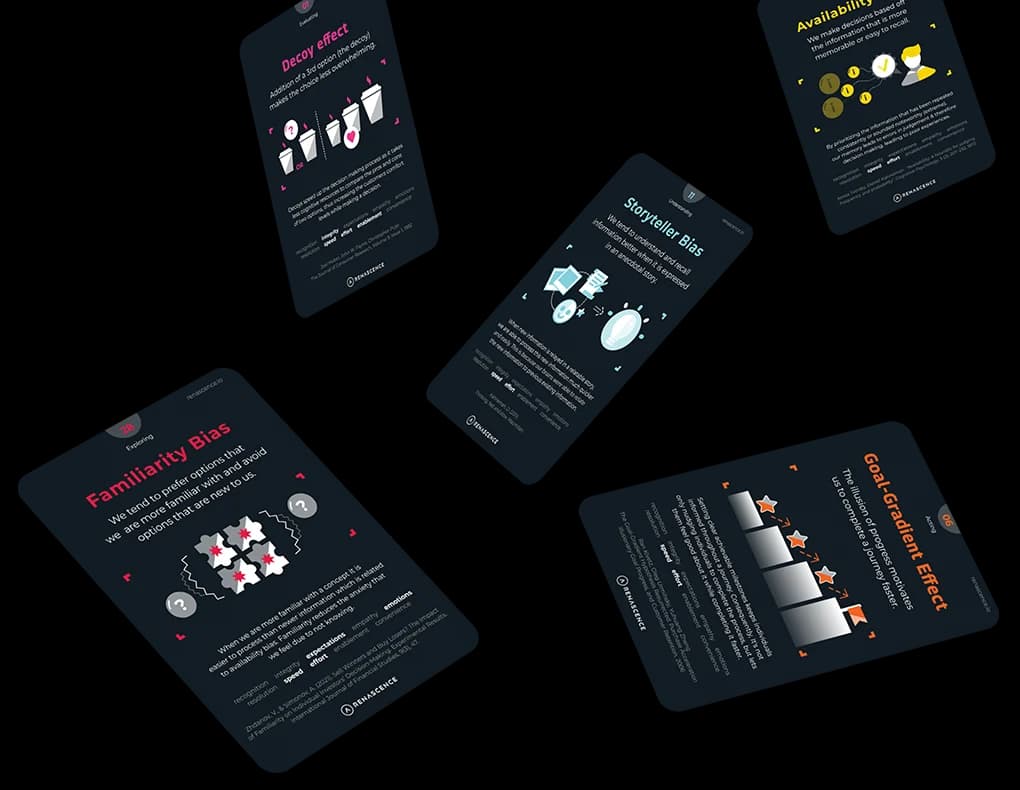
Points programmes also fall into a trap behavioural economists call the goal-gradient effect: people accelerate effort as they approach a reward, then coast once it is claimed. That produces spikes of engagement around tier thresholds and free-flight redemptions, and long, loyalty-free plateaus in between. It is activity, not attachment.
How does behavioral economics explain the emotional loyalty premium?
Three mechanisms do most of the work, and none of them require a single extra point issued.
The first is the endowment effect — the tendency to value something more once you feel you own it. In a landmark 1990 study, Daniel Kahneman, Jack Knetsch and Richard Thaler gave participants a coffee mug and then asked them to name a price to sell it, comparing that figure to what a separate group was willing to pay for the same mug. Owners priced the mug at roughly twice what buyers would offer — the same object, valued differently purely because of possession. Emotional loyalty behaves the same way. A customer who feels a brand relationship belongs to them — "my branch manager," "my usual table," "my account team" — will defend that relationship against a rational-sounding competitor offer, because giving it up feels like a loss, not a neutral choice. We've written before about how the endowment effect explains why customers resist change even when the alternative is objectively better on paper.
The second is the peak-end rule, Daniel Kahneman's finding that people judge an experience overwhelmingly by its emotional peak and its ending, largely ignoring the average. A loyalty relationship is really a string of small experiences; the ones that get remembered and retold are the worst failure recovered brilliantly, or the one moment someone went visibly out of their way. Points cannot buy a peak. A recovered complaint, handled with warmth at the exact moment of a customer's frustration, can.
The third is the IKEA effect — people value things more when they have had a hand in creating them. Loyalty tiers, personalised recommendations and co-designed experiences (choosing your own reward categories, building a custom flight path, curating a subscription box) borrow this mechanism. The customer isn't just receiving a benefit; they built part of it, which makes it harder to walk away from.
What does emotional loyalty look like in practice?
It rarely announces itself with a programme name. It shows up as customers who tolerate a price increase, forgive a service failure, and defend the brand unprompted in conversation with friends. Amazon's obsession with removing friction from the entire buying journey — not just the loyalty layer — is one of the clearer examples of a company earning emotional loyalty as a by-product of operational excellence rather than a rewards scheme; we explored the mechanics of that obsession in how Amazon obsesses over its customers.
Costco is another useful case, precisely because its "loyalty programme" is a paid membership with almost no points mechanics at all. The emotional loyalty comes from a consistent value promise, transparent pricing and a culture that customers feel protects their interests over the company's own margin — a form of reciprocity that a discount code can't replicate.
In sectors with high emotional stakes — private banking, healthcare, luxury hospitality — the pattern repeats: the brands with the least visible points economy often have the deepest loyalty, because the relationship is carried by people and rituals rather than a rewards ledger. That is not an argument against points; it is an argument for building the emotional layer first and letting the points reinforce it, rather than substitute for it.
How do you measure the gap between rented and owned loyalty?
Standard loyalty metrics — enrolment numbers, redemption rates, points liability — describe programme activity, not customer attachment. They can rise while true loyalty falls, because a customer can hoard points out of habit while quietly shopping the competition on price. A handful of sharper diagnostics tell you which kind of loyalty you actually have:
- Repurchase after a price increase. If retention holds steady through a price rise, you are looking at emotional loyalty. If churn spikes in lockstep with the increase, the relationship was transactional all along.
- Response to a competitor's superior offer. Emotionally loyal customers investigate and often stay anyway. Transactionally loyal customers switch, sometimes without even reading the fine print.
- Unprompted advocacy. Reichheld's likelihood-to-recommend question, tracked over time, captures something a redemption rate never will: whether the customer would put their own reputation behind the brand.
- Recovery behaviour after a failure. A customer who stays — and stays warm — after a service breakdown handled well is showing you the peak-end effect in action, and revealing genuine emotional equity.
- Share of wallet, not just share of visits. A customer can visit often out of habit while spending most of their category budget elsewhere. Emotional loyalty tends to show up as a growing share of spend, not just frequency.
Brands that want a structured view of where their retention economics actually sit — rather than a guess based on redemption dashboards — can start with a CX ROI Calculator to quantify what improving retention and reducing effort is actually worth, and work backward from there.
How can brands build emotional loyalty without abandoning the economics of points?
Points and emotion are not rivals; they solve different problems. Points reward frequency and defend margin against outright defection. Emotion builds the resilience that survives a price shock or a bad week. The brands that win long-term retention design for both, deliberately, in this order:
- Audit the journey for its moments of truth first. Before touching the rewards structure, map where customers form their strongest impressions — good and bad — and fix the failures that are quietly costing more loyalty than any reward tier is earning back. Our guide to finding and fixing moments of truth walks through how to locate these without guesswork.
- Redesign rewards around recognition, not just discount. A birthday call from a relationship manager, early access to a new product, or being remembered by name costs little and taps reciprocity and status far more effectively than another 2% off.
- Use choice architecture to make the emotional option the easy option. If redeeming a reward for something meaningful requires ten more clicks than taking the cash-back default, most customers will take the path of least resistance — and the brand loses the emotional upside it could have earned almost for free.
- Build rituals that customers can't get anywhere else. A signature unboxing, a welcome call, an annual review meeting — these create the endowment effect deliberately, giving customers something they would feel they are losing if they left. See our work on designing customer rituals and ceremonies for how this is structured in practice.
- Fix the employee experience upstream. Emotional loyalty is delivered by people, and disengaged frontline staff cannot manufacture warmth on demand. Retention on the customer side is downstream of retention on the employee experience side.
- Track leading indicators, not just lagging ones. Sentiment in service interactions, complaint recovery speed and voice-of-customer themes will tell you the emotional temperature months before churn or NPS numbers move.
None of this requires dismantling an existing points scheme. It requires treating points as the floor of the relationship, not the ceiling — the entry fee for staying in the conversation, while the real retention work happens in how people are treated when the points aren't the point.
Discounts rent a customer's next purchase. Emotion owns their next ten.
Programmes that mistake the rent for the deed eventually discover the difference at the worst possible moment — usually when a leaner competitor undercuts them on price and the customer leaves without a backward glance. A well-run customer loyalty strategy treats the points ledger and the emotional ledger as two separate balance sheets, and manages both, because a business that only manages the first is quietly funding its competitor's acquisition costs.
Where this goes next
The loyalty programmes worth studying in the years ahead won't be the ones with the richest points economics — they'll be the ones that figured out how to make customers feel owned by the relationship, not merely enrolled in it. That shift starts with better measurement of what is actually driving retention, not just what the redemption dashboard says. If your organisation is unsure whether it is buying loyalty or earning it, a structured CX assessment is a faster route to the answer than another round of programme tweaks — and a considerably cheaper one than finding out the hard way, the day a competitor's better offer lands in your best customers' inboxes.
Further reading
FAQ
Questions we get on this topic
Related reading



Writing on how human behavior shapes the experiences brands deliver — at the intersection of behavioral economics and customer experience.
Stay ahead of CX
Get the Journal in your inbox.
Insights, frameworks and event round-ups from the Renascence team. No spam, ever.