








Customer Experience · August 8, 2026
Customer Centricity Theories Compared: What Actually Works
Most organisations claim customer centricity but can't demonstrate it. This guide compares the dominant frameworks and identifies what actually changes outcomes.

Most organisations claim to be customer-centric. Very few can explain what that actually means — and fewer still can demonstrate it in their operations, their metrics, or their culture. The gap is not a lack of ambition. It is a proliferation of theories, each plausible on paper, none of them complete on their own, and most of them applied without the discipline to make them stick.
This article compares the dominant customer centricity theories — from Drucker's founding premise to the behavioural economics lens that has reshaped how serious practitioners think about experience design. The goal is not an academic survey. It is a working answer to the question every CX leader eventually faces: of all the frameworks on offer, which ones actually change outcomes?
The short answer: no single theory of customer centricity is sufficient. What works is a layered approach — one that combines a clear strategic definition, a measurable operating model, a behavioural understanding of how customers actually make decisions, and a cultural architecture that keeps the whole thing honest. The frameworks below are the building blocks. The discipline is in choosing which ones to combine, and in what order.
Why Defining Customer Centricity Still Matters in 2026
Defining customer centricity is not a semantic exercise. An organisation that cannot state precisely what it means will default to the nearest proxy — usually satisfaction scores, response times, or complaint volumes — and mistake measurement for strategy.
The most durable definition remains operational rather than aspirational: customer centricity is the consistent alignment of an organisation's decisions, processes, and culture around the creation of value for specific customers, in ways those customers recognise and reward. Three words in that definition do the heavy lifting: consistent (not episodic), specific (not all customers equally), and recognise (the customer is the judge, not the internal team).
Peter Drucker's foundational argument — that the purpose of a business is to create a customer — is still the most useful starting point, precisely because it locates value creation outside the organisation. But Drucker wrote before the age of digital channels, algorithmic personalisation, and real-time feedback loops. His premise needs updating, not replacing.
The more useful contemporary framing comes from Roger Martin's work on customer capitalism, which argues that shareholder value is an outcome of customer value creation, not a parallel goal. Organisations that optimise for the customer metric tend to produce better financial results over time; those that optimise directly for financial metrics tend to erode both. This reframing matters because it changes what gets measured, what gets funded, and what gets cut.
The Strategic Theory: Customer Lifetime Value as the Organising Principle
The most influential strategic theory of customer centricity is built around customer lifetime value (CLV). Popularised in academic marketing and operationalised by firms like Amazon, the CLV framework argues that customers should be understood as assets with long-term financial profiles — not as transactions to be maximised in the moment.
The practical implication is significant: it shifts investment logic. A business optimising for short-term revenue will under-invest in onboarding, recovery, and loyalty — the moments that determine whether a customer stays or leaves. A business optimising for CLV will treat those same moments as high-return capital allocation decisions.
The CLV theory also forces the uncomfortable question of which customers to centre. Not all customers are equally valuable, and customer centricity applied uniformly is a resource misallocation. Segmenting by lifetime value — and designing differentiated experiences accordingly — is not elitist; it is honest. The alternative is a mediocre experience for everyone. If you want to understand where your organisation currently sits on this spectrum, a structured CX maturity assessment can surface the gaps between stated intent and actual investment priorities.
The weakness of CLV as a sole framework is that it is retrospective and probabilistic. It tells you what a customer has been worth and models what they might be worth. It does not, on its own, explain how to create the experiences that drive retention and advocacy. For that, you need a different layer.
The Operational Theory: Jobs-to-Be-Done and the Service Blueprint
Clayton Christensen's jobs-to-be-done (JTBD) theory reframes the customer question entirely. Rather than asking "who is our customer?", it asks "what is the customer trying to accomplish?" The unit of analysis shifts from demographic segment to functional, emotional, and social job. A customer does not buy a mortgage; they hire a financial product to secure a home and reduce anxiety about the future. That distinction changes everything about how the product and the experience around it should be designed.
JTBD is at its most powerful when combined with service blueprinting — the operational discipline of mapping not just the customer's visible journey but the backstage processes, systems, and employee actions that produce each moment. A service blueprint makes the connection between organisational behaviour and customer experience explicit. It is the tool that most reliably reveals where the gap between customer centricity importance as a stated value and customer centricity as a lived reality actually sits.
The combination of JTBD and service blueprinting addresses a common customer centricity mistake: designing for the customer's stated preferences rather than their actual behaviour. Customers frequently cannot articulate what they want, but they can always tell you what job they were trying to do and whether the experience helped or hindered them. Designing around the job rather than the stated preference produces more durable solutions. Renascence's CX journey design work is grounded in exactly this logic — mapping the job first, then the experience architecture that serves it.
The Behavioural Theory: Why Rational Models of the Customer Are Wrong
Every strategic and operational theory of customer centricity contains a hidden assumption: that customers evaluate experiences rationally, weigh costs and benefits, and make decisions accordingly. Behavioural economics has spent the last four decades demonstrating that this is false — and the implications for customer centricity are profound.
Two mechanisms are particularly important for CX practitioners.
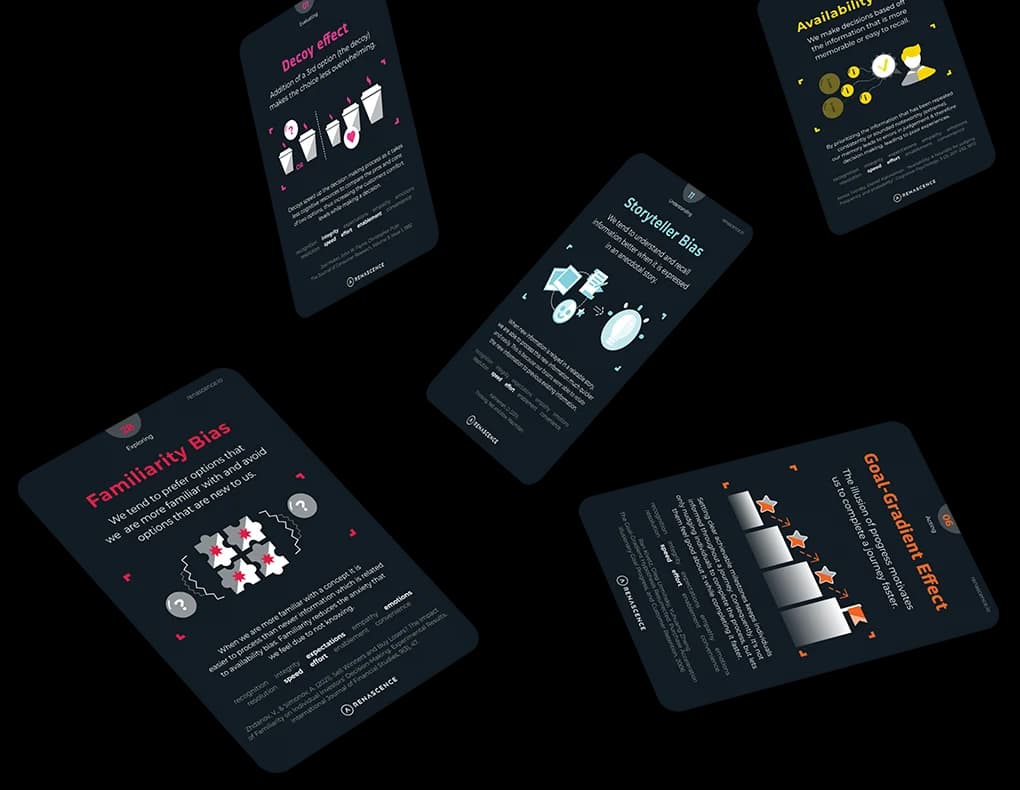
The first is the peak-end rule, documented by Daniel Kahneman and colleagues. Customers do not remember an experience as an average of all its moments. They remember it primarily by its most intense point (positive or negative) and by how it ended. This means that an organisation can deliver a largely competent experience and be remembered poorly if the peak was negative or the ending was flat. Conversely, a deliberately engineered positive peak — a moment of unexpected generosity, a recovery handled with genuine care — can reframe an otherwise ordinary experience. The implication for achieving customer centricity is that resource allocation should weight peak moments and endings far more heavily than the middle of the journey.
The second is loss aversion. Customers feel the pain of a loss roughly twice as acutely as the pleasure of an equivalent gain. This means that friction — a slow process, a confusing form, an unreturned call — does disproportionate damage to perception. Richard Thaler's distinction between friction (neutral resistance) and sludge (friction deliberately imposed to discourage action) is useful here: organisations that have allowed sludge to accumulate in their processes are not merely inefficient; they are actively destroying customer value. Identifying and removing sludge is one of the highest-return activities in any customer experience improvement programme.
The behavioural lens also explains why measuring customer centricity through satisfaction surveys alone is insufficient. Satisfaction is a post-hoc, System 2 judgement that often fails to capture the System 1 emotional response that actually drives behaviour. Loyalty, advocacy, and churn are driven more by emotional memory than by rational evaluation — which is why organisations that score well on CSAT can still face significant attrition.
The Cultural Theory: Customer Centricity as an Inside-Out Problem
The most underrated theory of customer centricity is also the most uncomfortable one: that the customer experience is a direct output of the employee experience, and that no amount of strategy, journey mapping, or technology investment will produce a customer-centric organisation if the culture is not aligned.
This is not a soft claim. The mechanism is straightforward. Employees who feel valued, trusted, and equipped to make decisions exercise discretion in favour of the customer. Employees who feel surveilled, constrained by rigid scripts, and measured on throughput rather than outcomes do the opposite. The customer feels the difference — not as a policy, but as a human interaction.
The cultural theory of customer centricity has practical implications for how organisations are structured. Customer-centric cultures tend to have fewer approval layers for customer-facing decisions, clearer ownership of the end-to-end journey, and explicit mechanisms for surfacing customer insight to decision-makers who are not in daily contact with customers. They also tend to treat employee experience as a design problem with the same rigour applied to the customer journey — not as an HR programme running in parallel.
The common customer centricity mistake here is treating culture as a communications exercise: a new set of values on the wall, a customer-first slogan in the town hall, a training day. Culture is not what you say; it is what you reward, what you tolerate, and what you measure. Organisations that want to implement customer centricity at a cultural level need to audit all three — and be prepared for what they find.
The Measurement Theory: What Gets Measured Gets Managed, and What Gets Managed Gets Gamed
Every theory of customer centricity eventually confronts the measurement problem. The dominant metrics — Net Promoter Score, Customer Satisfaction Score, Customer Effort Score — each capture something real, and each has well-documented limitations.
NPS measures advocacy intent, which correlates with growth in some contexts and is meaningless in others (monopoly services, captive markets, and low-involvement categories all distort the signal). CSAT measures satisfaction at a moment in time, which is useful for transactional touchpoints but poor at capturing relationship quality. CES measures effort, which is the most reliable predictor of disloyalty — but effort alone does not explain why customers stay or advocate.
The more sophisticated approach to measuring customer centricity treats these metrics as a portfolio, not a competition, and anchors them to business outcomes rather than treating them as outcomes in themselves. The question is not "what is our NPS?" but "what is the relationship between our NPS and our retention rate, and where in the journey does that relationship break down?" For a structured approach to selecting the right metric for your context, the guide to choosing the right north star metric is a useful starting point.
Beyond the standard trio, the most honest measure of customer centricity is behavioural: do customers return, do they spend more over time, and do they refer others? These are lagging indicators, but they are the ones that cannot be gamed. Organisations that optimise for leading indicators (survey scores) while ignoring lagging ones (retention, share of wallet, referral rate) are measuring their own self-perception, not their customers' reality.
What the Theories Get Wrong: The Five Most Common Mistakes
Comparing customer centricity theories reveals not just what works but what consistently fails. The following mistakes appear across industries and geographies with remarkable consistency.
- Treating customer centricity as a department. When customer centricity is owned by a CX team rather than embedded in every function, it becomes advisory rather than operational. Finance, product, operations, and HR all make decisions that shape the customer experience — and if they are not accountable for customer outcomes, the CX team's influence is cosmetic.
- Confusing listening with acting. Many organisations have sophisticated voice-of-customer programmes that generate insight and change nothing. The bottleneck is rarely data; it is the governance and prioritisation process that connects insight to action. A voice of customer strategy that does not include a clear escalation and decision-making pathway is a research exercise, not a management tool.
- Designing for the average customer. Customer centricity strategies built around average personas miss the customers who matter most — either because they are the highest-value segment or because they are the most at-risk. Segmentation by need, behaviour, and value is not optional; it is the foundation of any credible customer centricity strategy.
- Prioritising acquisition over retention. Loss aversion applies to organisations as well as customers: the pain of losing a customer is felt less acutely than the excitement of winning a new one, even when the economics strongly favour retention. This bias consistently leads to under-investment in the post-purchase experience — the phase that determines whether a customer becomes loyal or churns.
- Launching without a governance model. Customer centricity initiatives that lack clear ownership, defined metrics, and a review cadence decay within twelve months. The energy of a launch is not a substitute for the infrastructure of accountability. A CX governance strategy is not bureaucracy; it is the mechanism that keeps customer intent connected to operational reality over time.
What Actually Works: A Synthesis
The honest conclusion from comparing these theories is that none of them is wrong, and none of them is sufficient. Customer centricity is not a single framework problem. It is a layered design challenge that requires:
- A precise strategic definition — anchored in customer lifetime value and segmented by who matters most, not who is easiest to serve.
- An operational model — built around jobs-to-be-done and made visible through service blueprinting, so the connection between internal behaviour and customer experience is explicit and manageable.
- A behavioural lens — applied to journey design, so that peak moments, endings, and friction points are engineered deliberately rather than left to chance.
- A cultural architecture — that aligns what the organisation rewards, tolerates, and measures with the customer outcomes it claims to prioritise.
- A measurement portfolio — that connects leading indicators (survey scores) to lagging outcomes (retention, revenue, referral) and treats the relationship between them as the real management signal.
The organisations that achieve customer centricity in practice are not the ones that found the right theory. They are the ones that built the discipline to apply several theories simultaneously — and the governance to sustain that discipline when quarterly pressures push in the other direction.
Customer centricity is, in the end, a choice about what an organisation is optimising for. The theories are tools for making that choice coherent and executable. The hard part is not understanding them. It is deciding, with enough conviction to act on it, that the customer's experience of your organisation is the thing worth getting right — and then building everything else around that decision.
If you are at the point of translating that conviction into a structured programme, Renascence's customer experience practice works with organisations across MENA and beyond to design, implement, and govern exactly that kind of transformation — grounded in the frameworks above, and tested against the operational realities that frameworks alone cannot anticipate.
Further reading
FAQ
Questions we get on this topic
Related reading



Stay ahead of CX
Get the Journal in your inbox.
Insights, frameworks and event round-ups from the Renascence team. No spam, ever.