About

The consultancy born at the intersection of behavioral economics and human experience.

RENÉ STUDIO

The CX design platform we built from a decade of client work.

Open rene.cx ↗
NOW HIRING

Join a team reshaping how the world experiences brands.

View open roles →

COMPANY

GROW WITH US

CONNECT

Services

Comprehensive CX and management consulting for enterprise brands.

RENÉ STUDIO

Every engagement, mapped and scored in one AI workspace.

Open rene.cx ↗
ALL SERVICES

Explore the full range of CX & management consulting services.

Browse all services →

CORE

SPECIALIST

Solutions

Structured solutions that turn CX ambition into measurable outcomes.

RENÉ STUDIO

Map, score and fix the journeys we redesign, with AI.

Open rene.cx ↗
ALL SOLUTIONS

Explore every CX solution we offer.

Browse solutions →

STRATEGY & GOVERNANCE

DESIGN & DELIVERY

CULTURE & EXPERIENCE

Industries

A decade of CX transformation across the region's defining sectors.

RENÉ STUDIO

Sector-ready journeys, scored by AI in minutes.

Open rene.cx ↗
ALL INDUSTRIES

See how we work across every sector.

Browse industries →

BUILT ENVIRONMENT

FINANCE & TECH

PEOPLE & MOBILITY

Products

Proprietary tools, platforms, and AI that power CX transformation.

RENÉ STUDIO

Design, score and fix customer journeys with AI.

Open rene.cx ↗
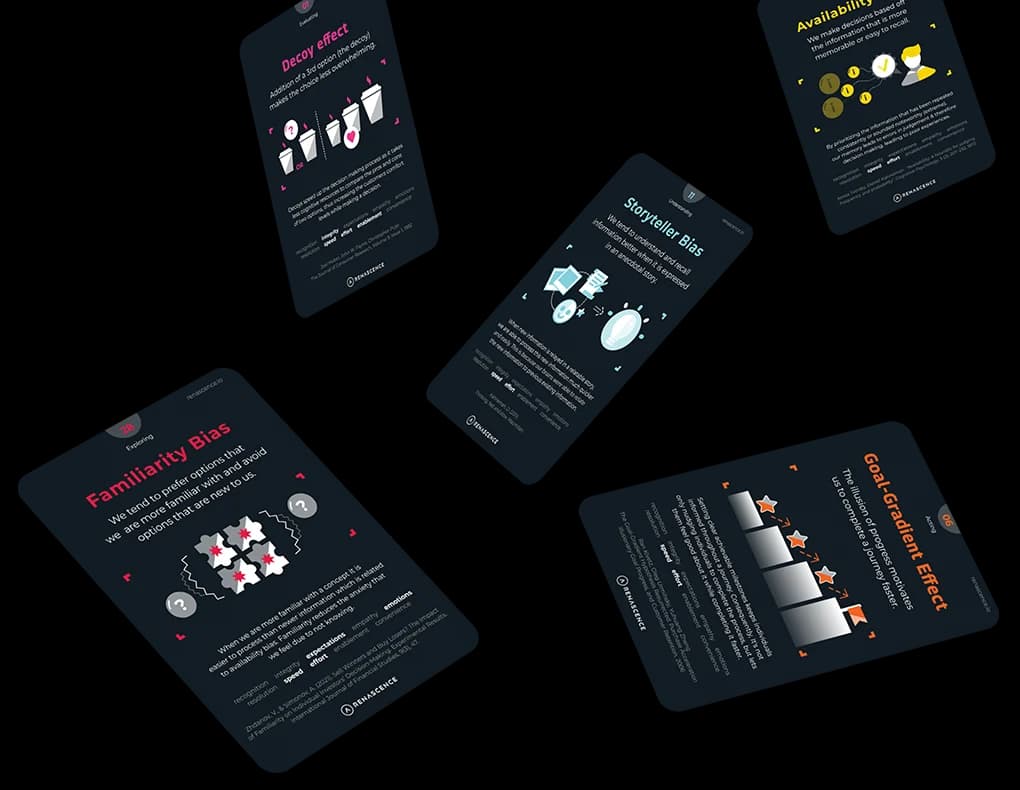
REBELDECK A · 36 FORCES

The forces that shape how humans experience the world.

Explore REBEL Reveal →
ALL PRODUCTS

Explore the full Renascence product ecosystem.

Browse products →

AI & TECHNOLOGY

LEARNING & GAMES

PLATFORMS & TOOLS

CX TOOLKIT

Opinion

Insights, research, and conversations at the frontier of CX.

RENÉ STUDIO

Turn what you read into a journey you can score.

Open rene.cx ↗
ReadExperience JournalArticles & research on CX, behavior, and transformation.Watch & listenExperience LoomOur video podcast on CX & behavior.CuratedCX NewsIndustry news that matters in CX, minus the noise.

Latest articles

Latest episodes

Latest news

Hub

Free tools, templates, and resources to advance your CX practice.

RENÉ STUDIO

Design, score and fix customer journeys with AI.

Open rene.cx ↗
THE MANIFESTOBurn the Deck.
Ten Virtues. Zero Excuses.Start reading →
THE HUB

Every free tool, template and resource in one place.

Visit the Hub →

AI TOOLS

FREE TOOLS

LEARNING

CULTURE

Retail · 1 October 2026

Kroger Ties AI Autonomy to Task Risk for CX Gains

Kroger's CIDO Yael Cosset says the grocer scales AI by matching autonomy levels to task risk and repeatability, not blanket automation, delivering measurable gains for shoppers and staff.

Newsdesk
Curated briefing · 2 min read · 2 sources

What happened

Kroger's chief information and digital officer, Yael Cosset, has set out how the US grocery giant is scaling artificial intelligence across its operations — not by automating indiscriminately, but by calibrating how much autonomy each AI system is given based on the risk and repeatability of the task it performs. Cosset says this risk-based approach is already producing measurable improvements for both shoppers and store associates.

Rather than pursuing blanket automation, Kroger is reportedly applying tighter human oversight to higher-stakes or less predictable decisions, while allowing AI greater autonomy on routine, low-risk, repeatable tasks. The approach spans both customer-facing functions and internal operations, with Cosset framing it as central to how the retailer is getting tangible value from its AI investments.

Why it matters

Kroger's framing offers a useful corrective to the "automate everything" instinct many large organisations default to when scaling AI. By explicitly tying autonomy levels to risk and repeatability, the retailer is building a governance logic that can flex across use cases — rather than a one-size-fits-all deployment model that either under-uses AI's capability or over-exposes the business to error.

For leaders in experience and digital transformation, this signals a maturing phase of enterprise AI adoption: the conversation is shifting from whether to deploy AI to how much decision-making authority it should be given, task by task. That distinction matters directly for service design — it determines where human judgement remains the safeguard for trust and nuance, and where speed and consistency can be handed to a machine without compromising the experience.

The Renascence take

What's easy to miss in stories like this is that the real innovation isn't the AI itself — it's the governance framework wrapped around it. Most organisations stumble not because their AI models are weak, but because they apply uniform trust levels to fundamentally different kinds of decisions.

The behavioral principle at play here is risk perception management: customers and employees tolerate automation readily when it handles predictable, low-stakes tasks, but lose trust fast when AI is let loose on ambiguous or emotionally charged moments. A customer-obsessed operator shouldn't ask "where can we deploy AI?" but "which decisions are safe to delegate, and which still need a human in the loop?" Kroger's approach suggests the next competitive advantage in AI adoption won't be model sophistication — it will be the discipline of knowing where to hold back.

Sources

This briefing was written by our Newsdesk, synthesising reporting from the outlets below. Follow the links for the original coverage.

FAQ

Questions we get on this topic

Kroger calibrates how much autonomy it gives each AI system based on the risk and repeatability of the task, applying tighter human oversight to higher-stakes decisions while letting AI handle routine, low-risk work with greater independence.

Yael Cosset, Kroger's chief information and digital officer, has described this risk-based model, saying it is already producing measurable improvements for both shoppers and store associates.

Rather than automating indiscriminately, Kroger ties AI autonomy to task risk and predictability so the business avoids under-using AI's capability on simple tasks while also avoiding over-exposure to error on complex, ambiguous decisions.

It suggests the key challenge in enterprise AI adoption is no longer whether to deploy AI, but deciding task by task which decisions are safe to delegate to AI and which still require human judgement to protect trust.

Stay ahead of CX

Get the signal, not the noise.

The stories shaping customer experience — plus the Journal and Experience Loom — in your inbox.