







About

The consultancy born at the intersection of behavioral economics and human experience.

René Studio
AI EXPERIENCE STUDIO

The CX design platform we built from a decade of client work.

Explore René Studio
Mysterya
MYSTERY AUDITS, LIVE

Mystery audits we run, scored live for every location.

Explore Mysterya
NOW HIRING

Join a team reshaping how the world experiences brands.

View open roles →

COMPANY

GROW WITH US

CONNECT

Services

Comprehensive CX and management consulting for enterprise brands.

René Studio
AI EXPERIENCE STUDIO

Every engagement, mapped and scored in one AI workspace.

Explore René Studio
Mysterya
MYSTERY AUDITS, LIVE

Mystery shopping, scored and evidenced in real time.

Explore Mysterya
ALL SERVICES

Explore the full range of CX & management consulting services.

Browse all services →

CORE

SPECIALIST

Solutions

Structured solutions that turn CX ambition into measurable outcomes.

René Studio
AI EXPERIENCE STUDIO

Map, score and fix the journeys we redesign, with AI.

Explore René Studio
Mysterya
MYSTERY AUDITS, LIVE

Check the experience you designed is delivered.

Explore Mysterya
ALL SOLUTIONS

Explore every CX solution we offer.

Browse solutions →

STRATEGY & GOVERNANCE

DESIGN & DELIVERY

CULTURE & EXPERIENCE

Industries

A decade of CX transformation across the region's defining sectors.

René Studio
AI EXPERIENCE STUDIO

Sector-ready journeys, scored by AI in minutes.

Explore René Studio
Mysterya
MYSTERY AUDITS, LIVE

Mystery audits tuned to your sector, scored live.

Explore Mysterya
ALL INDUSTRIES

See how we work across every sector.

Browse industries →

BUILT ENVIRONMENT

FINANCE & TECH

PEOPLE & MOBILITY

Products

Proprietary tools, platforms, and AI that power CX transformation.

René Studio
AI EXPERIENCE STUDIO

Design, score and fix customer journeys with AI.

Explore René Studio
Mysterya
MYSTERY AUDITS, LIVE

Audit every location and act on what you find.

Explore Mysterya
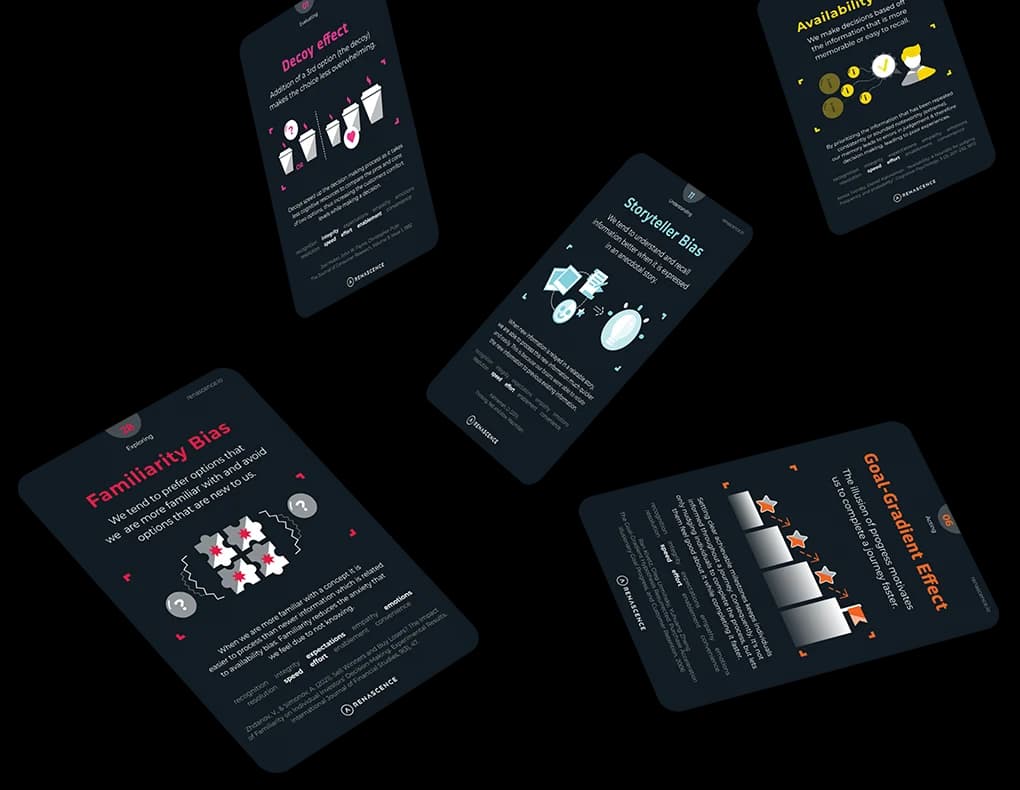
REBELDECK A · 36 FORCES

The forces that shape how humans experience the world.

Explore REBEL Reveal →
ALL PRODUCTS

Explore the full Renascence product ecosystem.

Browse products →

PLATFORMS

AI & TECHNOLOGY

LEARNING & FRAMEWORKS

CX TOOLKIT

Opinion

Insights, research, and conversations at the frontier of CX.

René Studio
AI EXPERIENCE STUDIO

Turn what you read into a journey you can score.

Explore René Studio
Mysterya
MYSTERY AUDITS, LIVE

See what customers really experience, visit by visit.

Explore Mysterya
ReadExperience JournalArticles & research on CX, behavior, and transformation.Watch & listenExperience LoomOur video podcast on CX & behavior.CuratedCX NewsIndustry news that matters in CX, minus the noise.

Latest articles

Latest episodes

Latest news

Hub

Free tools, templates, and resources to advance your CX practice.

René Studio
AI EXPERIENCE STUDIO

Design, score and fix customer journeys with AI.

Explore René Studio
Mysterya
MYSTERY AUDITS, LIVE

Every visit, every location, every score. Live.

Explore Mysterya
THE MANIFESTOBurn the Deck.
Ten Virtues. Zero Excuses.Start reading →
THE HUB

Every free tool, template and resource in one place.

Visit the Hub →

AI TOOLS

FREE TOOLS

LEARNING

CULTURE

AI · 29 November 2026

AI reliability: top models fail repeated-run tests in DeepMind study

Google DeepMind's 'Humanity's First Exam' tested 18 AI models and found leading systems struggle to repeat correct answers, with visual perception accounting for 73% of recorded errors.

Newsdesk
Curated briefing · 2 min read

What happened

Google DeepMind has used a benchmark it calls "Humanity's First Exam" to test the reliability of 18 AI models, and the results show a gap between peak capability and consistency. The leading systems solve nearly every task family at least once, but they struggle when required to repeat success. Even top models, including OpenAI's GPT-6.2 Astra, stumble when asked for 16 correct answers in a row.

According to reporting by The Decoder, visual perception accounts for 73 percent of the errors recorded. Allowing the models more compute time does not resolve the problem, the findings indicate.

The study places the emphasis on repeated runs rather than single attempts. That distinction matters for any organisation deploying these systems in workflows where the same task must be completed correctly every time.

Why it matters

Most AI evaluation headlines focus on the best score a model can reach. This work shifts attention to the distribution of outcomes. A model that succeeds once is not the same as one that can be relied upon across thousands of interactions, and for organisations embedding AI in service channels, claims handling or internal operations, that difference determines whether automation reduces effort or quietly generates rework.

The concentration of errors in visual perception also carries implications for digital transformation programmes that increasingly depend on reading documents, images and screens. Where those inputs feed customer-facing decisions, the reliability gap could surface as inconsistent experiences rather than obvious failures.

By the numbers

  • 18 AI models were tested for reliability under Google DeepMind's "Humanity's First Exam".
  • 16 consecutive correct answers was the bar set, and even leading models did not consistently meet it.
  • 73 percent of the errors recorded were attributed to visual perception.

The Renascence take

Reliability is the experience metric that most AI roadmaps leave out. Customers never see a model's best answer; they experience its worst one, repeated at scale.

The behavioural principle at work is consistency: people build trust from predictable outcomes, and one impressive response does little to offset a pattern of small, repeated failures. Operators should therefore measure AI against repeated-run success rates rather than peak benchmark scores, and design explicit recovery paths wherever visual inputs are involved. Treating extra compute as the fix is a costly distraction; the better investment is in testing, escalation routes and human checkpoints that catch the failures customers will actually notice.

Sources

This briefing was written by our Newsdesk, synthesising reporting from the outlets below. Follow the links for the original coverage.

FAQ

Questions we get on this topic

It is a benchmark Google DeepMind used to test the reliability of 18 AI models. The study focuses on whether models can repeat correct results, not just achieve a single high score.

Leading systems solved nearly every task family at least once but struggled to repeat success. Even top models, including OpenAI's GPT-6.2 Astra, did not consistently reach 16 correct answers in a row.

According to reporting by The Decoder, visual perception accounts for 73% of the errors recorded. Allowing models more compute time did not resolve the problem, the findings indicate.

Customers experience a model's worst answers repeated at scale, not its best. Measuring repeated-run success rates and designing recovery paths and human checkpoints can help catch failures customers would notice.

Stay ahead of CX

Get the signal, not the noise.

The stories shaping customer experience — plus the Journal and Experience Loom — in your inbox.