







About

The consultancy born at the intersection of behavioral economics and human experience.

René Studio
AI EXPERIENCE STUDIO

The CX design platform we built from a decade of client work.

Explore René Studio
Mysterya
MYSTERY AUDITS, LIVE

Mystery audits we run, scored live for every location.

Explore Mysterya
NOW HIRING

Join a team reshaping how the world experiences brands.

View open roles →

COMPANY

GROW WITH US

CONNECT

Services

Comprehensive CX and management consulting for enterprise brands.

René Studio
AI EXPERIENCE STUDIO

Every engagement, mapped and scored in one AI workspace.

Explore René Studio
Mysterya
MYSTERY AUDITS, LIVE

Mystery shopping, scored and evidenced in real time.

Explore Mysterya
ALL SERVICES

Explore the full range of CX & management consulting services.

Browse all services →

CORE

SPECIALIST

Solutions

Structured solutions that turn CX ambition into measurable outcomes.

René Studio
AI EXPERIENCE STUDIO

Map, score and fix the journeys we redesign, with AI.

Explore René Studio
Mysterya
MYSTERY AUDITS, LIVE

Check the experience you designed is delivered.

Explore Mysterya
ALL SOLUTIONS

Explore every CX solution we offer.

Browse solutions →

STRATEGY & GOVERNANCE

DESIGN & DELIVERY

CULTURE & EXPERIENCE

Industries

A decade of CX transformation across the region's defining sectors.

René Studio
AI EXPERIENCE STUDIO

Sector-ready journeys, scored by AI in minutes.

Explore René Studio
Mysterya
MYSTERY AUDITS, LIVE

Mystery audits tuned to your sector, scored live.

Explore Mysterya
ALL INDUSTRIES

See how we work across every sector.

Browse industries →

BUILT ENVIRONMENT

FINANCE & TECH

PEOPLE & MOBILITY

Products

Proprietary tools, platforms, and AI that power CX transformation.

René Studio
AI EXPERIENCE STUDIO

Design, score and fix customer journeys with AI.

Explore René Studio
Mysterya
MYSTERY AUDITS, LIVE

Audit every location and act on what you find.

Explore Mysterya
REBELDECK A · 36 FORCES

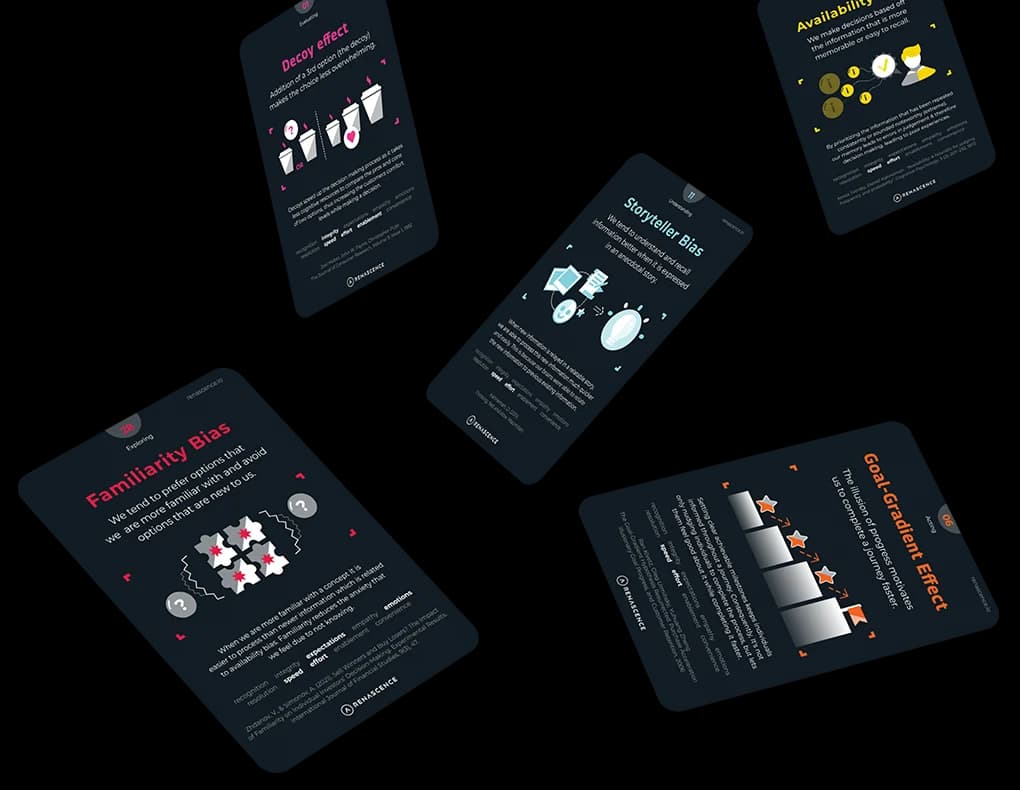
The forces that shape how humans experience the world.

Explore REBEL Reveal →
ALL PRODUCTS

Explore the full Renascence product ecosystem.

Browse products →

PLATFORMS

AI & TECHNOLOGY

LEARNING & FRAMEWORKS

CX TOOLKIT

Opinion

Insights, research, and conversations at the frontier of CX.

René Studio
AI EXPERIENCE STUDIO

Turn what you read into a journey you can score.

Explore René Studio
Mysterya
MYSTERY AUDITS, LIVE

See what customers really experience, visit by visit.

Explore Mysterya
ReadExperience JournalArticles & research on CX, behavior, and transformation.Watch & listenExperience LoomOur video podcast on CX & behavior.CuratedCX NewsIndustry news that matters in CX, minus the noise.

Latest articles

Latest episodes

Latest news

Hub

Free tools, templates, and resources to advance your CX practice.

René Studio
AI EXPERIENCE STUDIO

Design, score and fix customer journeys with AI.

Explore René Studio
Mysterya
MYSTERY AUDITS, LIVE

Every visit, every location, every score. Live.

Explore Mysterya
THE MANIFESTOBurn the Deck.
Ten Virtues. Zero Excuses.Start reading →
THE HUB

Every free tool, template and resource in one place.

Visit the Hub →

AI TOOLS

FREE TOOLS

LEARNING

CULTURE

AI · 21 November 2026

Anthropic mathematician claims Claude helped prove Riemann hypothesis

Levent Alpöge, a mathematician at Anthropic, claims he proved the Riemann hypothesis with Claude, according to The Verge. The claim has not yet been verified.

Newsdesk
Curated briefing · 2 min read

What happened

Levent Alpöge, a mathematician at Anthropic, claims he has proved the Riemann hypothesis with the help of Claude, the company's AI model. The Verge reports that the claim targets one of mathematics' most notoriously difficult problems, one that has resisted some of the world's leading mathematicians for decades and carries the status of a Millennium Prize problem.

The claim has not been verified. The reporting frames the result as a potential milestone for AI in mathematics only if it holds up under scrutiny, and it treats the announcement as an assertion that still needs independent checking rather than an established fact.

Why it matters

Whatever the outcome, the story shows how quickly AI systems are being pointed at problems that require long chains of formal reasoning. For organisations, the more immediate lesson is about the gap between a capability claim and proof of that capability. A striking result travels fast, but its credibility depends on whether others can inspect the reasoning, reproduce it and test it against known standards.

That gap matters well beyond mathematics. Leaders deploying AI in research, operations or customer-facing services face the same question: how do people know when an AI output can be trusted? The answer shapes adoption, internal sign-off processes and, ultimately, how much confidence users place in the systems they rely on.

The Renascence take

Most coverage will focus on whether Claude solved the problem. The more useful question is what happens next, and whether the result can be checked by people other than its author. In experience terms, trust is built through verifiability, not through headline claims, and the same principle applies to any AI product that asks users to take its answers on faith.

The real story here is the verification gap, not the headline. Trust in AI output is earned when people can see the working, test it and challenge it, so the design question is how to make checking easy rather than assuming it will happen. Customer-obsessed operators should treat auditability as part of the product experience: surface the reasoning, show the evidence and build review steps into the workflow before a bold claim reaches the market. If the claim holds, that scrutiny will have been the reason it was believed.

Sources

This briefing was written by our Newsdesk, synthesising reporting from the outlets below. Follow the links for the original coverage.

FAQ

Questions we get on this topic

Levent Alpöge, a mathematician at Anthropic, claims he has proved the Riemann hypothesis with the help of Claude, the company's AI model, according to reporting by The Verge.

No. The claim has not been verified, and the reporting treats it as an assertion that still needs independent checking.

It is one of mathematics' most notoriously difficult problems and carries Millennium Prize problem status. It has resisted some of the world's leading mathematicians for decades.

A striking result's credibility depends on whether others can inspect the reasoning, reproduce it and test it against known standards, rather than on the claim alone.

Stay ahead of CX

Get the signal, not the noise.

The stories shaping customer experience — plus the Journal and Experience Loom — in your inbox.