About

The consultancy born at the intersection of behavioral economics and human experience.

RENÉ STUDIO

The CX design platform we built from a decade of client work.

Open rene.cx ↗
NOW HIRING

Join a team reshaping how the world experiences brands.

View open roles →

COMPANY

GROW WITH US

CONNECT

Services

Comprehensive CX and management consulting for enterprise brands.

RENÉ STUDIO

Every engagement, mapped and scored in one AI workspace.

Open rene.cx ↗
ALL SERVICES

Explore the full range of CX & management consulting services.

Browse all services →

CORE

SPECIALIST

Solutions

Structured solutions that turn CX ambition into measurable outcomes.

RENÉ STUDIO

Map, score and fix the journeys we redesign, with AI.

Open rene.cx ↗
ALL SOLUTIONS

Explore every CX solution we offer.

Browse solutions →

STRATEGY & GOVERNANCE

DESIGN & DELIVERY

CULTURE & EXPERIENCE

Industries

A decade of CX transformation across the region's defining sectors.

RENÉ STUDIO

Sector-ready journeys, scored by AI in minutes.

Open rene.cx ↗
ALL INDUSTRIES

See how we work across every sector.

Browse industries →

BUILT ENVIRONMENT

FINANCE & TECH

PEOPLE & MOBILITY

Products

Proprietary tools, platforms, and AI that power CX transformation.

RENÉ STUDIO

Design, score and fix customer journeys with AI.

Open rene.cx ↗
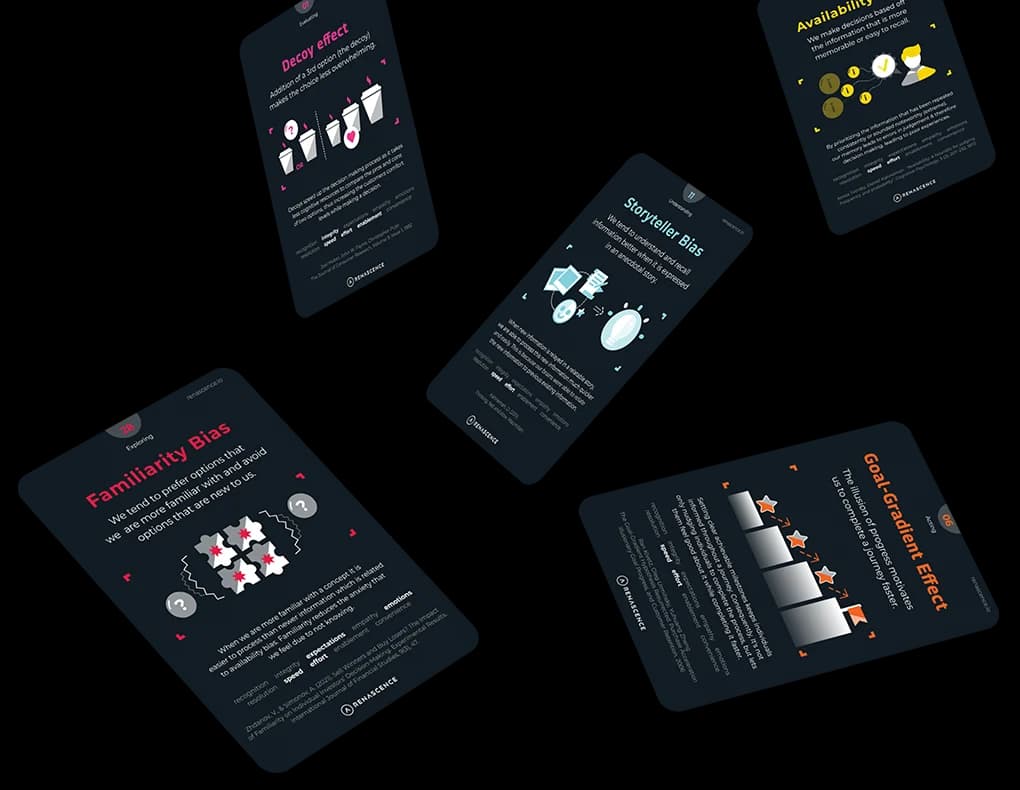
REBELDECK A · 36 FORCES

The forces that shape how humans experience the world.

Explore REBEL Reveal →
ALL PRODUCTS

Explore the full Renascence product ecosystem.

Browse products →

AI & TECHNOLOGY

LEARNING & GAMES

PLATFORMS & TOOLS

CX TOOLKIT

Opinion

Insights, research, and conversations at the frontier of CX.

RENÉ STUDIO

Turn what you read into a journey you can score.

Open rene.cx ↗
ReadExperience JournalArticles & research on CX, behavior, and transformation.Watch & listenExperience LoomOur video podcast on CX & behavior.CuratedCX NewsIndustry news that matters in CX, minus the noise.

Latest articles

Latest episodes

Latest news

Hub

Free tools, templates, and resources to advance your CX practice.

RENÉ STUDIO

Design, score and fix customer journeys with AI.

Open rene.cx ↗
THE MANIFESTOBurn the Deck.
Ten Virtues. Zero Excuses.Start reading →
THE HUB

Every free tool, template and resource in one place.

Visit the Hub →

AI TOOLS

FREE TOOLS

LEARNING

CULTURE

AI · 14 October 2026

Cheap Chinese, open-source LLMs may force AI infrastructure reset

Jefferies warns that falling token prices driven by cheap Chinese and open-source LLMs could undermine the economics behind trillions in AI infrastructure investment.

Newsdesk
Curated briefing · 2 min read

What happened

Financial services firm Jefferies has raised doubts about the long-term profitability of large language models, pointing to what it describes as an ongoing collapse in token pricing. According to reporting by The Register, the bank's analysts suggest that the rapid emergence of cheap Chinese and open-source LLMs is putting sustained downward pressure on the cost of running AI inference, raising questions about whether current levels of capital spending on AI infrastructure can be justified.

The note reportedly frames this as a potential trigger for a broader "reset" in AI infrastructure investment, given the scale of capital — running into the trillions of dollars globally — that has been committed to data centres, chips and compute capacity on the assumption that demand for proprietary, premium-priced AI models would remain strong and high-margin.

Why it matters

The story matters because it strikes at the economic assumptions underpinning the current AI infrastructure build-out. If token pricing keeps falling as open-source and lower-cost Chinese models close the capability gap with Western frontier models, the commercial case for some of the enormous capital expenditure committed by hyperscalers and chipmakers becomes harder to sustain at current trajectories. That has direct implications for how quickly, and on what terms, enterprises and public-sector bodies can expect access to affordable AI capacity for digital transformation programmes.

For leaders planning AI-enabled services, the signal is that the underlying unit economics of AI are shifting fast, and cost assumptions baked into multi-year transformation business cases may need revisiting well before those programmes conclude.

The Renascence take

Much of the commentary around this story will focus on winners and losers in the infrastructure race — who overbuilt, whose margins compress, whose capex gets stranded. The more useful lens for operators is what falling token prices actually unlock on the demand side.

A collapse in token pricing is not just a supply-chain or investor story — it is a behavioural one. When the marginal cost of an AI interaction falls towards zero, organisations stop rationing AI use and start embedding it everywhere: every customer query, every internal workflow, every edge case. That changes the experience design brief entirely, from "where can we justify AI" to "where should a human still be the default." Operators who treat this purely as an infrastructure or procurement question will miss the real work, which is redesigning service journeys and governance for a world where AI assistance is cheap, constant and easy to overuse.

Sources

This briefing was written by our Newsdesk, synthesising reporting from the outlets below. Follow the links for the original coverage.

FAQ

Questions we get on this topic

Jefferies argues that falling token pricing, driven by cheap Chinese and open-source LLMs, could undermine the profitability case for the trillions of dollars committed to AI data centres, chips and compute capacity.

Much of the current AI capex assumes sustained high-margin demand for proprietary, premium-priced models; if token costs keep dropping as cheaper alternatives close the capability gap, that economic assumption becomes harder to justify.

Organisations planning multi-year AI-enabled transformation programmes may need to revisit cost assumptions, since unit economics for AI inference are shifting faster than many business cases anticipated.

As the marginal cost of AI interactions falls, organisations are likely to embed AI into far more touchpoints, shifting the design question from justifying AI use to deciding where humans should remain the default.

Stay ahead of CX

Get the signal, not the noise.

The stories shaping customer experience — plus the Journal and Experience Loom — in your inbox.