








Customer Experience · July 11, 2026
Why a Customer Experience Strategy Is No Longer Optional
Treating CX as a department rather than a strategy is not a conservative choice — it is a slow bleed. Here is why enterprise-wide CX is now the baseline for commercial survival.

Most organisations still treat customer experience as a department. A team that handles complaints, runs surveys, and reports NPS to the board once a quarter. That framing is not just limiting — it is actively expensive. The companies that have moved CX from function to strategy are not doing so out of idealism. They are doing so because the economics have become impossible to ignore.
The central argument of this article is simple: a deliberate, enterprise-wide customer experience strategy is no longer a differentiator — it is the baseline condition for sustainable commercial performance. Organisations that treat it as optional are not choosing a conservative path; they are choosing a slow bleed. This holds across sectors, and it holds with particular force in the relationship-intensive markets of the MENA region, where trust is currency and word-of-mouth travels fast.
What Has Actually Changed — and Why Now?
The shift is not about technology, though technology accelerates it. It is about the collapse of the information asymmetry that once protected mediocre experiences. For most of the twentieth century, a customer who had a bad experience with a bank, a telecoms provider, or a property developer had limited options: absorb it, complain to a call centre, or leave. The cost of switching was high, alternatives were opaque, and the bad experience rarely travelled beyond a dinner-party conversation.
None of that is true now. Switching costs have fallen across almost every category. Comparison is instantaneous. And a single poor interaction — a tone-deaf automated response, a billing dispute handled badly, an onboarding process that requires the customer to repeat themselves four times — can be documented, shared, and amplified before the customer has left the building. The structural protection that allowed organisations to deprioritise experience has gone.
What has replaced it is a market in which the experience is the product. Not a wrapper around it. Not a support function behind it. The experience itself — how it feels to buy, to use, to get help, to renew — is what customers are actually evaluating, remembering, and recommending or warning against.
Why Most CX Efforts Fail Before They Start
The failure mode is almost always the same, and it is structural rather than executional. An organisation recognises that its NPS is declining or its churn is rising. It hires a CX director, commissions a journey map, and launches a voice-of-customer programme. Eighteen months later, the scores have moved marginally, the CX director is frustrated, and the board is questioning the investment.
The diagnosis is usually not that the tools were wrong. It is that the effort was never connected to strategy. The journey map sat in a PowerPoint. The VoC data fed a dashboard that nobody actioned. The CX director had influence but no authority over the product, the operations, or the technology decisions that actually shape the experience.
"A CX strategy without governance is a mood board. It describes an aspiration without creating the conditions for it to happen."
This is the distinction that separates organisations that improve at CX from those that merely talk about it. A genuine customer experience transformation requires three things that most CX programmes lack: executive ownership at the level where trade-offs are actually made, a clear link between experience investments and commercial outcomes, and the organisational authority to change the processes and systems that create bad experiences in the first place.
The Behavioral Economics of Why Experience Outweighs Product
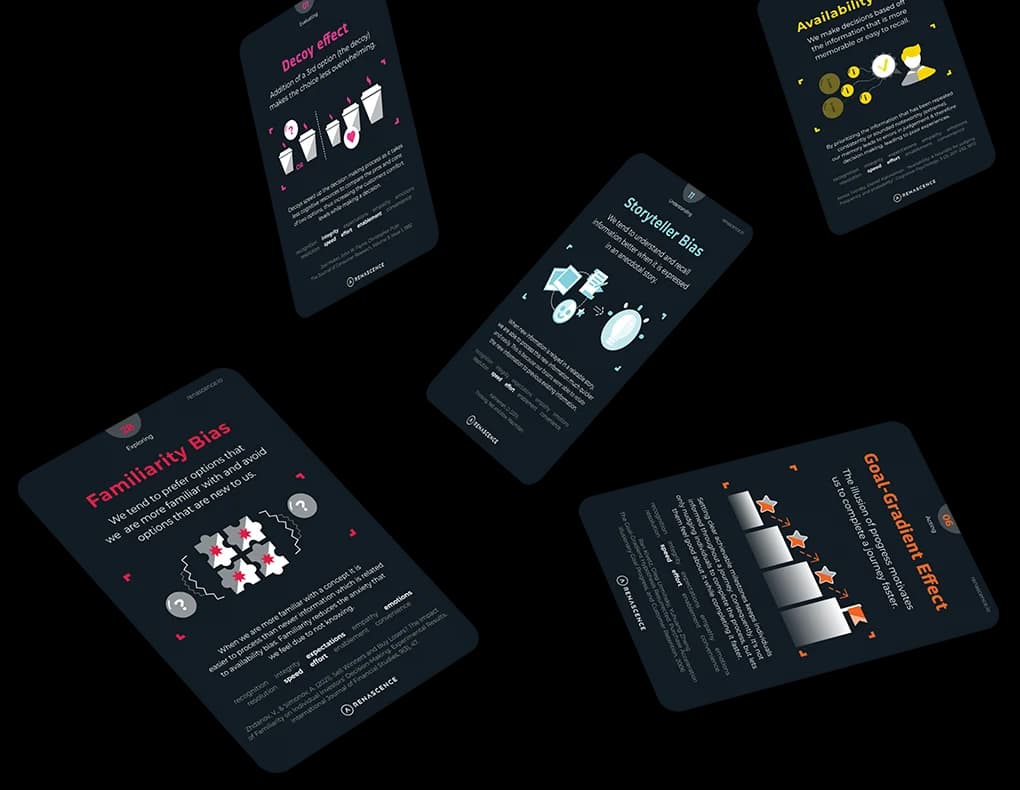
There is a reason customers remember how they were treated more vividly than what they were sold. Daniel Kahneman's peak-end rule — one of the most replicated findings in behavioral economics — holds that people evaluate an experience not as an average of all its moments, but based on its most intense point (the peak, positive or negative) and how it ended. The rational product features that took eighteen months to engineer are largely irrelevant to the memory the customer carries away.
This has a direct strategic implication. If you do not actively design the peak moments and the endings of your customer journeys, you are leaving the most powerful determinants of loyalty and advocacy to chance. A property developer who delivers a technically excellent apartment but fumbles the handover creates a negative peak that colours the entire relationship. A bank that resolves a disputed transaction quickly and with genuine empathy creates a positive peak that can outlast years of routine interactions.
The second behavioral mechanism worth naming here is loss aversion. Kahneman and Tversky's foundational work established that losses loom roughly twice as large as equivalent gains in human psychology. In CX terms, this means a single bad experience does disproportionate damage relative to the uplift from a good one. The asymmetry is not fair, but it is real, and it argues strongly for a strategy that prioritises the elimination of negative peaks before it optimises for positive ones. Fix the failures first; then engineer the memorable moments.
B2B Customer Experience: The Underestimated Frontier
The CX conversation has historically centred on consumer markets, where the emotional texture of experience is obvious and the feedback loops are short. B2B customer experience has received less attention, and the gap between what B2B organisations believe they deliver and what their clients actually experience tends to be wider as a result.
The dynamics in B2B are different but not less consequential. Relationships are longer, contracts are larger, and the cost of losing a key account is substantial. But the experience is also more complex: multiple stakeholders, extended procurement processes, implementation phases, ongoing account management, and renewal cycles — each of which is a touchpoint that either builds or erodes the relationship. A B2B client who feels their account manager has gone quiet six months after contract signature is experiencing a CX failure, even if the product is performing perfectly.
The behavioral mechanisms are the same. The goal-gradient effect — the tendency to increase effort and engagement as a goal approaches — means B2B clients are most attentive and most emotionally invested during onboarding and at renewal. These are the moments that disproportionately shape their perception of the relationship. A B2B CX strategy that does not deliberately engineer these moments is missing its highest-leverage opportunities.
For organisations operating in sectors like banking and financial services, where B2B relationships involve significant trust and regulatory complexity, the stakes are even higher. The experience of a corporate treasury client is shaped not just by the product but by the quality of every interaction — from the onboarding documentation to the responsiveness of the relationship manager to the clarity of the quarterly review.
What a Real CX Strategy Actually Contains
A CX strategy is not a set of service standards, a journey map, or a satisfaction survey programme. Those are tools. A strategy is a set of deliberate choices about where to compete on experience, how to allocate resources to deliver it, and how to measure whether it is working.
In practice, a robust CX strategy addresses five interconnected questions:
- What experience are we promising? The articulation of an experience promise — specific, distinctive, and connected to the brand — that every function can orient around. Not "we will be customer-centric" but "we will make every client feel that their time is respected and their problem is genuinely understood."
- Where do we focus? A journey-level prioritisation of the moments that matter most to customers and that have the greatest commercial impact. Not every touchpoint deserves equal investment.
- What do we need to change? An honest assessment of the processes, systems, policies, and behaviours that currently undermine the promised experience — and a plan to change them, not just to measure them.
- How do we govern it? The ownership structures, decision rights, and accountability mechanisms that ensure CX commitments are honoured when they conflict with short-term cost or efficiency pressures. A CX governance framework is not bureaucracy — it is the mechanism by which strategy survives contact with the organisation.
- How do we know it is working? A measurement architecture that connects experience metrics to commercial outcomes — not just NPS in isolation, but the link between experience quality, retention, share of wallet, and lifetime value.
The Role of CX Strategy Consulting
There is a legitimate question about when an organisation needs external support for CX strategy work, and when it can and should build the capability internally. The honest answer is that both are necessary, and they serve different purposes.
Internal teams carry irreplaceable institutional knowledge — they understand the politics, the history of past initiatives, and the practical constraints that an outsider will miss. But internal teams also carry the cognitive biases that come with proximity. They have normalised the friction their customers experience. They have absorbed the organisational logic that produces bad experiences and stopped questioning it. The affect heuristic — the tendency to evaluate a situation based on how we feel about it rather than its objective characteristics — means that people who built a process are rarely the best judges of whether it is working for customers.
Effective CX strategy consulting is most valuable at the diagnostic and design phases: bringing an external lens to the gap between the experience the organisation believes it delivers and the experience customers actually have, and then helping to design the strategy and governance structures that close that gap. The implementation — the cultural change, the capability building, the sustained measurement — requires internal ownership to succeed.
This is why the most productive consulting relationships in CX are not ones where the consultant delivers a strategy and leaves. They are ones where the consultant builds the client's capacity to own and evolve the strategy independently. Building internal CX capability is not a nice-to-have at the end of an engagement — it is the condition under which the strategy survives.
Why Employee Experience Is the Upstream Variable
No CX strategy survives a workforce that is disengaged, undertrained, or operating within systems that make it structurally impossible to serve customers well. This is not a motivational claim — it is an operational one. The front-line employee who is handling a customer complaint is working with the information, the authority, and the tools their organisation has given them. If those are inadequate, the customer experience will be inadequate regardless of how well-intentioned the employee is.
The implication for CX strategy is that employee experience is not a parallel workstream — it is a prerequisite. The organisations that consistently deliver strong customer experiences have typically made deliberate investments in clarity of role, quality of tools, and the psychological safety to make decisions in the customer's interest without fear of reprimand. They have also aligned incentives: if front-line staff are measured and rewarded purely on speed and volume, they will optimise for speed and volume, not for the quality of the interaction.
"The customer experience is the sum of every employee decision made under pressure. Strategy that ignores the conditions under which those decisions are made is not a strategy — it is a wish."
The MENA Context: Why the Stakes Are Higher Here
The MENA region presents a specific set of conditions that make CX strategy both more consequential and more complex than in many other markets. Relationship orientation is high — personal trust and referral networks carry significant commercial weight, and a damaged relationship with one client can affect access to an entire network. The diversity of customer expectations across nationalities, languages, and cultural norms within a single market like the UAE or Saudi Arabia demands a level of experience personalisation that many organisations have not yet built.
At the same time, the pace of digital adoption in the region has been rapid, and customer expectations have risen accordingly. A government service that was acceptable in a paper-based format becomes a source of frustration the moment a comparable digital experience exists elsewhere. The reference point shifts, and with it, the threshold for what constitutes an acceptable experience.
For sectors like real estate, where transactions are high-value, emotionally charged, and infrequent, the CX stakes are particularly acute. A buyer who has a poor experience during a property purchase is unlikely to return and highly likely to share that experience. The margin for error is narrow, and the cost of a poor experience — measured in lost referrals and damaged reputation — is disproportionate to whatever was saved by cutting corners on service design.
From Strategy to Execution: The Implementation Gap
The most common failure point in CX transformation is not the strategy itself — it is the distance between the strategy document and the daily decisions of the people who deliver the experience. This is the implementation gap, and closing it requires more than communication. It requires the redesign of the systems, processes, and incentives that shape behaviour at every level of the organisation.
A practical approach to closing the gap involves four stages:
- Diagnose with precision. Use a CX maturity assessment to establish where the organisation genuinely is — not where leadership believes it is. The gap between these two is almost always larger than expected, and it needs to be quantified before it can be addressed.
- Design for the moments that matter. Identify the three to five journey moments that have the greatest impact on customer perception and commercial outcomes. Redesign these deliberately, using service design methods and behavioral economics principles, before attempting to improve the full journey.
- Build the governance infrastructure. Establish the ownership, decision rights, and accountability mechanisms that will sustain the strategy through the inevitable organisational pressures to revert. Without governance, every CX improvement is temporary.
- Measure what moves the business. Connect experience metrics to commercial outcomes — retention rates, share of wallet, referral rates, cost to serve. NPS alone is not a business case; the link between NPS and revenue is the business case.
The sequencing matters. Organisations that attempt to improve the full customer journey simultaneously, without prioritising the highest-impact moments and without governance structures in place, consistently underdeliver. Breadth without depth is the enemy of CX progress.
The Organisations That Get This Right
What distinguishes the organisations that consistently deliver strong customer experiences is not that they have more resources or more sophisticated technology. It is that they have made a genuine strategic choice to compete on experience — and then built the organisational conditions to honour that choice.
That choice manifests in specific, observable ways: a CEO who treats a significant drop in customer satisfaction with the same urgency as a revenue miss; a product team that includes the customer journey in every design decision, not as an afterthought; a finance function that can model the commercial value of reducing churn by a percentage point and therefore makes the case for CX investment in the language the board understands.
It also manifests in the willingness to manage the organisational change that genuine CX improvement requires. Processes that create bad experiences exist because they were designed to optimise something else — cost, speed, compliance, internal convenience. Changing them requires confronting those trade-offs explicitly, and that is uncomfortable. The organisations that improve at CX are the ones that are willing to have that discomfort rather than paper over it with a new survey tool.
The question for any senior leader reading this is not whether customer experience matters to their organisation. It does — demonstrably, commercially, and increasingly urgently. The question is whether their organisation has made the deliberate choices — about focus, governance, investment, and accountability — that turn that acknowledgement into a strategy. Acknowledgement without architecture is just aspiration. And aspiration, as any CX practitioner will tell you, does not survive the next quarterly review.
If you are ready to move from aspiration to architecture, speak with the Renascence team about where your organisation is and what a credible path forward looks like.
Further reading
FAQ
Questions we get on this topic
Related reading



Stay ahead of CX
Get the Journal in your inbox.
Insights, frameworks and event round-ups from the Renascence team. No spam, ever.