








Customer Experience · July 24, 2026
The Link Between Solutions and Customer Experience
Most CX programmes stall not because the diagnosis is wrong, but because the solution is disconnected from it. Here's why that gap exists and how to close it.

Most CX programmes stall not because the diagnosis is wrong, but because the solution is disconnected from it. Teams invest months mapping journeys, scoring touchpoints, and surfacing pain points — then hand the findings to a project manager who converts them into a generic backlog of "improvements." The link between what the research reveals and what actually gets built is severed at the handoff. That gap is where customer experience goes to die.
The argument here is simple and uncomfortable: a solution that cannot be traced back to a specific moment in the customer journey is not a CX solution. It is an operational change with a CX label on it. The distinction matters enormously, because one compounds over time and the other merely consumes budget.
Why the Word "Solution" Deserves More Rigour
In most organisations, "solution" is used loosely — a new chatbot, a revised complaints process, a loyalty tier restructure. Each of these might improve something. None of them is automatically a CX solution unless it is designed to resolve a specific, evidenced failure in the customer's experience at a defined point in their journey.
A genuine CX solution has three properties. First, it is anchored to a moment: a specific touchpoint or stage where a measurable gap exists between what the customer expects and what they receive. Second, it is designed around the customer's job-to-be-done at that moment — not the organisation's operational convenience. Third, its success can be evaluated against the experience it was meant to repair, not just against a process metric that sits upstream of the customer.
Without all three, you are optimising a system, not an experience. Systems optimisation has its place. But it should not be mistaken for customer experience management, and it should not be funded from a CX budget.
The Behavioural Economics of Why Solutions Miss
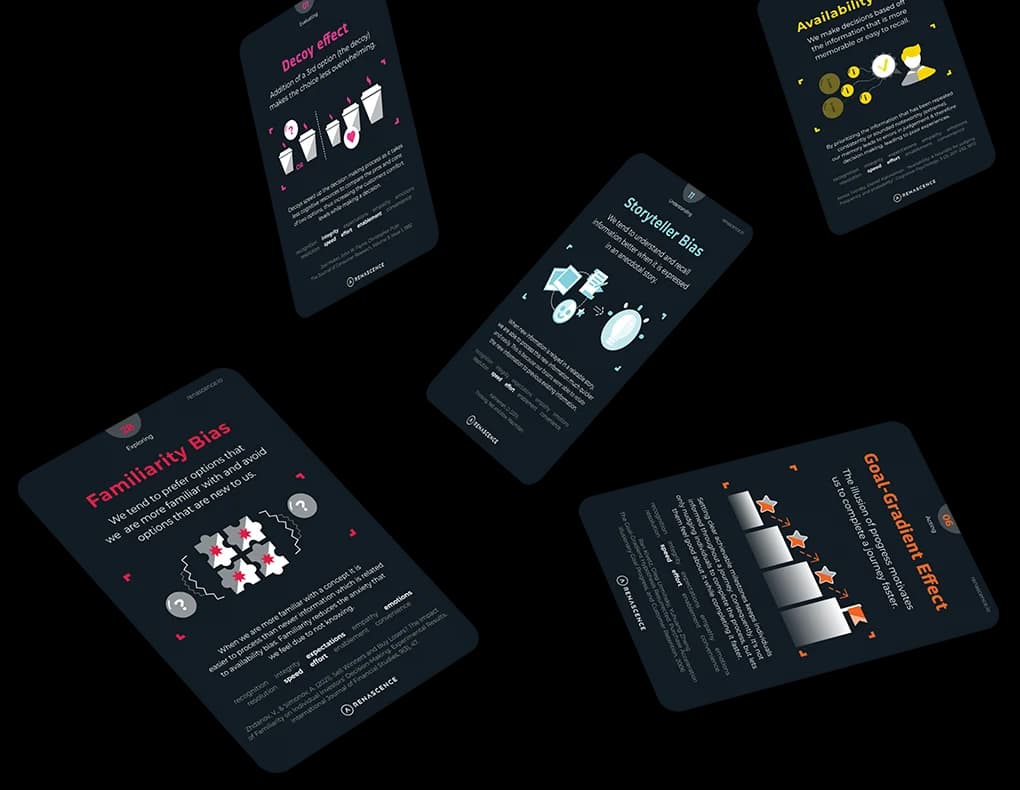
There is a behavioural explanation for why organisations consistently deploy solutions that do not move the experience needle. It is rooted in what Daniel Kahneman identified as the peak-end rule: people do not evaluate an experience as an average of all its moments. They remember it by its emotional peak — positive or negative — and by how it ended. This means that a solution targeting a low-salience touchpoint, however technically sound, will have almost no effect on how customers feel about the brand.
Organisations, meanwhile, tend to fix what is easiest to measure — call handling time, first-contact resolution rates, digital drop-off percentages. These are real problems, but they are not necessarily the moments that shape memory. A bank that reduces its mortgage application processing time by two days has solved an operational problem. If the customer's peak-negative moment was the condescending tone of the relationship manager at the initial meeting, the faster processing changes nothing about how they remember the experience — or whether they recommend the bank to a colleague.
The implication is that solution prioritisation must be driven by emotional salience, not operational convenience. The question is not "what can we fix?" but "what, if fixed, would most change how customers feel and what they remember?"
How Journey Mapping Creates the Architecture for Solutions
A journey map is only as valuable as the decisions it enables. Too many maps end up as workshop artefacts — visually compelling, intellectually satisfying, operationally inert. The reason is that they are built to describe the experience, not to generate solutions from it.
A map that is built for solutions looks different. Each touchpoint carries not just an emotion rating but a structured articulation of the customer's job-to-be-done, the friction encountered, and the gap between expectation and delivery. This structure makes it possible to move directly from diagnosis to design: the touchpoint data tells you what kind of solution is needed, not just that something is wrong.
Consider a retail banking customer journey through the account-opening process. A standard map might note that customers feel frustrated at the document submission stage. A solution-ready map goes further: it records that the customer's job at that moment is to feel confident their application is progressing, that the friction is the absence of any acknowledgement after submission, and that the expectation — shaped by every other digital service they use — is real-time status visibility. The solution that follows from that framing is not "simplify the document checklist." It is "build a status tracker with proactive updates." These are different interventions, and only one addresses the actual experience failure.
This is why structured journey mapping is the upstream architecture for every solution worth deploying. Without it, solution design is guesswork dressed up as strategy.
The Taxonomy of CX Solutions: Not All Fixes Are Equal
One of the most practical things a CX team can do is establish a working taxonomy of solution types — not to bureaucratise the process, but to ensure that the full range of interventions is considered, rather than defaulting to the ones that are easiest to implement.
Solutions in a mature CX programme typically fall across several categories:
- Behavioural solutions — interventions that change how staff or customers behave at a specific moment, without changing the underlying system. A scripted empathy prompt at the point of complaint resolution. A default opt-in to a follow-up call after a complex transaction. These are fast to deploy and often disproportionately effective because they target the emotional layer directly.
- Process solutions — redesigns of the steps a customer or employee must take to complete a task. Reducing the number of form fields. Eliminating a redundant approval stage. These address friction in the cognitive-effort sense — what Richard Thaler calls sludge: unnecessary complexity that erodes trust and goodwill even when the outcome is positive.
- Technological solutions — automation, AI-assisted interactions, digital self-service, and digital transformation initiatives. These can dramatically improve consistency and speed, but they carry a specific risk: they are the category most likely to be deployed for operational efficiency rather than experience improvement, and the two are not the same.
- Environmental solutions — changes to the physical or digital environment in which the experience occurs. Wayfinding in a hospital. The layout of a bank branch. The visual hierarchy of a checkout page. Often underestimated, because they operate on System 1 — the automatic, intuitive processing that shapes perception before conscious evaluation begins.
- Social solutions — interventions that use the presence and behaviour of other people to shape the experience. Staff who visibly enjoy their work. Peer reviews surfaced at the point of purchase hesitation. Community features that make customers feel part of something larger than a transaction.
- Ritual solutions — designed signature moments that create disproportionate memory. A handwritten note with a first delivery. A specific phrase used at the close of every service interaction. These are the solutions that generate the emotional peaks the peak-end rule rewards.
The organisations that consistently deliver superior customer experience are not those that deploy the most solutions. They are those that deploy the right type of solution for each specific moment of failure — and that understand why each type works at the level of human psychology, not just process logic.
The Employee Experience Connection Is Not Optional
Any honest account of CX solutions has to address the employee experience dimension, because the two are structurally linked in a way that most solution frameworks ignore. A solution deployed into a broken employee experience will degrade over time. This is not a motivational observation — it is a systems one.
When a frontline employee lacks the authority to resolve a complaint, no amount of empathy training will produce a good customer outcome. When a call centre agent is evaluated on handle time rather than resolution quality, the behavioural incentives actively undermine the experience the organisation is trying to create. The solution, in both cases, is not a CX intervention — it is an employee experience intervention that enables the CX outcome.
The practical implication is that solution design must include an upstream check: does the employee have the tools, authority, information, and incentive to deliver this solution consistently? If not, the solution design is incomplete, regardless of how well it performs in a pilot. Pilots succeed partly because they are supervised. Scaled deployment succeeds only if the employee experience supports it.
A CX solution that depends on heroic individual effort is not a solution. It is a temporary workaround waiting to fail at scale.
Measurement: Connecting Solutions to Outcomes, Not Activities
The measurement problem in CX is well documented. Organisations track NPS, CSAT, and CES at the programme level, then struggle to connect movements in those scores to specific interventions. The result is that good solutions are not recognised, bad ones are not retired, and the CX function cannot demonstrate its contribution to business outcomes with any precision.
The fix is not a better dashboard. It is a different measurement architecture — one that connects each solution to the specific touchpoint it was designed to improve, and tracks the experience metric at that touchpoint before and after deployment. This requires Voice of Customer measurement at the touchpoint level, not just at the relationship level, and it requires that solutions be tagged to the journey stage they address so that attribution is possible.
This is also where customer experience analytics and cx measurement tools earn their keep — not as reporting layers on top of a programme, but as the mechanism by which solution effectiveness is evaluated in near-real time. The question every CX solution should be able to answer is: did this change move the experience score at the moment it was designed to address? If the measurement architecture cannot answer that question, the programme is flying blind.
For organisations that want to quantify the business case before committing to a solution portfolio, the CX ROI Calculator provides a structured way to model the relationship between experience improvement and financial outcomes — useful both for prioritisation and for securing investment.
Automation and AI: Powerful Tools, Narrow Mandate
Automation and AI are reshaping what is possible in customer experience delivery, and the pace of change in 2026 makes it easy to overstate their role. The honest position is this: automation in CX is excellent at eliminating friction in high-volume, low-complexity interactions. It is poor at managing the emotional peaks that determine how customers remember an experience.
An AI-powered service agent that resolves a billing query in thirty seconds is a genuine improvement over a fifteen-minute hold queue. But if the customer's peak-negative moment is the feeling that their complaint was not taken seriously by a human being, the AI agent does not address that moment — it may even deepen it. The solution architecture must be honest about where automation helps and where it substitutes the wrong thing for the right one.
The more sophisticated use of AI in customer experience is not in front-line delivery but in solution design and prioritisation: using machine learning to identify which touchpoints are generating the most emotional volatility, which customer segments are most at risk of churn, and which interventions have the highest predicted impact. This is where AI earns its place in a CX programme — as an analytical capability that sharpens solution selection, not as a replacement for the human judgment that solution design requires.
Building a Solution Roadmap That Actually Holds
A solution without a roadmap is an idea. A roadmap without accountability is a slide deck. The gap between a well-designed solution and a delivered improvement is almost always an execution problem, not a design one — and execution problems in CX are almost always governance problems in disguise.
A solution roadmap that holds has four characteristics. It is sequenced by customer impact, not by implementation ease — the hardest-to-fix, highest-salience moments come first, not last. It assigns ownership at the individual level, not the team level, because shared ownership is a reliable mechanism for inaction. It includes a clear definition of success at the touchpoint level, so there is no ambiguity about whether the solution has worked. And it distinguishes between current-state solutions — fixes to the experience as it exists today — and future-state solutions that require capability building before they can be deployed.
This is the architecture that CX implementation roadmaps are designed to provide: not a list of projects, but a sequenced, owned, measurable plan that connects each initiative to the experience outcome it is meant to produce.
The Trust Dimension: Solutions as Signals
There is a dimension of CX solutions that rarely appears in frameworks but that customers feel acutely: whether the solution signals that the organisation is paying attention, or whether it signals that the organisation is managing its own operational risk.
Trust in customer experience is built through solutions that are visibly designed for the customer's benefit. When a bank proactively alerts a customer to an unusual transaction before the customer notices it, that is a trust signal. When the same bank adds a friction-heavy authentication step to protect itself from fraud liability, that is a trust cost — even if the underlying intent is protective. The customer cannot see the intent. They can only see the experience.
This is why behavioural economics belongs at the centre of solution design, not at the periphery. The question is not only "does this solution fix the problem?" but "what does this solution communicate to the customer about how we think about them?" Solutions that reduce friction, anticipate needs, and resolve problems before they are raised communicate something fundamentally different from solutions that add steps, require justification, or shift effort onto the customer. Both might be technically effective. Only one builds the kind of relationship that generates advocacy and long-term loyalty.
The organisations that understand this design their solutions with the customer's interpretation in mind, not just the operational outcome. They ask: when a customer encounters this change, what will they conclude about us? That question is not soft. It is the most commercially precise question in CX strategy.
From Insight to Impact: The Discipline That Separates Leaders
The difference between CX programmes that move metrics and those that generate reports is, in the end, a discipline question. It is the discipline to insist that every solution traces back to a specific moment of failure. To refuse to fund an intervention that cannot articulate which customer emotion it is designed to address. To measure at the touchpoint level rather than the programme level. To treat the employee experience as a prerequisite, not an afterthought. To use automation where it genuinely reduces friction and resist it where it substitutes efficiency for empathy.
None of this is technically complex. All of it requires organisational will — the kind that comes from leaders who understand that improving customer experience is not a campaign or a quarter's initiative, but a continuous, structured discipline of connecting what customers feel to what the organisation does about it.
The link between solutions and customer experience is, at its core, a link between evidence and action. Organisations that maintain that link, rigorously and consistently, do not just improve their scores. They build the kind of trust that competitors cannot replicate by copying a feature or matching a price. That is the durable competitive advantage that CX, done properly, was always capable of delivering.
Further reading
FAQ
Questions we get on this topic
Related reading


Stay ahead of CX
Get the Journal in your inbox.
Insights, frameworks and event round-ups from the Renascence team. No spam, ever.