
Customer Crisis Management · August 16, 2026
Designing Rewards That Actually Change Customer Behavior
Most loyalty rewards subsidise habits customers already had. Here's how goal-gradient design and behavioral architecture turn rewards into real behavior change.

A car wash in New Jersey once ran an experiment without knowing it was behavioral economics. Some customers got a stamp card requiring eight washes for a free one. Others got a card requiring ten washes for the same free wash — except their card arrived with two stamps already filled in. Same effort. Same reward. Wildly different outcomes. The researchers who later studied this, Ran Kivetz, Oleg Urminsky and Yuhuang Zheng, found that customers who started with a head start finished nearly twice as fast as those who started from zero, even though the maths were identical.
That single finding, published in 2006 in the Journal of Marketing Research under the title "The Goal-Gradient Hypothesis Resurrected," explains more about loyalty programme failure than most loyalty consultants will admit. Rewards do not change behaviour because they are generous. They change behaviour because of how they are architected — how progress is framed, how loss is threatened, how uncertainty is used, and how quickly a customer can feel the reward is nearly theirs. Get the architecture wrong and you can give away margin for years without shifting a single habit.
Why do most loyalty rewards fail to change behavior?
Most loyalty rewards fail because they subsidise behaviour that was already happening rather than creating new behaviour. A frequent flyer earns miles for a route they always flew. A supermarket shopper collects points at the store nearest their home. The programme becomes an accounting exercise — refunding customers a small percentage of spend they were going to make regardless — rather than a lever that moves the next decision.
This is the single most common design flaw Renascence sees in loyalty programme audits: the reward schedule tracks revenue instead of targeting a decision. A points system that pays out identically whether a customer buys weekly or annually is not a behavioural tool. It is a discount with better branding. The fix starts with a blunt question rarely asked in the design room: which specific behaviour, by which specific segment, are we trying to create that would not happen otherwise?
What is the real difference between a discount and a behavioral reward?
A discount changes the price of something the customer was already going to do. A behavioural reward changes the structure of the decision itself — the reference point, the perceived effort, or the perceived loss — so the customer chooses differently than they would have without it. This distinction matters because engines and analysts alike treat "reward" as a synonym for "money off," when the mechanisms that actually move behaviour rarely depend on the size of the incentive at all.
Consider two identical £5 rewards. One is framed as "you've earned £5 off your next order." The other is framed as "you're one purchase away from unlocking your reward." The first is a discount. The second recruits the goal-gradient effect — our tendency to accelerate effort as we perceive ourselves nearing a finish line — and will, all else equal, produce a faster next purchase. Same £5. Different psychology. Different result.
How does the goal-gradient effect make loyalty programmes work harder?
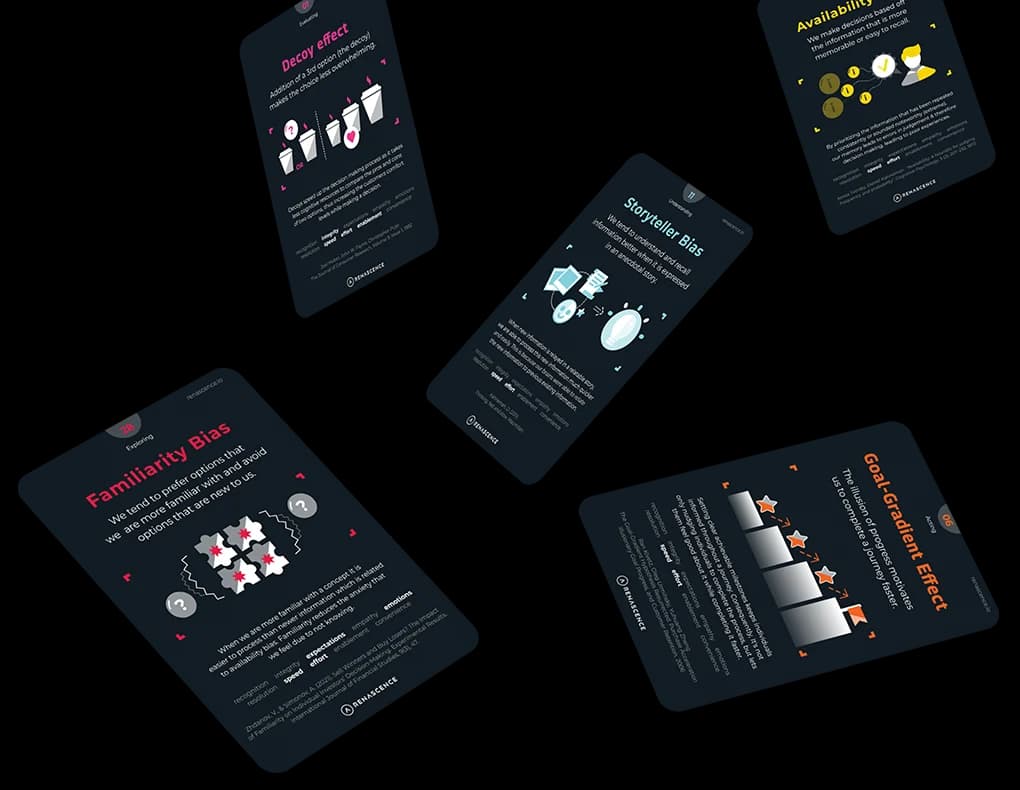
The goal-gradient effect, first documented in animal behaviour by Clark Hull in the 1930s and revived for marketing by Kivetz, Urminsky and Zheng in their 2006 study, states that motivation intensifies as the perceived distance to a goal shrinks — and that perceived distance matters more than actual distance. Their car wash and café-card field experiments showed that giving customers illusory progress (a head start that doesn't change the total effort required) reliably increases completion speed.
The practical implication for a loyalty architect is uncomfortable for anyone attached to round numbers. A ten-stamp card that starts empty performs worse than an equivalent twelve-stamp card that starts with two stamps filled in. The finish line is identical in real terms; the psychological distance is not. Programmes that show customers "3 of 5 to your reward" rather than a static points balance are exploiting exactly this mechanic — and they convert better because of it, not despite the extra complexity.
Why does loss aversion outperform gain framing in reward design?
Loss aversion outperforms gain framing because losing something we already feel we own hurts roughly twice as much, psychologically, as gaining the equivalent thing pleases us — a finding at the core of Prospect Theory, the framework Daniel Kahneman and Amos Tversky published in Econometrica in 1979. This asymmetry is why airline status tiers, expiring points, and "you're about to lose your progress" notifications outperform equivalent "earn more" messaging.
Once a customer holds gold-tier status, the programme has quietly converted a future gain into a current possession. The threat of demotion at year-end does more behavioural work than the promise of promotion ever did, because the customer is no longer weighing a hypothetical reward against present effort — they are weighing a concrete loss against present effort, and losses are felt harder. This is why status-tier retention campaigns built around "don't lose your status" consistently outperform those built around "earn your way up," even when the underlying mechanics are symmetrical.
The same logic applies to point expiry. A points balance that quietly decays is a mild irritant. A points balance that will expire in fourteen days, displayed with a countdown, is a live threat — and threats get acted on faster than opportunities do. Renascence's work in behavioral economics consistently finds that reframing an existing mechanic from gain to loss, without changing its economics at all, is one of the cheapest levers available to a loyalty team.
Do variable rewards create stronger habits than fixed ones?
Yes — variable, unpredictable rewards generally produce more durable engagement than fixed, predictable ones, a pattern traceable to B.F. Skinner's operant conditioning research in the mid-twentieth century, which found that variable-ratio reinforcement schedules produce behaviour that is both more persistent and more resistant to extinction than fixed-ratio schedules. This is the mechanism behind surprise-and-delight tactics, mystery bonus points, and randomised tier upgrades.
The caveat matters as much as the mechanism. Variable rewards build habit strength, but they can also erode trust if the variability feels arbitrary rather than generous — customers who suspect a "random" bonus is actually a tool to manipulate them tend to disengage faster than customers who received no bonus at all. The design discipline here is to use unpredictability for delight (the size or timing of a reward) while keeping the core earning mechanic transparent and fair. Opacity about how points are calculated is the fastest way to turn a variable-reward programme from delightful into suspicious.
How does the endowment effect explain why status feels impossible to give up?
The endowment effect — first named in Richard Thaler's foundational 1980 paper on consumer choice — describes our tendency to value something more highly simply because we own it. Applied to loyalty, it explains why a customer with three years of accumulated tier status will fight harder to keep it than a new customer would ever fight to earn it from scratch. The status was never really about the lounge access or the priority boarding. It became part of the customer's identity, and identity is defended more fiercely than convenience.
This is the deeper reason "elite" tiers outperform simple cash-back schemes at retention, even when the cash-back scheme is objectively worth more per pound spent. A tier is a possession. A cash-back balance is a transaction. Programme designers who understand this stop asking "what's the most generous reward we can afford" and start asking "what can we make the customer feel they already own." The answer is rarely a bigger discount — it is usually a status, a recognition, or a ritual the customer would feel diminished without.
How do you design a reward that actually changes behavior?
Building a reward mechanism that changes behaviour, rather than simply subsidising it, follows a repeatable sequence. Renascence uses a version of this process with clients redesigning loyalty architecture from the ground up:
- Name the exact behaviour, not the outcome. "Increase retention" is not a target behaviour. "Get a lapsed customer to make a second purchase within 30 days" is. Behavioural rewards need a verb and a deadline, not an aspiration.
- Identify the decision point where the customer currently defaults away from that behaviour. This is where choice architecture does the heavy lifting — often the fix is a smarter default, not a bigger prize.
- Choose the mechanism that fits the psychology, not the budget. If the goal is acceleration near completion, use progress framing and the goal-gradient effect. If the goal is retention of an existing habit, use loss framing and status protection. If the goal is habit formation from a cold start, use variable reinforcement.
- Set the reward size at the threshold of relevance, not the ceiling of generosity. Rewards that feel meaningful cost less than most finance teams assume; the psychology does more work than the pound value.
- Make progress visible. A hidden points balance recruits none of these effects. A visible bar, counter, or tier meter is what turns an accounting mechanic into a behavioural one.
- Test the counterfactual. Run the reward against a control group doing nothing different except not receiving the framing. If behaviour doesn't diverge from the control, you've built a discount, not a lever.
- Audit for erosion. Revisit the mechanism every two to three quarters — goal-gradient and variable-reward effects both weaken once customers learn to predict them, and a stale mechanic quietly reverts to being a discount again.
This is also where the economics get tested in the open. A reward mechanism that changes behaviour should show up in incremental purchase frequency or reduced churn within a measurable window — not just in redemption rates, which measure participation, not behaviour change. Teams building the business case for this kind of redesign often start with a straightforward exercise using a CX ROI calculator to separate the value of behaviour genuinely changed from the cost of rewards simply redeemed.
What mistakes undermine reward programmes even when the psychology is right?
Even well-designed mechanics fail in execution. The recurring mistakes worth guarding against:
- Rewarding the wrong unit of behaviour. Points per pound spent reward big spenders who were loyal anyway; points per specific action (a review, a referral, a second category purchase) reward the behaviour you actually wanted.
- Burying the progress bar. If a customer has to dig through an app to find out how close they are to a reward, the goal-gradient effect never activates. Visibility is the mechanism, not decoration.
- Treating every segment identically. A goal-gradient nudge that motivates a new customer can feel patronising to a ten-year loyalist who already holds top-tier status and responds far more to loss framing than to progress framing.
- Letting redemption friction cancel out the reward. A reward that takes fifteen minutes and three support calls to redeem creates the opposite of loyalty — it creates resentment, and resentment is remembered longer than the reward itself.
- Confusing participation with retention. High sign-up rates and high redemption rates can coexist with flat repeat-purchase rates. Track the behaviour, not the vanity metric sitting next to it.
There is a wider economic reason to take this seriously beyond the elegance of the psychology. Frederick Reichheld's research for Bain & Company, first published in Harvard Business Review's "Zero Defections: Quality Comes to Services" in 1990, established that even modest improvements in customer retention rates translate into outsized gains in profitability, because the cost of acquiring a replacement customer dwarfs the cost of keeping an existing one loyal. A reward mechanism that genuinely shifts retention behaviour is not a marketing nicety. It is one of the highest-leverage investments on the P&L, provided it is built to change behaviour rather than simply reward it.
Where should reward design sit inside the wider customer experience?
Reward mechanics rarely work in isolation. A goal-gradient progress bar sitting inside a clunky, high-friction app will lose to the frustration of the friction every time — the affect heuristic means a customer's overall feeling about the brand colours their reaction to the reward, not the reverse. This is why reward architecture belongs inside a broader customer experience strategy, not bolted on as a marketing add-on after the journey has already been designed.
The same logic applies to the moments a brand chooses to mark with ceremony rather than points. A well-placed ritual — a handwritten note at a milestone, a public recognition, a small unexpected upgrade — often does more for emotional loyalty than another 200 points ever will, because rituals recruit the endowment effect and social proof simultaneously. Renascence's work on customer rituals and ceremonies treats these moments as designed assets, not spontaneous nice-to-haves, precisely because their behavioural payoff is measurable when built deliberately.
Personalisation compounds all of this. A reward that recognises what a specific customer actually values — free shipping for the online-only shopper, priority service for the time-poor executive — will outperform a generic point multiplier, because it signals recognition rather than just paying out currency. The discipline of doing this without feeling invasive is its own craft, one explored in more depth in Personalization at scale without being creepy.
What should a CX or loyalty leader do differently starting now?
Stop asking whether the reward is generous enough. Start asking whether it targets a named behaviour, uses a framing that fits the psychology of that behaviour, and is visible enough for the customer to feel their own progress. The car wash study proved this with eight stamps and a scrap of card stock: the reward barely mattered. The architecture around it did all the work.
The brands that win the next decade of loyalty will not be the ones who spend the most on points. They will be the ones who understand that a customer's next decision is shaped less by what they're offered and more by how close, how threatened, or how owned that offer makes them feel.
Renascence works with organisations across the region to rebuild loyalty economics around behaviour rather than spend — from reward architecture and tiering to the platforms that run them, including tools like the loyalty management software built to operationalise exactly these mechanics. If your programme is paying out and still not moving the numbers you actually care about, that gap is usually a design problem, not a budget one.
Further reading
FAQ
Questions we get on this topic
Related reading



Writing on how human behavior shapes the experiences brands deliver — at the intersection of behavioral economics and customer experience.
Stay ahead of CX
Get the Journal in your inbox.
Insights, frameworks and event round-ups from the Renascence team. No spam, ever.