








Service Design · July 11, 2026
What Is CX Design? A Precise, Practitioner's Guide
CX design is the deliberate, upstream act of shaping what customers feel before they react. Here's what it is, where it operates, and why most organisations get it wrong.

Most organisations that say they care about customer experience are actually managing customer reactions. They measure NPS after the fact, train staff to apologise more warmly, and redesign complaint forms. That is not CX design. CX design is the deliberate, upstream act of shaping what customers feel before they have anything to react to.
The distinction matters enormously. Reactive CX is expensive and largely defensive. Designed CX compounds — every well-engineered moment reduces friction, builds trust, and increases the probability that a customer returns and tells someone else. Understanding what CX design actually is, where it operates, and how it differs from adjacent disciplines is the prerequisite for doing it well.
What Is CX Design, Precisely?
CX design is the intentional structuring of every interaction a customer has with an organisation — across channels, time, and emotion — so that the cumulative experience produces a specific, desired outcome: trust, loyalty, advocacy, or commercial return. It is not a single project or a visual exercise. It is a discipline that spans strategy, organisational behaviour, service operations, and the psychology of perception.
The word "design" is doing real work here. It implies intent, method, and iteration — not accident. Most customer experiences are not designed; they are inherited. They accumulate from departmental decisions made in isolation, legacy systems nobody wanted to replace, and policies written to protect the company rather than serve the customer. CX design is the counter-force: the deliberate act of asking, at every touchpoint, "what should the customer feel here, and what would it take to produce that reliably?"
That question, asked seriously and answered systematically, is what separates organisations that consistently earn loyalty from those that are perpetually surprised by churn.
Where Does CX Design Actually Operate?
CX design is not a department. It is a lens applied across the full customer lifecycle — from the moment a potential customer first encounters the brand to the moment they leave, or ideally, the moment they become an advocate who brings others in.
In practice, it operates across four interconnected layers:
- Strategic layer: defining the intended experience — what the brand promises, what emotional territory it owns, and what trade-offs it is willing to make. This is where customer experience strategy and CX design meet.
- Journey layer: mapping and engineering the sequence of interactions a customer moves through, identifying where friction accumulates, where emotion peaks, and where the experience diverges from the intent.
- Touchpoint layer: designing the individual interactions — digital interfaces, physical environments, human conversations, communications — so that each one is coherent with the whole.
- Operational layer: ensuring the processes, systems, and people behind the scenes can actually deliver what the design requires, consistently and at scale.
Most organisations invest heavily in the touchpoint layer — a new app interface, a refurbished branch, a revised script — while neglecting the strategic and operational layers. The result is cosmetic improvement that does not move loyalty metrics, because the underlying experience architecture is unchanged.
How CX Design Differs From UX Design and Service Design
These three disciplines are related but not interchangeable, and conflating them is a common and costly error.
UX design (user experience design) is concerned with a person's interaction with a specific product or interface — typically digital. It asks: is this screen navigable? Is this flow logical? Does this interaction feel intuitive? UX is a component of CX, not a synonym for it. A perfectly designed app embedded in a broken customer journey still produces a poor customer experience.
Service design operates at a broader scope than UX but is still primarily concerned with the design of service processes — the "backstage" operations, the staff roles, the systems that enable service delivery. Service design and CX design overlap significantly, but CX design places greater emphasis on the emotional arc of the customer relationship over time, including the psychological dimensions of perception and memory.
CX design is the most encompassing of the three. It holds the whole relationship in view — digital and physical, transactional and emotional, functional and symbolic. It asks not just "does this work?" (UX) or "can we deliver this reliably?" (service design) but "does this experience, taken as a whole, produce the feelings and behaviours we need?"
The Nielsen Norman Group's foundational definition of UX is a useful reference point here: they are explicit that UX is a subset of the broader customer experience — a clarification that many practitioners still need to hear.
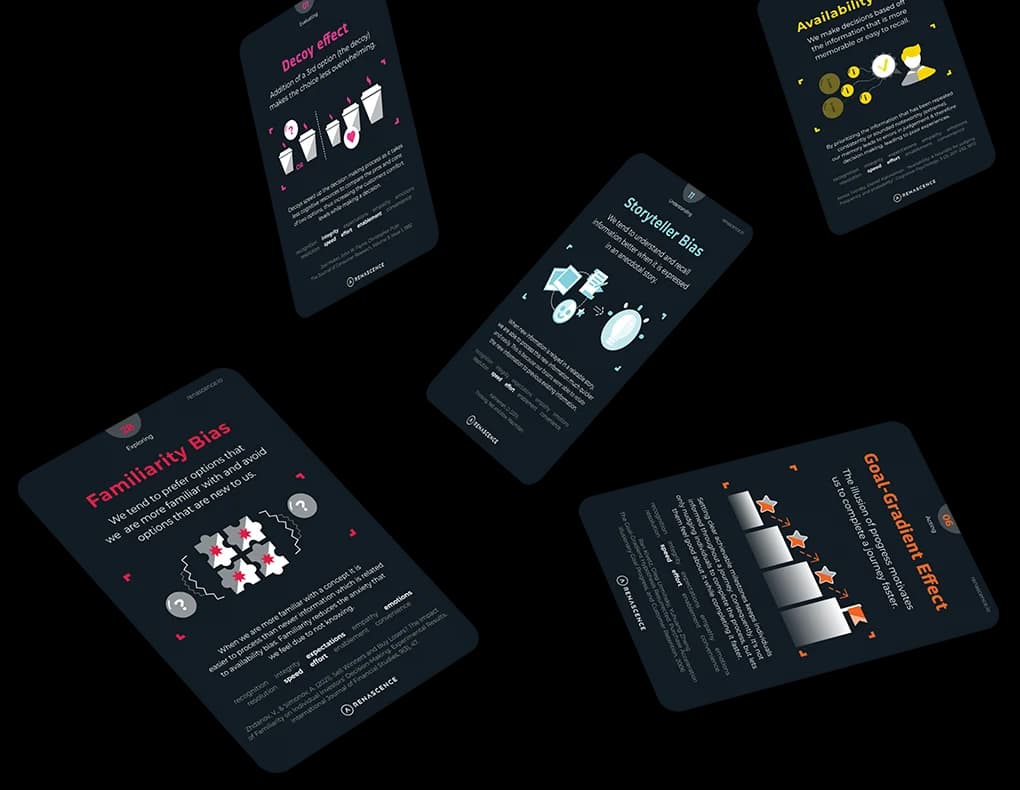
The Behavioral Economics Dimension: Why Perception Is the Product
CX design without behavioral economics is engineering without physics. You can build something that looks right and still fails, because you have not accounted for how human minds actually process experience.
Two principles from Daniel Kahneman's research are non-negotiable inputs to any serious CX design effort.
The first is the peak-end rule: people do not evaluate an experience by averaging every moment. They remember it primarily by its most intense point (the peak — positive or negative) and its final moment. This means a journey with nine good interactions and one terrible one will be remembered as a bad experience if that terrible moment is the peak or the ending. CX design must therefore identify and engineer the peaks deliberately, and pay obsessive attention to how experiences close.
The second is loss aversion: the psychological pain of losing something is roughly twice as powerful as the pleasure of gaining something of equivalent value. In CX terms, a single moment of friction, confusion, or perceived unfairness does disproportionate damage to overall perception. This is why reducing negative moments is often more valuable than adding positive ones — a principle that runs counter to most CX investment logic, which tends to favour adding features and benefits.
Applying these principles is not about manipulation. It is about designing with an accurate model of how customers actually work, rather than how organisations wish they did. The behavioral economics lens transforms CX design from intuition-driven to mechanism-driven.
What CX Design Looks Like in Practice
Abstract principles are only useful if they translate into concrete decisions. Here is what rigorous CX design actually involves, step by step:
- Define the intended emotional arc. Before mapping journeys or designing touchpoints, establish what the customer should feel at each stage — not just what they should be able to do. "Confident," "valued," "in control," "surprised" are legitimate design objectives. "Completed the transaction" is not.
- Map the current experience honestly. This means following the customer's actual path, not the organisation's assumed one. Mystery shopping, ethnographic observation, and session recordings routinely reveal that the real journey diverges significantly from the process map on the wall.
- Identify friction and emotional low points. Not all friction is equal. Some friction is protective (a confirmation step before a large transaction). Most is simply inherited — the residue of internal processes that nobody ever questioned from the customer's perspective.
- Engineer the peaks and the ending. Given the peak-end rule, decide which moments in the journey will be the signature interactions — the ones designed to be memorable, distinctive, and emotionally resonant. Then design the ending of each interaction and the overall relationship arc with the same care.
- Align the backstage to the frontstage. The most common failure mode in CX design is a beautiful customer-facing experience that collapses because the operational reality cannot support it. Process design must be treated as integral to CX design, not a downstream implementation concern.
- Build measurement into the design. CX design without feedback loops is guesswork. Define what signals — behavioural, attitudinal, operational — will tell you whether the design is working, and build the mechanisms to collect them before launch, not after.
The Role of the Customer Journey in CX Design
The customer journey is both the primary diagnostic tool and the primary design canvas in CX design. It externalises the experience — makes it visible, discussable, and actionable — in a way that internal process maps never do, because it is structured around what the customer experiences rather than what the organisation does.
A well-constructed journey map does three things that matter for design. It reveals the gaps between intended and actual experience. It surfaces the emotional texture of the journey — not just the functional steps. And it creates a shared language across functions that otherwise operate in silos, each optimising their own piece without visibility of the whole.
The danger is treating journey mapping as the deliverable rather than the starting point. Many organisations invest in beautiful journey maps that live in presentations and change nothing. The map is only as valuable as the design decisions it drives. CX journey design at its best is iterative: map, design, test, measure, revise.
CX Design in Specific Sectors: Why Context Changes the Rules
The principles of CX design are universal. Their application is not. The emotional stakes, the regulatory constraints, the competitive benchmarks, and the customer expectations vary enormously by sector — and CX design that ignores this produces generic experiences that satisfy nobody.
In banking and financial services, the dominant emotional register is anxiety — about money, security, and complexity. CX design here must prioritise clarity, control, and reassurance above almost everything else. The peak-end rule applies with particular force: a customer who feels confused or exposed at any point in a financial interaction will remember that above all else.
In hospitality, the emotional register is anticipation and pleasure. CX design must engineer moments of delight — small, unexpected, personal — because the category promise is an elevated experience. Functional competence is the floor, not the ceiling.
In healthcare, the stakes are highest and the design constraints most complex. Patients are often frightened, in pain, or both. CX design here is not about delight; it is about dignity, clarity, and the restoration of a sense of control in a situation where patients feel they have none.
Understanding which emotional territory a sector occupies — and what that demands of the design — is the first act of contextually intelligent CX design.
Why Most CX Design Efforts Fail to Deliver
The failure modes are well-established and largely preventable.
Designing for the average customer. Averages obscure the variation that matters. A journey that works adequately for the median customer may be actively hostile to the customers who generate the most value, or the customers who are most at risk of leaving. CX design must account for the range of customer archetypes, not just the central tendency.
Designing the front stage while neglecting the back stage. Customer-facing design that is not matched by operational redesign produces a promise the organisation cannot keep. The gap between promise and delivery is one of the most reliable drivers of customer distrust.
Treating CX design as a one-time project. Customer expectations shift. Competitive benchmarks move. Regulatory environments change. CX design is a continuous discipline, not a programme with a completion date. Organisations that treat it as the latter find themselves redesigning from scratch every few years, rather than iterating from a strong foundation.
Separating CX design from employee experience. The quality of the customer experience is largely a function of the quality of the employee experience. Staff who are confused, disempowered, or disengaged cannot reliably deliver a designed experience, however well that experience is specified on paper. Employee experience is the upstream driver of CX, and any design effort that ignores it is working against itself.
The Organisational Conditions That CX Design Requires
CX design does not happen in a vacuum. It requires specific organisational conditions to take root and produce durable results.
The first is cross-functional ownership. No single department owns the customer experience, because no single department controls all the touchpoints. Effective CX design requires a governance model that gives someone meaningful authority to make decisions across functions — and that holds those functions accountable for their contribution to the whole. A CX governance strategy is not a bureaucratic nicety; it is the structural prerequisite for consistent design execution.
The second is a feedback infrastructure. CX design is an empirical discipline. It requires real data about what customers actually experience — not what the organisation believes they experience. Customer feedback management that is systematic, timely, and connected to design decisions is what separates organisations that improve from those that merely measure.
The third is design capability at scale. CX design cannot be the exclusive preserve of a central team. The principles and methods need to be understood and applied by the people who make decisions about customer-facing processes, communications, and environments across the organisation. This is a capability-building challenge as much as a design challenge.
CX Design as Competitive Advantage
There is a version of this conversation that treats CX design as a cost of doing business — a minimum standard required to avoid losing customers. That framing undersells it significantly.
When CX design is executed with genuine rigour — when the emotional arc is deliberate, the peaks are engineered, the backstage is aligned, and the feedback loops are working — it produces something that is genuinely difficult to replicate: a distinctive experience that customers associate specifically with one brand. That distinctiveness is a durable competitive asset in a way that product features and price points are not, because it lives in perception and memory rather than in a specification sheet that a competitor can copy.
"The experience is the product. In most categories, what customers are actually buying is not the functional output — it is the feeling of being dealt with well, understood, and respected. CX design is the discipline of making that feeling reliable."
The organisations that understand this — that customer experience is not a support function but the primary value-creation mechanism — are the ones that invest in CX design as a strategic capability rather than a reactive remediation effort. They are also, consistently, the ones that find loyalty metrics and commercial performance moving in the same direction.
The question is not whether your organisation can afford to take CX design seriously. The question is whether it can afford the compounding cost of the alternative: an experience that happens to customers rather than one that is built for them.
Further reading
FAQ
Questions we get on this topic
Related reading


Stay ahead of CX
Get the Journal in your inbox.
Insights, frameworks and event round-ups from the Renascence team. No spam, ever.