About

The consultancy born at the intersection of behavioral economics and human experience.

NOW HIRING

Join a team reshaping how the world experiences brands.

View open roles →

COMPANY

GROW WITH US

CONNECT

Services

Comprehensive CX and management consulting for enterprise brands.

ALL SERVICES

Explore the full range of CX & management consulting services.

Browse all services →

CORE

SPECIALIST

Solutions

Structured solutions that turn CX ambition into measurable outcomes.

ALL SOLUTIONS

Explore every CX solution we offer.

Browse solutions →

STRATEGY & GOVERNANCE

DESIGN & DELIVERY

CULTURE & EXPERIENCE

Industries

A decade of CX transformation across the region's defining sectors.

ALL INDUSTRIES

See how we work across every sector.

Browse industries →

BUILT ENVIRONMENT

FINANCE & TECH

PEOPLE & MOBILITY

Products

Proprietary tools, platforms, and AI that power CX transformation.

ALL PRODUCTS

Explore the full Renascence product ecosystem.

Browse products →

AI & TECHNOLOGY

LEARNING & GAMES

PLATFORMS & TOOLS

AI PRODUCTS

Opinion

Insights, research, and conversations at the frontier of CX.

ReadExperience JournalArticles & research on CX, behavior, and transformation.Watch & listenExperience LoomOur video podcast on CX & behavior.CuratedCX NewsIndustry news that matters in CX, minus the noise.

Latest articles

Latest episodes

Latest news

Hub

Free tools, templates, and resources to advance your CX practice.

NEW · MANIFESTO

Burn the Deck. Ten Virtues. Zero Excuses. — read our manifesto for the brave consultant.

Start reading →

AI TOOLS

FREE TOOLS

LEARNING

CULTURE

Solution · Service Design

Service Design That Makes the Experience Work — End to End

Renascence designs services so that every backstage decision shows up as a better moment for the customer — fewer handoff failures, less wasted effort, and experiences people actually remember.

Book a discovery callWhat's included

01 — Overview

What is service design and why does it matter for organisations in the MENA region?

Service design is the discipline of deliberately orchestrating people, processes, technology, and physical or digital environments so that every interaction a customer has feels coherent, low-effort, and worth repeating. It works simultaneously on the frontstage — what the customer sees and feels — and the backstage — the operational machinery that makes it possible.

Most organisations already have a service. What they lack is intentional design. Processes accumulate over years of departmental fixes; handoffs between teams become invisible fault lines; and customers absorb the cost of internal misalignment as confusion, delay, or disappointment. In Kahneman's terms, the average of those moments rarely matters — but the painful peaks and the unsatisfying endings define whether someone comes back.

Renascence applies service design to close that gap: mapping what actually happens, diagnosing where the system breaks down, and rebuilding the experience so that the organisation's intent and the customer's reality finally match. In the MENA context — where rapid service expansion, multichannel complexity, and rising customer expectations collide — that alignment is not a nice-to-have. It is the difference between a service that scales and one that quietly erodes trust.

The operational and commercial case for deliberate service design is well-established across industries.

Cost impactMcKinsey & Company, Customer Experience practice
~20%
Reduction in service operating costs reported by organisations after end-to-end service redesign
Retention driverCEB / Gartner Customer Effort research
2–3×
Higher customer retention likelihood when customers rate their journey as consistently low-effort
Operational qualityIndustry benchmark, service operations research
+40%
Improvement in first-contact resolution when service blueprinting is used to fix backstage handoffs

02What's Included

What a Renascence Service Design Engagement Includes

Each engagement is scoped to your context, but every one covers the full system — not just the visible surface.

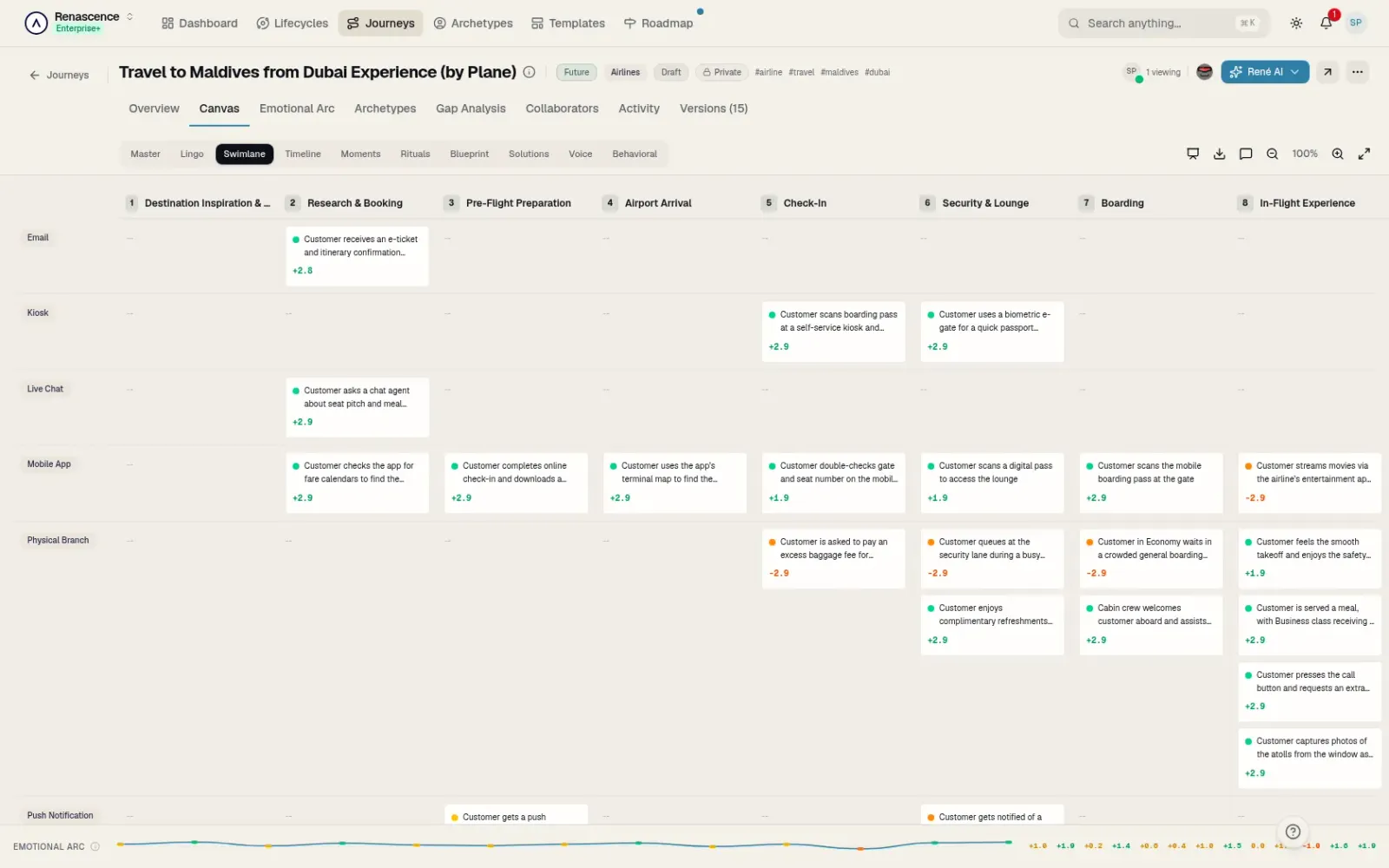
A precise, validated map of every frontstage moment and backstage action, showing exactly where the system breaks — not where the org chart says it should work.

A layer on top of the blueprint that traces how customers actually feel at each stage, identifying the pain peaks and the missed opportunities to create a memorable high.

Redesigned workflows, handoff protocols, and role accountabilities that eliminate the internal friction customers absorb — turning operational fixes into experience improvements.

New or reimagined service concepts tested with real users before any costly build, so the organisation invests in what works rather than what seemed logical in a meeting room.

A sequenced, prioritised plan that connects design decisions to operational reality — with quick wins that build momentum and structural changes that hold.

Facilitated sessions that bring frontline staff, operations, and leadership into a shared picture of the service, so the design does not die in the handover to delivery.

03Our Approach

How Renascence Approaches Service Design

1

Discover

We assess your maturity, research the people involved and pinpoint the highest-impact opportunities.

2

Design

We craft the strategy and interventions, grounded in evidence and validated with real users.

3

Deliver

We implement alongside your teams, with quick wins and knowledge transfer along the way.

4

Sustain

We embed governance, measurement and tools so the gains compound over time.

04Outcomes

What you can expect.

1

Measurable impact

Every engagement ties to business metrics — not vanity scores.

2

Capability you keep

We transfer the skills, tools and frameworks so your team owns it.

3

Aligned organization

Shared standards and governance get every team rowing together.

05Proof

See it in the work.

All case studies

07 — Why It Matters

Why Service Design Decides Whether a CX Strategy Lives or Dies

A customer experience strategy without service design is a vision without a mechanism. Organisations invest in brand promises, loyalty programmes, and NPS measurement — then wonder why scores plateau. The answer is almost always backstage: a broken handoff between sales and onboarding, a policy that made sense to compliance but baffles the customer, a digital channel that was built by IT without a service logic behind it. Design the frontstage without fixing the backstage and you are painting over damp.

The behavioral economics here is precise. Research by Kahneman and colleagues on the peak-end rule shows that people judge an experience not by its average quality but by its emotional peak and its final moment. Service design is the only discipline that gives you deliberate control over both — because it traces the full arc from first contact to resolution, and it reaches into the operational decisions that determine whether that arc ends well or badly. Organisations that understand this stop optimising individual touchpoints and start designing the whole system.

In the MENA region specifically, the stakes are high and the window is narrow. Government and private-sector organisations are simultaneously expanding service channels, digitising operations, and facing customers whose expectations are set by the best global experiences they have ever had. The organisations that will lead are those that treat service design as a core capability, not a one-off project. Renascence exists to build that capability — and to leave teams able to sustain it after we leave.

Listen: The Naked Customer podcastConversations on CX, loyalty & behavior

08FAQ

Service Design — Frequently Asked Questions

Service design is the practice of intentionally planning and organising the people, processes, technology, and environments that deliver a service — from the customer's first contact to their last. It works on both what the customer experiences directly and the operational systems behind it, ensuring the two are aligned.

UX focuses primarily on digital interfaces and usability. Journey mapping visualises the customer's path but does not redesign the system behind it. Service design does both: it maps the experience and then engineers the backstage — processes, roles, policies, and technology — so the journey actually improves in practice, not just on paper.

Service design is most valuable for heads of CX, operations directors, and transformation leads in organisations where customer experience is inconsistent, where internal handoffs regularly fail, or where a new service is being built and needs to work from day one. It applies across banking, government, retail, healthcare, hospitality, and telecoms — any sector where a service is delivered by people and systems working together.

A typical engagement runs six to sixteen weeks depending on scope. It begins with current-state research and blueprinting, moves into diagnosis and concept design, then into prototyping and testing, and closes with an implementation roadmap and internal alignment sessions. Focused redesigns of a single service journey can move faster; enterprise-wide service transformations take longer.

Renascence scopes and prices each engagement based on the complexity of the service, the number of journeys in scope, and the depth of operational change required. Engagements are typically fixed-fee by phase, so you know the investment before committing to the next stage. We are happy to discuss a scoping conversation before any commercial commitment.

Core deliverables include a validated current-state service blueprint, a customer journey and emotional arc analysis, redesigned process and handoff specifications, a tested service concept or prototype, and a prioritised implementation roadmap. All materials are built to be used by your teams, not filed away — that is a deliberate design choice.

Management consultancies tend to focus on strategy and operating model; design agencies on visual and digital output. Renascence sits at the intersection of CX strategy, behavioral science, and operational redesign. We do not hand over a report and leave — we work with your teams to translate the design into operational reality, and we build internal capability so the improvement holds.

We agree on outcome metrics at the start: typically a combination of customer effort score (CES), first-contact resolution, process cycle time, and NPS for the redesigned journeys. Where a prototype is tested, we measure against a defined hypothesis before recommending a full build. Success is not a deliverable on a slide — it is a measurable shift in how the service performs.

The most directly applied framework is the peak-end rule: we deliberately map and engineer the emotional high point and the closing moment of each journey, because those are what customers remember and act on. We also apply choice architecture principles to defaults and decision points within the service, and we use the concept of friction versus sludge — removing the effort that frustrates customers while preserving the steps that protect them.

Particularly so. Government entities across the UAE, Saudi Arabia, and the wider GCC are under explicit mandates to improve service quality and digitise citizen journeys — from Vision 2030 to UAE government service standards. Service design provides the methodology to meet those mandates in a way that is operationally grounded, not just cosmetically improved. Renascence has direct experience working in this context.

Service design applies to any service — digital, physical, or hybrid. In fact, it is most critical for digital services, because the backstage systems that support a digital channel (data flows, fulfilment processes, exception handling, human escalation paths) are often designed by engineers without a service logic, and customers feel the gaps. Service design brings that logic in from the start.

The first step is a focused conversation — typically 30 to 45 minutes — where we listen to the service challenge you are facing, share how we would approach it, and outline what a scoped engagement might look like. There is no obligation and no sales script. If it is the right fit, we propose a phased scope; if it is not, we will tell you that too.

Keep exploring Renascence

Start the conversation

Ready to get started with Service Design?

Book a discovery call with a senior consultant and see what's possible.