关于

行为经济学与人类体验的交汇点,由此诞生了 Renascence 咨询公司。

现正招聘

加入我们的团队,一起重塑世界体验品牌的方式。

查看开放岗位 →

公司

与我们共同成长

联系我们

服务

为企业品牌提供全面的客户体验和管理咨询。

所有服务

探索 Renascence 提供的全方位客户体验和管理咨询服务。

浏览所有服务 →

核心业务

专家

解决方案

转化为可衡量的成果。" is smooth, authoritative, and perfectly captures the source meaning and tone.通过结构化解决方案,将 CX 愿景转化为可衡量的成果。

所有解决方案

探索我们提供的所有 CX 解决方案。

浏览解决方案 →

战略与治理

设计与交付

文化与体验

行业

跨越十年的客户体验转型,赋能本地区最具代表性的行业。

所有行业

了解我们如何服务各大行业。

浏览行业 →

建筑环境

金融与科技

人员与流动性

产品

Renascence专有的工具、平台和AI,赋能客户体验转型。

所有产品

探索 Renascence 的完整产品生态。

浏览产品 →

人工智能与技术

学习与游戏

平台与工具

AI 产品

观点

Renascence:客户体验前沿的洞察、研究和对话。

阅读体验日志关于CX、行为与转型的文章和研究。观看与收听体验蓝图我们的CX与行为视频播客。精选CX新闻CX行业重要新闻,去芜存菁。

最新文章

最新剧集

最新新闻

中心

免费工具、模板和资源,助您提升客户体验实践。

新 · 宣言

破釜沉舟。十大美德。绝无借口。——阅读我们为勇敢的咨询顾问撰写的宣言。

开始阅读 →

AI 工具

免费工具

学习资料

文化

Solution · 客户体验原型

CX Archetypes: Know Exactly Who You're Designing For

Most CX failures trace back to one root cause: designing for an average customer who doesn't exist. CX Archetypes give your teams a shared, research-grounded picture of who actually walks through your door.

预约探索性通话包含内容

01 — 概览

What are CX Archetypes and why do they matter more than personas?

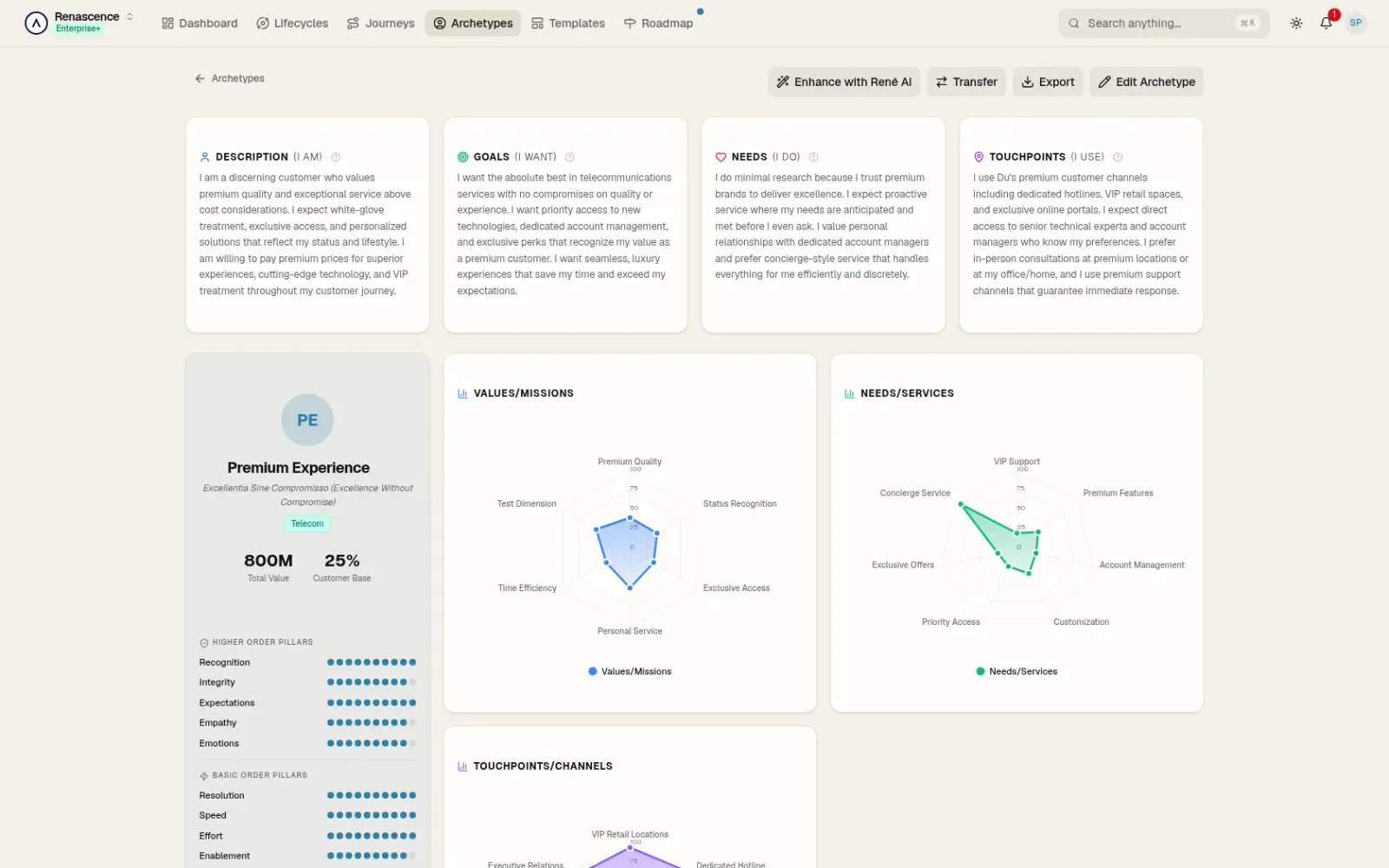
CX Archetypes are research-based models of your distinct customer types, defined by their goals, motivations, behaviors, and decision-making patterns — not demographics alone. Where a persona tells you a customer is a 35-year-old professional, an archetype tells you she's a Control-Seeker who needs to feel informed at every step or she walks.

Most organisations already have personas. What they lack is behavioral depth: the underlying drivers that explain why a customer hesitates, complains, churns, or advocates. Archetypes answer that question. They draw on behavioral economics — specifically the distinction between System 1 and System 2 thinking — to map not just what customers do, but the cognitive shortcuts and emotional triggers that shape every choice they make.

The practical result is a shared language across your business. When your product team, your contact centre, and your branch network all understand that Archetype 3 is a Reassurance-Seeker who needs social proof before committing, every design decision gets faster, sharper, and more consistent. That alignment is where the commercial return lives.

The business case for archetype-driven design is grounded in what happens when teams stop guessing who they're serving.

Commercial impactMcKinsey & Company, 2023
3.2x
Higher likelihood of exceeding revenue targets for companies that lead with customer understanding over product-out thinking
Efficiency gainObserved pattern across Renascence engagements
-23%
Reduction in wasted design effort when cross-functional teams share a single validated model of customer behavior
Risk reductionForrester Research
40%
Of CX investments fail to deliver because they target the wrong customer need — archetypes directly address this root cause

02包含内容

What a CX Archetypes Engagement Delivers

Each engagement produces a set of validated, activation-ready archetype models — not slide decks that gather dust, but working tools your teams use in design sprints, service blueprints, and campaign briefs.

Qualitative interviews, observational research, and behavioral data analysis that surface the real motivations, anxieties, and decision triggers behind your customers' actions.

A concise set of 3–6 distinct archetype profiles, each defined by goals, core needs, behavioral patterns, and the emotional states that drive or derail their journey with you.

For each archetype, a clear map of the moments that matter most — the points where their specific needs are highest and where your service either earns or loses their trust.

Each archetype is annotated with the behavioral economics principles most relevant to that type — loss aversion, the goal-gradient effect, social proof — so your designers know which levers to pull.

Ready-to-use reference cards, journey overlays, and workshop facilitation guides that embed archetypes into your team's day-to-day design and decision-making processes.

A facilitated working session that brings your CX, product, marketing, and operations teams into a shared understanding of the archetypes and how each function serves them differently.

03我们的方法

How We Build Your CX Archetypes

1

Discover

We assess your maturity, research the people involved and pinpoint the highest-impact opportunities.

2

Design

We craft the strategy and interventions, grounded in evidence and validated with real users.

3

Deliver

We implement alongside your teams, with quick wins and knowledge transfer along the way.

4

Sustain

We embed governance, measurement and tools so the gains compound over time.

04成果

您可获得什么。

1

可衡量的影响

每次合作都与业务指标挂钩,而非虚荣分数。

2

您保持的能力

我们转移技能、工具和框架,让您的团队掌握它们。

3

Aligned organization

共享标准和治理让每个团队齐心协力。

更清晰
目标与设计
已分享
客户语言
更高
相关性与共鸣

05证明

在工作中查看。

所有案例研究

07 — 重要意义

Why Behavioral Depth Changes Everything in CX Design

The dominant failure mode in CX is designing for a statistical average. Demographic segments tell you who is in the room; archetypes tell you what they need from you and what will make them leave. Daniel Kahneman's work on dual-process cognition established that most customer decisions are driven by fast, emotional, heuristic thinking — not the rational deliberation that most service designs assume. An archetype built on behavioral research reflects that reality. One built on survey demographics does not.

There is a compounding organisational benefit that is easy to underestimate. When a bank's digital team, its branch network, and its complaints function all operate from different mental models of the customer, every handoff creates friction. Archetypes dissolve that. They become the common reference point that makes cross-functional design conversations shorter, sharper, and less political. We have consistently found that teams with a shared archetype model move from insight to design decision in a fraction of the time.

In MENA markets specifically, the behavioral diversity within a single customer base is striking. A retail bank in the Gulf may serve a risk-averse national customer, a transaction-focused expatriate professional, and a digitally-native younger segment — each with fundamentally different trust signals, communication preferences, and service expectations. A single persona flattens that. A well-constructed set of archetypes preserves it, and gives your teams the precision to serve each type well without building three separate service models.

Listen: The Naked Customer podcastConversations on CX, loyalty & behavior

08FAQ

CX Archetypes: Frequently Asked Questions

A CX Archetype is a behavioral model of a distinct customer type, defined by goals, motivations, decision-making patterns, and emotional drivers. A persona typically describes who a customer is demographically. An archetype explains why they behave as they do — which is the information you actually need to design services that work.

It is most valuable for CX, product, marketing, and service-design leaders who are making significant decisions about customer journeys, digital experiences, or service models. It is particularly well-suited to organisations that have data on what customers do but lack a clear picture of why — and to teams where different functions are working from inconsistent assumptions about the customer.

Most engagements produce between three and six archetypes. Fewer than three tends to flatten meaningful behavioral differences; more than six becomes difficult for teams to hold in working memory and apply consistently. The right number depends on the genuine behavioral diversity in your customer base, which the research phase establishes.

We combine qualitative depth interviews, observational and ethnographic research, and analysis of existing behavioral and operational data. Where client data permits, we also draw on behavioral analytics — drop-off patterns, complaint themes, channel-switching behavior — to validate and sharpen the qualitative findings. The goal is archetypes grounded in evidence, not intuition.

A full engagement — from research through to activation toolkit and alignment session — typically runs six to ten weeks, depending on the size of the customer base, the number of segments to explore, and the volume of existing research available. A focused engagement building on strong existing data can move faster.

Engagements are scoped and priced on a project basis, reflecting the research depth, number of archetypes, and activation requirements. We do not offer a one-size template because the research phase is genuinely variable. We provide a clear scope and fixed fee after an initial discovery conversation.

You receive a set of validated archetype profiles, a needs-and-moments map for each archetype, a behavioral annotation layer identifying the key cognitive and emotional drivers, an activation toolkit for embedding archetypes in design work, and a facilitated alignment session. All deliverables are built for practical use, not for presentation.

Segmentation divides customers by observable characteristics — spend, frequency, product holding, demographics. Archetypes explain the behavioral logic underneath those segments. The two are complementary: segmentation tells you who is in each group; archetypes tell you how to design for them. Many clients use both, mapping archetypes onto existing segments to add the behavioral layer their current models lack.

This is the right question, and it is why activation is a core part of the engagement rather than an afterthought. We build reference tools designed for the formats your teams actually work in — journey workshops, sprint briefs, service blueprints — and run a cross-functional alignment session to establish shared ownership. An archetype that lives only in a PDF has no commercial value.

Significantly. Customer bases in MENA markets often span national and expatriate populations, multiple languages, and sharply different levels of digital adoption and institutional trust. These are not cosmetic differences — they produce genuinely distinct behavioral patterns that a single archetype set must capture accurately. Our research approach is designed for this complexity, and our teams operate across the region with direct market experience.

Yes. The same behavioral modeling approach applies to employee archetypes, and the two are closely related: the archetype of the customer a frontline employee serves shapes what that employee needs to do their job well. Some engagements run customer and employee archetypes in parallel, which produces a much richer service-design foundation.

The first step is a 30-minute discovery conversation to understand your current customer understanding, the decisions you are trying to make, and where behavioral depth would add the most value. From that conversation, we produce a clear scope and recommendation. There is no obligation and no sales pressure — if archetypes are not the right tool for your situation, we will tell you.

继续探索Renascence

开始对话

准备好与客户体验原型一起开始了吗?

与资深顾问预约探索性通话,了解更多可能性。