





关于

行为经济学与人类体验的交汇点,由此诞生了 Renascence 咨询公司。

René Studio
AI体验工作室

我们基于十年客户合作经验打造的客户体验设计平台。

探索 René Studio
Mysterya
神秘顾客审计,实时

我们运行的神秘审计,对每个地点进行实时评分。

探索 Mysterya
现正招聘

加入我们的团队,一起重塑世界体验品牌的方式。

查看开放岗位 →

公司

与我们共同成长

联系我们

服务

为企业品牌提供全面的客户体验和管理咨询。

René Studio
AI体验工作室

每一次互动,都在一个AI工作区中进行映射和评分。

探索 René Studio
Mysterya
神秘顾客审计,实时

神秘顾客,实时评分和取证。

探索 Mysterya
所有服务

探索 Renascence 提供的全方位客户体验和管理咨询服务。

浏览所有服务 →

核心业务

专家

解决方案

转化为可衡量的成果。" is smooth, authoritative, and perfectly captures the source meaning and tone.通过结构化解决方案,将 CX 愿景转化为可衡量的成果。

René Studio
AI体验工作室

借助AI,对我们重新设计的旅程进行绘制、评分和修复。

探索 René Studio
Mysterya
神秘顾客审计,实时

检查您设计的体验是否已交付。

探索 Mysterya
所有解决方案

探索我们提供的所有 CX 解决方案。

浏览解决方案 →

战略与治理

设计与交付

文化与体验

行业

跨越十年的客户体验转型,赋能本地区最具代表性的行业。

René Studio
AI体验工作室

AI 在数分钟内完成行业就绪旅程评分。

探索 René Studio
Mysterya
神秘顾客审计,实时

针对您所在行业量身定制的神秘顾客审计,实时评分。

探索 Mysterya
所有行业

了解我们如何服务各大行业。

浏览行业 →

建筑环境

金融与科技

人员与流动性

产品

Renascence专有的工具、平台和AI,赋能客户体验转型。

René Studio
AI体验工作室

利用AI设计、评估和优化客户旅程。

探索 René Studio
Mysterya
神秘顾客审计,实时

审计每个地点并根据发现采取行动。

探索 Mysterya
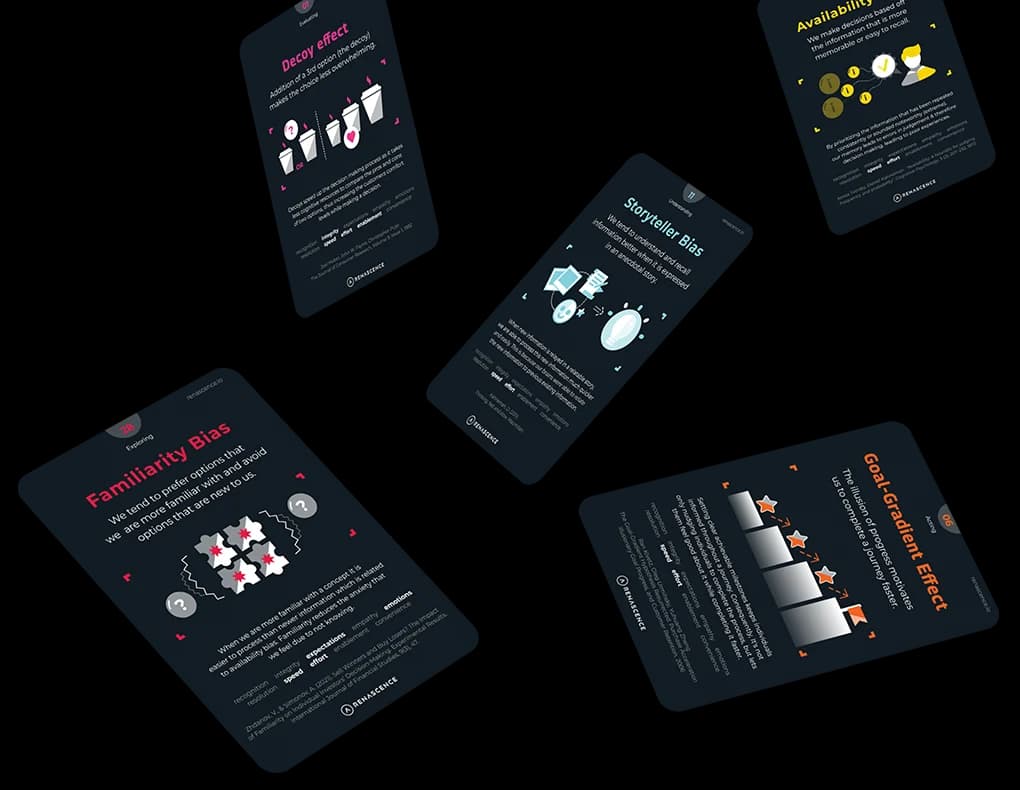
REBEL牌组A · 36种力量

塑造人类体验世界的各种力量。

探索 REBEL Reveal →
所有产品

探索 Renascence 的完整产品生态。

浏览产品 →

PLATFORMS

人工智能与技术

学习与框架

客户体验工具包

观点

Renascence:客户体验前沿的洞察、研究和对话。

René Studio
AI体验工作室

将您的阅读体验转化为可评分的旅程。

探索 René Studio
Mysterya
神秘顾客审计,实时

了解客户每次访问的真实体验。

探索 Mysterya
阅读体验日志关于CX、行为与转型的文章和研究。观看与收听体验蓝图我们的CX与行为视频播客。精选CX新闻CX行业重要新闻,去芜存菁。

最新文章

最新剧集

最新新闻

中心

免费工具、模板和资源,助您提升客户体验实践。

René Studio
AI体验工作室

利用AI设计、评估和优化客户旅程。

探索 René Studio
Mysterya
神秘顾客审计,实时

每次访问、每个地点、每个分数。实时呈现。

探索 Mysterya
宣言烧毁牌组。
十大美德。零借口。开始阅读 →
中心

所有免费工具、模板和资源尽在一个地方。

访问中心 →

AI 工具

免费工具

学习资料

文化

All courses
Behavioural Economics For CxAll levels

Behavioural Economics for CX: Designing for How People Actually Decide

The foundational science beneath the whole customer-experience discipline. Learn why customers are not the rational agents classical economics assumes; the two systems of thinking and the say-do gap; the workhorse biases and how to read a moment with the Behavioural Diagnosis Grammar; prospect theory, loss aversion and framing, with the Reframe Grammar; how memory, emotion and the peak-end rule shape the remembered experience, and the psychology of waiting; choice architecture, defaults, choice overload and the EAST framework, with the Nudge Grammar; and the ethics of influence — nudge versus sludge and dark patterns — with the Ethical Nudge Test. The four grammars form one design pipeline: diagnose, reframe, nudge, ethics-check. Grounded in Kahneman & Tversky, Thaler & Sunstein, the peak-end research and the Behavioural Insights Team's EAST, with GCC context throughout and explicit links to VoC, journey mapping, service design and CX strategy.

4.8(401)500+ enrolled
APCreated by Aslan Patov
Founder & Lead Instructor, Renascence
Renascence Academy
Modules6
Lessons24
CategoryBehavioural Economics For Cx
LevelAll levels

What you'll learn

The outcomes you'll walk away with, module by module.

Why customers are not the rational agents classical economics assumes, the two systems of thinking behind every decision, why m…
The workhorse biases every CX practitioner must know, expressed and read through the Behavioural Diagnosis Grammar, and applied…
How people actually value gains and losses relative to a reference point, why losses loom larger, how the same facts framed dif…
Why the remembered experience differs from the lived one, how the peak and the end dominate memory, the role of emotion in judg…
How the design of the choice environment steers behaviour, the power of defaults and the danger of choice overload, the EAST fr…
The ethical line between nudging and manipulation, sludge and dark patterns, the Ethical Nudge Test, why ethical behavioural de…

Who it's for

A all levels program built for anyone serious about behavioural economics for cx.

1Professionals who want a practical, structured foundation in behavioural economics for cx.
2Teams that need a shared behavioural economics for cx vocabulary and a toolkit they can apply immediately.
3Newcomers building behavioural economics for cx skills from first principles — no prior background required.
4Leaders who want their organisation to make better, evidence-led customer decisions.

How you'll learn

This isn't passive video. You'll learn through 13 interactive mechanics — games, challenges and checks that make every concept stick.

Recall & memoryPractice

Flashcard review

Flip concise prompt-and-answer cards to rehearse terminology before a checkpoint. Ungraded practice.

Ordering & sortingPractice

Matching pairs

Tap a term then its match. Reinforces links between concepts and definitions.

Ordering & sortingPractice

Card sort

Assign cards into the correct category buckets. Good for taxonomy and classification.

Knowledge checksGraded

Multiple choice

Single-answer question with instant correct/incorrect feedback and an explanation.

Knowledge checksGraded

Fill in the blank

Complete one or more missing concepts in context. Tests precise recall rather than recognition.

Applied challengesGraded

Scenario challenge

Make a decision in a realistic situation, then see its consequence. Auto-graded through the authored best response.

Applied challengesGraded

True / false blitz

Work through a fast deck of statements. Every round receives an immediate decision and the full set is auto-graded.

Word & letter gamesGraded

Crossword

Solve interlocking clues on a grid — learners see the letter count of each word and type answers cell-by-cell. Auto-graded.

Ordering & sortingPractice

Sequence ordering

Reorder items into the correct sequence — ideal for process and journey steps.

Word & letter gamesGraded

Word scramble

Unscramble jumbled letters to form the correct term. Quick, playful vocabulary practice.

Applied challengesGraded

Categorization sprint

Classify cards one at a time against a target score. A focused, graded counterpart to the exploratory card sort.

Knowledge checksGraded

Multiple select

Choose every correct answer from a set. Best for testing nuanced criteria where more than one response is valid.

Recall & memoryPractice

Memory match

A concentration grid pairing terms with their definitions. Ungraded practice that strengthens conceptual links.

Full curriculum

6 modules · 24 lessons · 3h 44m of learning

Why customers are not the rational agents classical economics assumes, the two systems of thinking behind every decision, why mental shortcuts are features not bugs, and the gap between what customers say and what they actually do.

The Two Systems of Thinking10 min
Heuristics: Shortcuts That Usually Work9 min
The Say-Do Gap9 min
Checkpoint: The Two Minds8 min

Renascence Academy

Ready to start learning?

Join 500+ learners in Behavioural Economics for CX: Designing for How People Actually Decide. Self-paced, interactive, and certified.