Mystery audit platform
Standards, checked in the field.
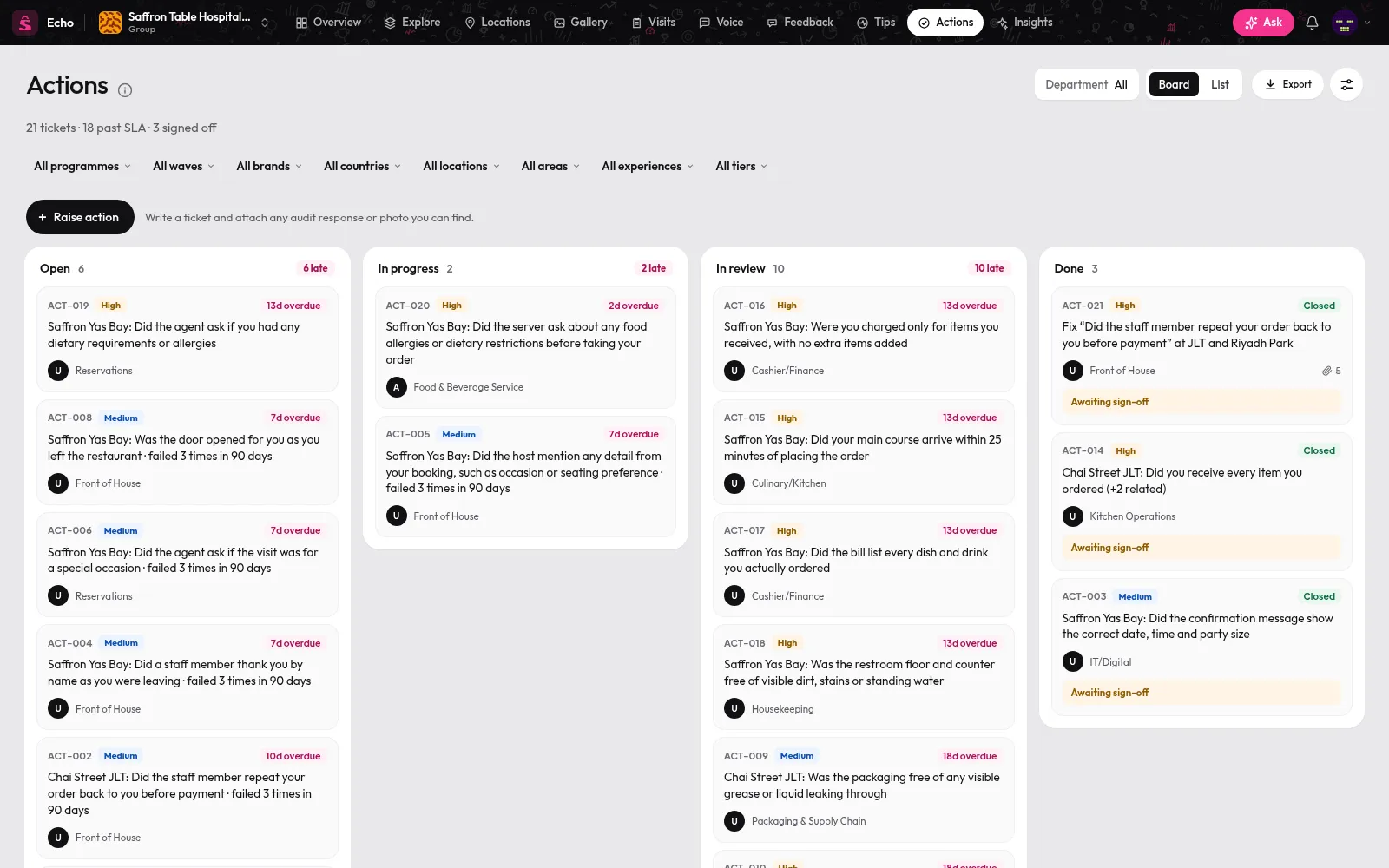
Mysterya audits every location against your standards, checks each visit for quality and turns failures into actions with owners and due dates.
- Standards audits
- Actions
- Due dates
- Every location
About
The consultancy born at the intersection of behavioral economics and human experience.
COMPANY
Services
Comprehensive CX and management consulting for enterprise brands.
CORE
Solutions
Structured solutions that turn CX ambition into measurable outcomes.
STRATEGY & GOVERNANCE
DESIGN & DELIVERY
Industries
A decade of CX transformation across the region's defining sectors.
BUILT ENVIRONMENT
FINANCE & TECH
Products
Proprietary tools, platforms, and AI that power CX transformation.
LEARNING & FRAMEWORKS
Opinion
Insights, research, and conversations at the frontier of CX.
Hub
Free tools, templates, and resources to advance your CX practice.
AI TOOLS
FREE TOOLS
Solution · CX Governance
Without clear ownership, standards, and decision rights, CX strategy stays on slides. Governance is what makes it real — consistently, across every team and touchpoint.
The platform behind this work
Mysterya audits every location against your standards, checks each visit for quality and turns failures into actions with owners and due dates.
01 — Overview
CX governance is the system of ownership, standards, decision rights, and metrics that ensures customer experience is managed deliberately and consistently across an organisation — not left to whoever cares most that week. It answers the questions every CX leader eventually faces: who decides, who is accountable, and how do we know it is working?
Most organisations invest in journey mapping, voice-of-customer programmes, and CX training — then watch the improvements erode within a quarter. The culprit is rarely strategy. It is the absence of a governance structure that sustains it. Without defined roles, cross-functional forums, and agreed standards, CX reverts to the default: siloed, reactive, and inconsistent.
Renascence designs CX governance frameworks that embed customer experience into the operating model itself — so that good decisions happen by design, not by exception. The result is a CX function that survives leadership changes, scales across business units, and produces measurable outcomes rather than periodic enthusiasm.
The cost of ungoverned CX is measurable. Here is what the evidence says about what governance actually changes.
02 —What's included
Each engagement is scoped to your maturity and context. These are the core building blocks — delivered as an integrated system, not a menu of standalone outputs.
03 —Our Approach
We assess your maturity, research the people involved and pinpoint the highest-impact opportunities.
We craft the strategy and interventions, grounded in evidence and validated with real users.
We implement alongside your teams, with quick wins and knowledge transfer along the way.
We embed governance, measurement and tools so the gains compound over time.
04 —Outcomes
05 —Proof
06 —From the Journal
Deeper dives from our consultants.
07 — Why It Matters
Most CX investments produce a wave of energy and a set of outputs — a journey map, a new survey, a refreshed service standard. What they rarely produce is a system that sustains those outputs when the project team disperses and the next priority arrives. Daniel Kahneman's peak-end rule explains part of the problem: organisations remember the peak of a CX initiative (the launch, the workshop, the executive sponsor's enthusiasm) and forget that the ending — the quiet erosion of standards six months later — is what customers actually judge them by. Governance is how you design a better ending.
Decision rights are the most underrated element. When it is unclear whether CX improvements require sign-off from Marketing, Operations, or the COO, nothing moves. Thaler and Sunstein's work on choice architecture applies internally as much as it does to customers: the default behaviour of any organisation is to do what is easiest, which is usually to defer. A governance framework changes the default — it makes acting on CX insight the path of least resistance, not the exception that requires a champion.
In the MENA region specifically, where organisations are often growing rapidly across multiple markets and business units, the absence of governance creates compounding inconsistency. A customer in Riyadh experiences a different standard from one in Dubai, not because of deliberate localisation but because no one owns the standard. CX governance is not bureaucracy — it is the infrastructure that makes intentional, consistent experience possible at scale.
Listen: The Naked Customer podcastConversations on CX, loyalty & behavior08 —FAQ
Start the conversation
Book a discovery call with a senior consultant and see what's possible.